Reason #18: Black & White

I claim no intricate knowledge regarding Dawat theology or its sophisticated legal doctrine. But I do know what I see, and I believe in what I see. And what I see is Black and White.

1.       Black is repeatedly claiming ‘maney’ (me). White is voicing ‘mamlook’.

2.       Black is repeating ‘my belief’… White is belief in Moula.

3.       Black is leaving Moula’s janaazah. White is staying by its side.

4.       Black fears. White sacrifices.

5.       Black is claiming grief. White is showing it.

6.       Black is claiming saathey rakha. White is silently saathey rhaya.

7.       Black is demanding rutba. White is serving it.

8.       Black is quoting trust numbers. White is earning trust.

9.       Black is claiming knowledge. White is applying it in Dawat’s service.

10.   Black is feigning superiority. White is humility.

11.   Black is claiming time for ziyaarat. White is ensuring that others are blessed with it.

12.   Black is copying Moula. White is serving him.

13.   Black demands his place next to Moula. White always stands behind him.

14.   Black is idle chatter. White is dignified silence.

15.   Black is inarticulateness. White is eloquence.

16.   Black is tarnishing your predecessor. White is celebrating him.

17.   Black is feigning remembrance. White never forgets.

18.   Black mentions enemies. White attracts friends.

19.   Black misuses children. White cherishes them.

20.   Black demands ta’at. White is ta’at personified.

In this case, life is indeed black and white.

Reason #17: Analysis of Syedi Aminji b Jalal Text Regarding Nass e Khafi with reference to Nabi Idris AS

Analysis of Syedi Aminji b Jalal Text Regarding Nass e Khafi with reference to Nabi Idris AS and Syedna Mohammed Burhanuddin’s Waaz Mubarak on the Subject

The FatemiDawat website’s fundamental premise lies on the alleged claim that nass occurred in private. It aims to substantiate this claim by referring to Syedi Aminji b Jalal’s QA text. This is referred to as follows:

“Nass in private from the Dai to his Mansoos without any other witnesses is valid. Syedna Taher Saifuddin RA explains in his risalat 1363H (p.144), on the authority of Syedi Ameenji b. Jalaal QA and Syedna Daud b. Qutubshah QA, the private Nass performed by the 7th Dai Syedna Ahmad bin Mubarak RA on 8th Dai Syedna Husain bin Ali RA. After Syedna Ahmad RA’s wafat, his successor the Syedna Husain RA himself declared that he had been appointed by his predecessor in private without any witnesses, for reasons pertaining to the welfare of Dawat. Syedna Husain RA also asserted that there was no one at par with him in ‘ilm and knowledge. He presented a book of haqiqat he had written (kitab al-Īdāh wa l-Bayān) and challenged anyone to produce anything similar. The excerpt relating to this account with translation is in the documentary evidence section below”

The actual text proves that there were witnesses to the nass of the 8th Dai Syedna Husain RA. A linguistic analysis of the text proves this. Actually, there is just one word which alters the meaning of the text fundamentally.  (Discussed in detail Reason #2 & #10).

“Fa ma ash’hada al shohadaa’aa zaaheran.

The sentence WITHOUT the word ‘zaaheran’ (openly, publicly) at the end would offer the meaning that Khuzaima futilely wishes it does. It would read that:

‘Syedna Ahmed RA did not engage or seek witnesses to the nass.’

However, the complete sentence is:

“Fa ma ash’hada al shohadaa’aa zaaheran.”

The word “zaaheran” adds to the sentence and changes it to read:

‘Witnesses were not engaged to testify ‘openly’.’

Their testimony was not requested or called for publicly. If there had been no witnesses, there would be no need for this additional word. Syedi Ameenji bin Jalal QA would have sufficed with just “Fa ma ash’hada al shohadaa’aa” 

****

Rather than just depending on a semantic reading of the text, there is no better rendering of the text, other than what Syedna Mohammed Burhanuddin RA said in reference to it in Ashara Mubaraka in 1426H in the first waaz:

“Syedi Amin b Jalal QA says…..the reason for writing Kitab ul Idhaah wal Bayaan, was that the Dai who wrote the kitaab, the Dai before him did not openly perform nass (te na aage na Dai guzra te nass ZAAHERAN noti keedi) the people did not know…..this Dai, Syedna Hussain RA, the author of this kitaab, he thought, ‘How do I show others that nass has been conferred upon me?’. These are wise and articulate people. So I chose the same path chosen by Idris Nabi.”

 Syedna Mohammed Burhanuddin RA clearly draws a definitive parallel between the actions of Syedna Hussain RA with that of Idris Nabi. So what exactly did Idris Nabi do? Syedna Taher Saifuddin RA refers to this in The book Agharul Majalis where he says:

“Allah Taala states in his book that Idris was truthful and was a nabi. We elevated him to a high position. It is related that the Imam who appointed him, did so discretely from the people of Dawat, [but] in the presence of his ‘noqaba’ (hudood) ‘sirran un ahle dawate hi be mah-dharin min noqabaa ehi.”

Idris Nabi AS used the ‘astrolabe’ to show to others he was Nabi, whereas Syedna Hussain RA wrote The book Idhaahe wal Bayaan to corroborate that he was the mansoos of his predecessor. The conclusion of this analysis is that Syedna Mohammed Burhanuddin RA, in highlighting the similarities between the conditions and actions of both Syedna Hussain and Idris Nabi AS, explains the parallels by which Nass was conferred on both Moulas, and how they set about proving it. Nass was conferred privately to Idris Nabi AS but several of his noqaba were witness to it. Similarly, when we analyse the precise wording of the text in the risaala and the wording of Syedna Mohammed Burhanuddin’s RA words in waaz with reference to the text in question, we can clearly understand that although the nass on Syedna Hussain RA was a discreet one, it was still conferred in the presence of a number of witnesses.

Therefore, it is NOT a ‘private nass’ in the sense in which the website claims it to be.  One should also note that the need to either use an astrolabe or write a kitaab, does not mean that nass did not happen in the presence of other individuals. Both Idris Nabi and Syedna Hussain opted, through Ilhaam and Ta’eed, to utilize the astrolabe and kitaab respectively, to establish their nass to others. This does not mean that the astrolabe or the kitaab is the reason or the cause why Idris became a Nabi or Syedna Hussain RA became a Dai. They may have chosen to call upon the testimony of the witnesses of their respective nass’, but chose this path based on what Allah Taala and Imam ul Zaman guided them to do.

Reason #16: Syedi Mukasir Saheb; An Example To Follow

Khuzaima Qutbuddin argues that the Dai, Mazoon and Mukasir are one and the same and all three can see with the Noor of Allah Taala. His website also states the following: “Syedna Qutbuddin’s supporters are with Syedna Mohammad Burhanuddin, and he is with us. We are mumineen, true followers of Syedna Mohammad Burhanuddin, and true adherents to the misaaq, fulfilling our qasam of walayat to Dai Mazoon Mukasir.” What justification can they provide for Syedi Mukasir Saheb Husain Bhai Saheb Husamuddin accepting Syedna Mufaddal Saifuddin TUS as the mansoos of Syedna Mohammed Burhauddin RA?

He writes that al Maula al Ajal Syedi Qadi Khan states that the obedience (ta’at) of the Dai, Mazoon and Mukasir are compulsory. Are Mumineen wrong in following Syedi Mukasir Saheb in accepting this Nass? (Please refer Reason #5 below, which will clarify Syedi Mukasir Sahebs acceptance of the Nass on Syedna Mufaddal TUS, and how he carried out the rusumaat (traditions) of the public Nass at Raudat Tahera, while Khuzaima was absent.)

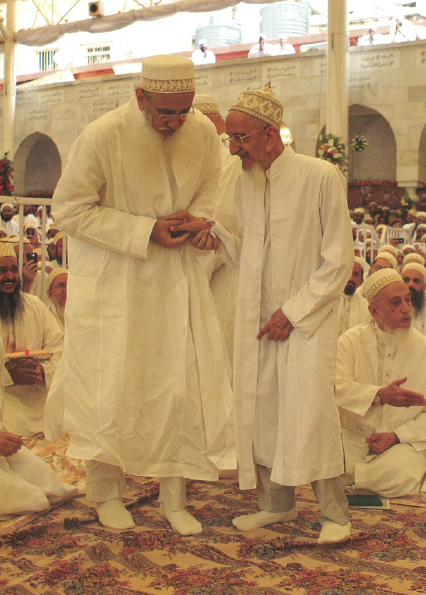
Syedni Mukasir Saheb doing talaqqi of Syedna Mufaddal Saifuddin TUS

Syedi Mukasir Saheb doing talaqqi of Syedna Mufaddal Saifuddin TUS.

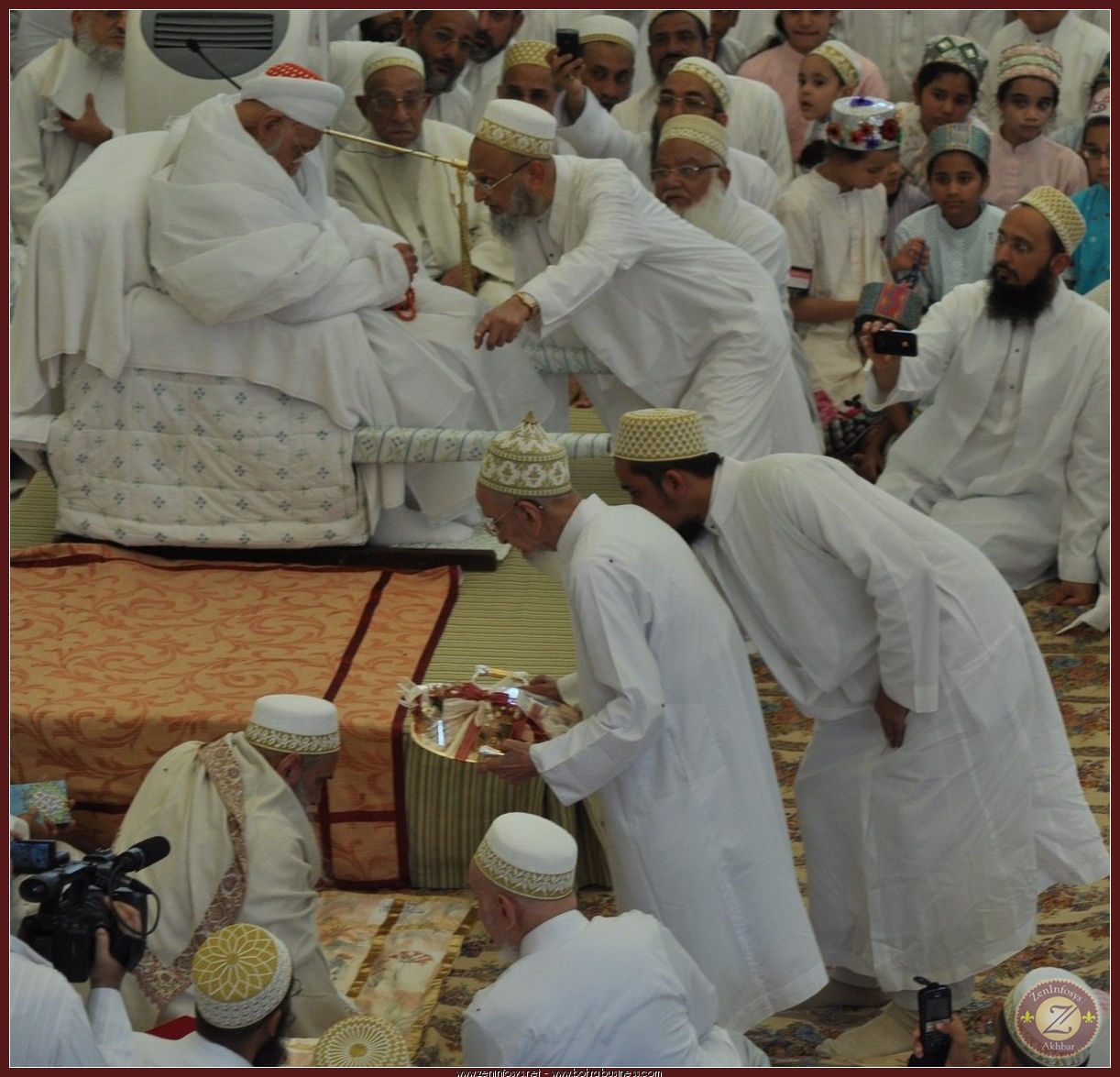
Syedni Mukasir Saheb guiding Syedna Mufaddal Saifuddin TUS to Syedna Burhanuddin RA, and Syedna Burhanuddin RA seen welcoming him

Syedi Mukasir Saheb guiding Syedna Mufaddal Saifuddin TUS to Syedna Burhanuddin RA, and Syedna Burhanuddin RA seen welcoming him.

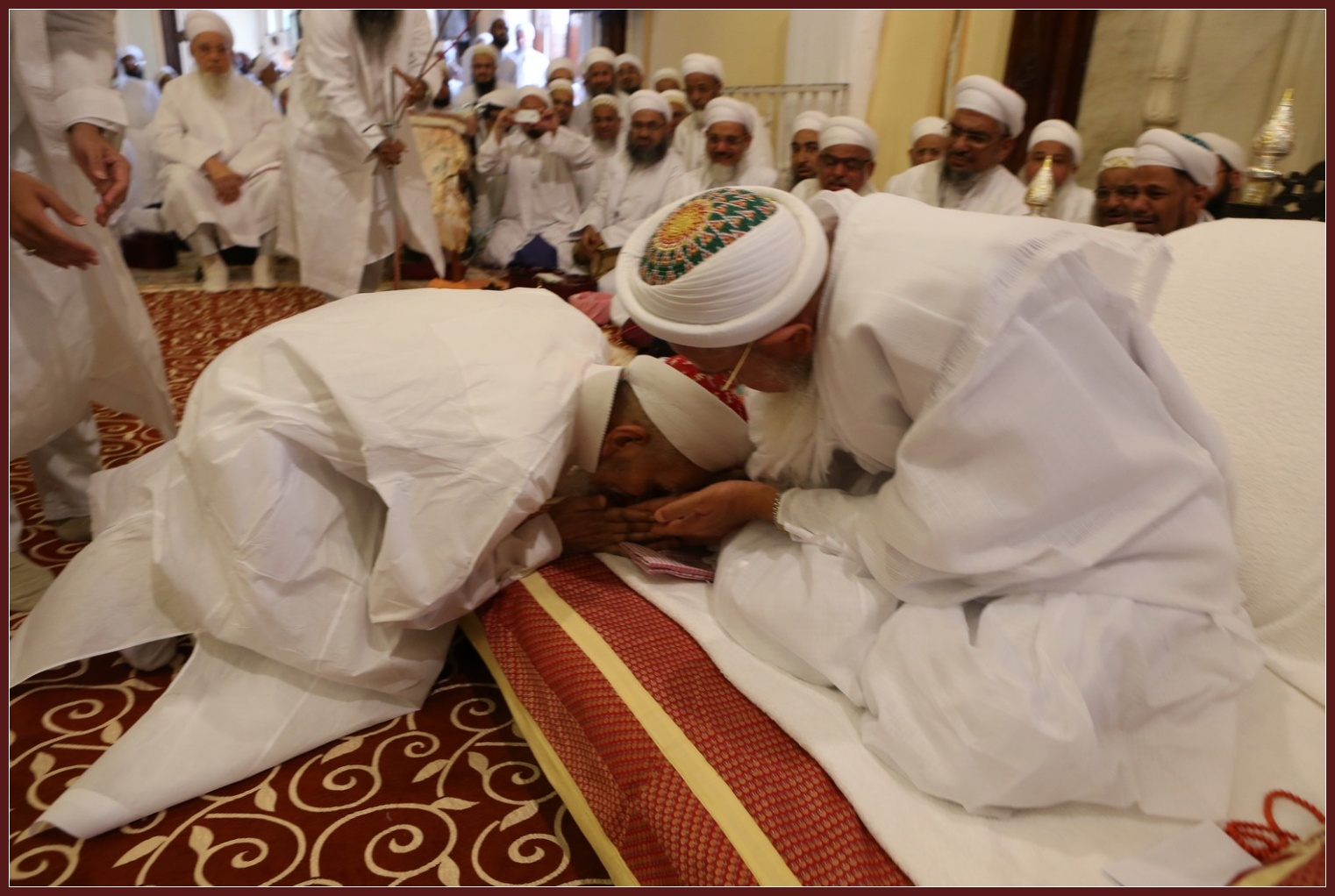
Syedna Mukasir Saheb doing wadhawa on Syedna Mufaddal TUS after Nas.

Syedi Mukasir Saheb doing wadhawa to Syedna Mufaddal TUS after Nass.

On Sunday, 25th Rabi al Awwal 1435, during the Sadaqallah Majlis of Syedna Mohammed Burhanuddin RA, Syedi Mukasir Saheb Husamuddin (despite his age and health), stood and did a bayaan in the hazrat of Syedna Mufaddal Saifuddin TUS:

  • He did shukr araz that had had the good fortune of serving 3 Dais, Syedna Taher Saifuddin RA, Syedna Mohammed Burhanuddin RA, and Syedna Mufaddal Saifuddin TUS.
  • He said the Syedna Mufaddal TUS was the mansoos of Syedna Mohammed Burhanuddin RA and the Nusoos (plural Nass) from the time of Ghadeer e Khum have reached him.
  • He then went on to say that he was Syedna Mufaddal Saifuddins TUS humble servant, and would remain in his khidmat till his last breath.
  • Syedi Mukasir Saheb then clarified the ikhlaas ni tasawwur saying “maraatib na maalik aap cho” (you are the owner of the maraatib (rutba) (of Dawat), and then recited an ayah of the Quran (Aale Imran:26) saying it is solely the Dais right to give and his to take.
  •  He ended by saying that the impostors that do inkaar  (reject) of the True Nass in reality have done inkaar  (rejected) of ALL the previous Nass, and are mustahiq (worthy) of la’nat.

Immediately after completing is bayaan, he gestured allegiance and kissed the ground before the feet of Syedna Mufaddal Saifuddin TUS and did salaam and qadambosi. At that moment, I couldn’t help but remember this quote of Imam Jafar al Sadiq AS:

When an Abd (servant – of Allah) performs Sajda, Iblees (the devil) screams, “This man obeyed, and I disobeyed, He performed the Sajda and I refused!”. (Kitab al Taharaat – Introdution).

Maybe Khuzaima should take advice and learn humility and obedience from Syedi Mukasir Saheb, he who has lived alongside Syedna Mohammed Burhanuddin RA for 99 years.

Syedni Mukasir Saheb doing bayaan on 25 Rabi Awwal 1435.

Syedi Mukasir Saheb doing bayaan on 25 Rabi Awwal 1435.

Syedni Mukasir Saheb doing salaam to Syedna Mufaddal Saifuddin on 25 Rabi Awwal 1435.

Syedi Mukasir Saheb doing salaam to Syedna Mufaddal Saifuddin on 25 Rabi Awwal 1435.


Reason #15: Nass-e-Jali 1432H, A rendering in English

On the 19th of Ramadhan al-Moazzam this event was chronicled in a mithaal shareef released by the administrative office of the Dawat – Al-Wazaratus Saifiyah – entitled‘Barakato Bayaan-e-Fadhlin Kabeer.’ In this document of some 40 pages is described the significance of nass, examples of nass conferral throughout history and some of the peerless virtues of Syedna Mufaddal Saifuddin (tus) that show him to be the rightful recipient of the nass of Syedna Mohammed Burhanuddin (tus).

Please read renditions of some of the articles of this document from these 2 links:

http://akhbar.mumineen.org/archive/deen/fatemi-dawat/nass-e-jali-1432h-a-rendering-in-english/

http://akhbar.mumineen.org/archive/fatemi-dawat/nass-e-jali-1432h-part-ii-raudat-tahera/

Reason # 14: Khuzaima as the Son of Syedna Taher Saifuddin RA

Many have pondered around the fact that Khuzaima was the son of Syedna Taher Saifuddin RA especially since he [Khuzaima] has exploited that relationship to express validity for his claims. However, the spiritual relationship between father and son far outweighs the same physical relationship. This fact is attested to by not only the Kutub of Da’wat but by the Qur’an itself. On his website, Khuzaima tries to use this relationship of spiritual father and son, both with Syedna Taher Saifuddin RA and Syedna Mohammed Burhanuddin RA, to prove that he is righteous in his claims as their successor. However, we must look at the wisdom left to us by Aqa Moula al-Hayy al-Muqaddas Syedna Mohammed Burhanuddin RA who clearly taught us the interpretation of many zikrs from the Qur’an. For instance, Aqa Moula RA often compared the era of Syedna Taher Saifuddin RA to that of Nabi Nuh SA in terms of its longevity. Among all the Mursaleen (messengers/prophets), Nuh Nabi had the longest era (dawr). Similarly, Syedna Taher Saifuddin RA’s era was fifty-three years long – the longest era on the ‘arsh of Da’wat for any previous Dai. Therefore, Moulana Mohammed Burhanuddin RA would say that –

Nuh Nabi was considered Shaykh ul Mursaleen and Syedna Taher Saifuddin RA was considered Shaykh ul Duat il Mutlaqeen

This comparison possibly further reminds us of the main zikr of Nuh Nabi’s era – that of his building of a safina (ark) of which its zikr appears in the Quran in Surat al-Hud (41-43). Khuda Taala says,

Surat al-Hud 41

Surat al-Hud 41

And [Nuh Nabi] said, “Embark in the safina; in the name of Allah is its course and its anchorage. Indeed, my Lord is Forgiving and Merciful.”

Surat al-Hud 42

Surat al-Hud 42

And it (the safina) sailed with them through waves like mountains, and Noah called to his son who had separated from them, “O my son, come aboard with us and be not with the disbelievers.

Surat al-Hud 43

Surat al-Hud 43

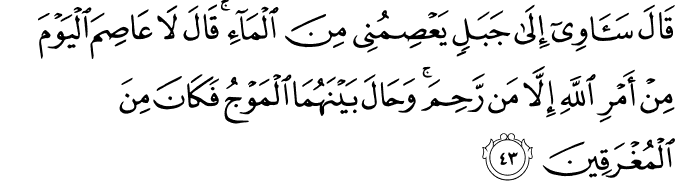
The son said, “I will take refuge on a mountain to protect me from the water.” Nuh said, “There is no protector today from the decree of Allah , except for whom He gives mercy.” And the waves came down between them, and he was among the drowned.

Surat al-Hud 44

Surat al-Hud 44

And it was said, “Oh earth, swallow your water, and oh sky, withhold [your rain].” And the water subsided, and the matter was completed, and the safina came to rest on the Mount Judee. And it was said, “may the unjust be made to go far away.”

Surat al-Hud 45

Surat al-Hud 45

And Nuh called upon his Lord and said, “My Lord, indeed my son is of my family; and indeed, Your promise is true; and You are the most just of judges!”

Surat al-Hud 46

Surat al-Hud 46

Khuda said, “Oh Nuh, indeed he is not of your family; indeed, he is one whose deeds are not righteous (‘amal ghayr salih), so do not ask me for that about which you have no knowledge. Indeed, I advise you, lest you be among the ignorant.”

What the Qur’an Majid teaches us here is that biological kinship becomes meaningless when the spiritual relationship between father and son is severed through disobedience.  Khuda Taala explicitly states in these abovementioned ayats that Nuh Nabi’s son is no longer his kin because of the deeds he has done, chiefly refusing to join Nuh in the safina and instead taking refuge on a mountain. Therefore, Khuzeima’s claims that he is the son of Moulana Taher Saifuddin RA are no longer relevant or valid according to Da’wat’s philosophy. He severed those ties many years ago as we all have come to learn. 

As for mumineen, we are greatly blessed that Taher Saifuddin RA  reminded us that he was the qaptan of Da’wat’s safina. Furthermore,  Aqa Moula Syedna Mohammed Burhanuddin RA also continuously reminded us that he was steering the safina of Da’wat and not to ever worry about the colossal waves that might try to rock it. He heeded us to rest assured because he was our qaptan and was steering us through this life. Today, the admiralship of Aqa Burhanuddin TUS’s safina is in the hands of his mansoos, Syedna Mufaddal Saifuddin TUS because Aqa Moula al-Hayy al-Muqaddas Syedna Mohammed Burhanuddin RA publicly and privately appointed him as his heir and the 53rd Dai, not once but several times. We shall all sit with a peace of mind in his safina with no worries for the present fitnat which hasn’t even rocked this vessel. We know that soon  all stormy waters will be clear. However, those who refused to climb aboard this safina, like Khuzaima, have deprived themselves of any real kinship with the qaptans and passengers of this glorious vessel. 

Reason #13: Humility Vs Self Centeredness

(Response to Khuzaimas Reference to “Firishta Karta Wadhi Gaya”)

It is appalling how Khuzaima misreads history. He uses the words which Syedna Hatim mentioned in favour of Syedna Ali b Mohammed that “arba ala l-mala’ika,” higher in station than the celestial angels.”, to underpin the status of a mazoon. However it was precisely because Syedna Ali b Mohammed, despitebeing mazoon, put forward the son of Dai al-Zaman as being more worthy of the rutba of mansoos. The reference to the zikr of firishta, (see Quran, Sura Al Baqara, Ayat 30-32) is that when Allah created Adam, they exhibited their hesitation to submit to Adam, hinting that Adam and his descendants would wreak havoc on earth and cause bloodshed and they would suffice in carrying out the ibadat of Allah, hence why was there a need to create Adam and humanity? The angels were mistaken on a number of points. They assumed that Allah did not know what Adam and his descendants would do, questioning the omniscient entity that is Allah. Secondly, by implication, they were more knowledgeable and more aware of what the future held for humanity. This was a direct contestation of Allah’s authority. Thirdly, they held a narcissistic view that somehow Allah required their ibadat and since they were fulfilling that function, there was no need to create others.

Syedna Ali b Mohammed RA held the complete opposite view. Instead of basking in self-adulation and being self-centered, he thought of himself as nothing but a humble servant of Syedna Hatim and that another individual, the son of a Dai was far more worthy of the rutba of mansoos. It was for this reason – his ability to pass over his own achievements and focus instead on the qualities of others – that Syedna Hatim RA said “firishta karta wadhi gaya”.

This individual has always been an example of hubris and vanity. In hardly any of his unintelligible discourses or in his actions, has he attributed anything to Syedna Mohammed Burhanuddin. On the other hand, Syedna Mufaddal Saifuddin has NEVER spoken about himself and instead the focus of his every thought, every sentence, every action, every bayaan, every waaz has been “Moulana Mohammed Burhanuddin”. Even now, when he is the undisputed 53rd Dai al Mutlaq, his every moment revolves round the zikr of Syedna Mohammed Burhanuddin. When Syedna Mufaddal Saifuddin recited Shahadat of Imam Hussain last Friday, it was within the context that “this is how Syedna Mohammed Burhanuddin recited the Shahadat of Imam Hussain”. The angels realised the error of their ways and repented, but here the claimant continues to be intoxicated with his own delusional claims to angelic virtue.

Reason # 12 – The Inherent Contradictions In Khuzaimas Reference to Syedna Hatim’s RA Zikr

From Khuzaima’s website:

The Mazoon in every day and age should be considered, after the Dai, the highest authority).”

“The zikar of the 3rd Dai Syedna Hatim also supports the point that nass signifies that the mansoos has attained the highest shaan. When Syedna Hatim expressed his intention to perform nass on his Mazoon (and later 5th Dai) Syedna Ali bin Mohammad, Syedna Ali bin Mohammad did araz to Syedna Hatim to appoint Syedna Ali bin Hatim, and  based on his araz Syedna Hatim decided to place Syedna Ali bin Hatim ahead. Nowhere do the bayaans say that Syedna Hatim revoked nass of Syedna Ali bin Mohammad. In fact, Syedna Hatim describes him as “arba ala l-mala’ika,” higher in station than the celestial angels.” Syedna Hatim did nass on Syedna Ali bin Mohammad to show that he had reached the high station that a saheb must have in order to be appointed Dai. Similarly, when Syedna Burhanuddin did Nass on Syedna Qutbuddin fifty years ago, it was because Syedna Qutbuddin had reached the high station that a saheb must have in order to be appointed Dai.”

The website continues to misinterpret and misrepresent the facts of history to substantiate his fallacious claims. In fact, his erroneous conclusions are evident in the garbled line of argument he presents. What he presents is self contradictory. On the one hand he says that “The Mazoon in every day and age should be considered, after the Dai, the highest authority”. On the other hand, he refers to the zikr of the 5th Dai Syedna Ali b Mohammed b Walid, where he submitted that Syedna Hatim’s son was more worthy of becoming mansoos than he was. Syedna Hatim did appoint his son, Syedna Ali b Hatim as his mansoos and by definition, by the very institution which is that of Mansoos, Syedna Ali’s position took precedence over that of the mazoon of the time. Therefore Khuzaima’s claim that the mazoon in every day and age should be considered, after the Dai, the highest authority, is undermined by the very point he’s presented to support it.

His claim is further subverted by this particular incident. He claims that “nowhere do the bayaans say that Syedna Hatim revoked nass of Syedna Ali bin Mohammed”. That maybe true, but nowhere is there any mention that Syedna Hatim mentioned that Syedna Ali b Mohammed is Dai after Syedna Ali b Hatim either. This is unlike the case of the 25th Dai, Syedna Jalal who conferred nass on both the 26th Dai Syedna Dawood b Ajab and the 27th Dai Syedna Dawood b Qutub. Syedna Jalal clearly indicated to the former that “I have saved you the trouble of appointing your mansoos, for I have already prepared him – he is Dawood b Qutub.” (Muntaza ul Akhbar, Vol 2, pg 119)

The repetitive use of the word ‘revoked’ is used to mislead. It doesn’t matter whether it was ‘revoked’ or ‘retracted’ or any other word he may care to use. The fact remains that the instant when Syedna Hatim conferred nass on Syedna Ali b Hatim, Syedna Ali b Hatim became mansoos and after Syedna Hatim, became Dai. There is not an inch of doubt that he was.  It was Syedna Ali b Hatim’s prerogative that he appoints his Mansoos and that’s exactly what he did.

This is mirrored in the actions of Syedna Ibrahim Wajihuddin. The 38th Dai, Syedna Ismail Badruddin documented the conferring of Nass on his son, Syedi Al-Shaikh Adam in an official letter addressed to the 39th Dai Syedna Ibrahim Wajihuddin which was prepared on 16th Zilqada in the year 1149H. Syedna Taher Saifuddin has referred to it in his risaala sharifa, Ashe’at-ul-Faiz-il-Azali, 1376H (page 326). The text reads as follows:

“I am notifying you, my brother, that I have entrusted the responsibility of your Dawat after your passing, to my son Shaikh Adam bin Syedna Nuruddin.”

Syedna Ibrahim Wajihuddin did not appoint Syedi Al-Shaikh Adam his mansoos as per the wasiyat of his predecessor, but rather appointed Syedna Hebatullah. This again highlights how each Dai has the sole responsibility and sole authority to appoint his mansoos. Whether or not he implements the wishes of his predecessor, is subject to the Ilhaam and Ta’eed which the present Dai receives from Imam ul-Zaman.

In addition, he claims that Syedna Hatim conferred nass on Syedna Ali b Hatim “based on his araz”. Again, this is a distortion. Is he claiming that Syedna Hatim did not act out of his own volition which is guided by none other than the Ilhaam of Imam ul Zaman? Syedna Hatim is al-Dal al-Mutlaq whose actions and thoughts are independent of the influence of any other individual. To believe in anything other than that, would be tantamount to blasphemy.

This is evident in what Syedna Taher Saifuddin says in relation to this zikr (Risala Sharifa, Balaag ul Duat al Fatemiyeen 1375H, pg205) He quotes Syedna Hatim, saying:

“This Dai Ali b Mohammed indicated to me that I should put forward my son who is his student by way of Nass on him and the assigning of Dawat to him.”

Immediately Syedna Taher Saifuddin clearly states the following:

Syedna Hatim always remained the recipient of Ilham from Allah in all that he saw and observed. In fact, all his actions were founded on what Allah had pronounced and according to what he had destined”

Syedna Ali b Mohammed may have indicated to Syedna Hatim, but it was Syedna Hatim who made the decision based on Ilham. The decision was his as Dai, and the decision of Imam ul Zaman and Allah Taala.

The araz of Syedna Ali b Mohammed is a testimony to his humility and sincerity of khidmat to the Dai of his age. The website has repeatedly, through its own references, plainly revealed its complete and utter disregard of the shaan and maqaam of the Al Dai Al Mutlaq. How can anyone who has such blatant disregard for the Dai, ever contemplate to hold that exalted office, let alone make claim to it?

The events of history should be read as facts and not as a fictitious retelling of reality.

Reason # 11: “Jamea maari zaat che”

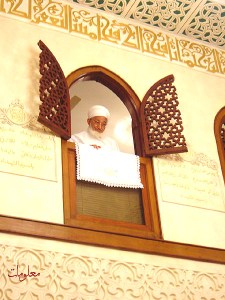
Overlooking from the Ghurfah Mubarakah (Jamea Saifiyah, Surat).

Syedna al Muqaddas RA overlooking from the Ghurfah Mubarakah (Jamea Saifiyah, Surat).

Khuzaima Qutbuddin harbored a deep animosity for al Jamea tus Saifiyah and everything it stood for. If you look back at the last fifty years of his life, you will see there is little to no connection to Jamea whatsoever. In his bayaan uploaded to Youtube (given while Moula Burhanuddin’s RA jism mubarak still lay in Saifee Mahal) he lists his supposed ‘shaanaat’, one of which was that his mithaaq took place in the Iwaan of Aljamea-tus-Saifiyah. He insists it was taken in a similar manner as Syedna Mohammed Burhanuddin’s was in Jamea’s Iwaan. Here, Khuzaima acknowledges the importance of Jamea. He recognizes that the fact that Syedna Mohammed Burhanuddin’s RA mithaaq took place in Jamea is important and by drawing paralells with his own mithaaq and wishes to gain the same legitimacy from Jamea. Generations of Talib e Ilm (students) bear witness that Khuzaima never attended the Imtehan with Syedna Mohammed Burhanuddin RAMany testify that he would attend some Zikra waaz in Surat and then leave before the  Imtehan. Further, on his website www.tahiyaat.com, along with parading his children’s worldly qualifications, he attempted to give credibility and legitimacy to them by stating that they had all received the ‘barakat of Jamea’. How many of his children attended Jamea? How often do they speak of it; contribute to it? The truth is, he and his family wanted nothing to do with Jamea. 

There will be those who argue that Jamea has nothing to do with the physical institute that resides in Surat, Karachi, Nairobi and Mumbai; it is an intangible notion that is beyond space and time which Khuzema and his children are active participants of. Yet the history of the Doat Mutlaqeen RA will stand to negate this argument and demonstrate that with the intangible, the tangible is just as important. Jamea is both spirit and form. In the period of Syedna Abdulhusain Husamuddin RA, there was a group of scholars known as the Uloma al-Sou’, ‘The Scholars of Evil’ who thought it beneath themselves to come to Dars e Saifee (later al Jamea tus Saifiyah) and teach there.  Their arrogance and conceit led them to believe that they in themselves were Jamea: a veritable institution of knowledge. They understood themselves to be disseminators of wisdom and those who sought enlightenment should seek them. Syedna Husamuddin RA responded by saying that if you will not abandon your homes and come to Jamea and teach in its halls, I will personally do so. And he did. Not only have the Doat taught in the institution of Jamea, they have been prepared there as well. Syedna Mohammed Ezzuddin RA and Syedna Tayyib Zainuddin RA were both students of Jamea, prepared in its sacred confines at the hands of the Doat of their time.

Syedna Mohammed Burhanuddin RA has repeatedly stated that Jamea maari zaat che. That Jamea and him are one in the same. Moulana Mohammed Burhanuddin RA demonstrated this Truth not only with his words but his deeds. Every year he visited Surat for Jamea imtehaan (annual exam) and personally conducted and oversaw its administration. Hours upon hours, he would sit and listen to Abna al-Jamea shafahi imtehaanaat and respond and remark. Each imtehaan would begin with the Zikra Khutba which was an unparalleled example of discourse on Fatemi philosophy and history.

Jamea was always on Syedna Mohammed Burhanuddin’s RA khiyaal mubarak. References to Jamea were made on a regular basis in his discourses, qasa’id and munaajaat. He was personally involved in even the most minute details of the academic and financial administration of the campus. His benevolence span every aspect of Jamea life. He treated the children of Jamea as his own children. On the Urs Mubarak of Syedna Ismail Badruddin, he would send special flour which he had personally blessed with his own hands for the maleeda. When he visited, he would enquire into and appreciate even the most youngest students academic endeavours and efforts. Even on secular holidays and occasions, Moula RA would think of Jamea and its students. For Utraan, the Gujarati public holiday, Moulana RA would grant a sum of money to purchase kites and string for students to participate. For Diwaali he would send fireworks. Moulana Burhanuddin RA was always concerned for the well-being of Jamea, its students and khidmatguzar. In fact, one of his biggest tashaareef on his 100th birthday was the announcement regarding the new campus of Jamea in Nairobi.

Today, Syedna Mufaddal Saifuddin TUS embodies Jamea. His every action, his every statement, his every motion, his every movement, his every maatam, his every tear, his every bayaan mubarak, his every harakat and sakanat is Jamea. Even before his nass was made apparent, Syedna Mufaddal Saifuddin TUS was intimately involved in the affairs that concerned Jamea and its students. Syedna Mufaddal Saifuddin TUS graced both the young and the old of the institution: the newly admitted, the aged and experienced. Syedna Mufaddal Saifuddin TUS is to Jamea what Syedna Mohammed Burhanuddin RA was.

How does Khuzaima reflect any single aspect of Syedna Mohammed Burhanuddin’s RA and Syedna Mufaddal Saifuddin’s TUS care, concern and dedication to Jamea? A Jamea khidmatguzar has testified that in his 40 years of service to Jamea, not once has Khuzaima sent instructions for a student to be admitted to Jamea. In fact, a couple from California has recounted an instance where Khuzaima discouraged them from admitting their child into Jamea saying that ‘his/her beliefs would be compromised’. I personally am witness to Syedna Mohammed Burhanuddin RA encouraging, in fact, instructing Mumineen to send their children to Jamea during the wada majlis in Fremont masjid in 2007 during his stay in California. How can an alleged mansoos state that the institution of his Naas (appointer: Syedna Mohammed Burhanuddin RA) has administered and nurtured for fifty years compromises beliefs? Further, Khuzema has been heard stating that Jamea does not do anything but prepare ghundao (thugs) whereas his father Syedna Taher Saifuddin RA has said:

“Behold this Jamea Saifiyah, it has become so prosperous… May Allah Ta’ala give strength to all Talabat al-Ilm (students of Jamea) in their pursuit of knowledge, may He bless them with prosperity in both worlds. They are khidmatguzars. There are those who treat Aamils and khidmatguzar with disdain. DO NOT DISRESPECT THEM. They are my limbs (assistants), they work for me. (Asharah Mubarak, 1379H)”

Although Khuzaima seeks much of his legitimacy from claims associated to Syedna Taher Saifuddin RA, he obviously did not heed his fathers’ words. Khuzaima’s most atrocious act towards Jamea is his sympathy towards the manaahis: the four individuals who Syedna Mohammed Burhanuddin RA removed from Jamea’s pious saahat. What more is there to say about his disregard for Jamea and Burhanuddin Moula RA?

Today it is clear why Khuzaima stayed away from Jamea: He hated the tangible Jamea (al Jamea tus Saifiyah) because he despised the intangible Jamea (Syedna Mohammed Burhanuddin RA).

Of course, like everything else, Khuzaima will claim that he was kept away from Jamea, just like everything else in Dawat. The way he claims he was kept away from his own Moula’s janazah mubarakah. He will claim that there was even an attempt on his life in Jamea; a blatant lie. These are fabrications and delusions of a man who has lost all sense of reality; enough so that he has claimed the mantle of Dawat from its true maalik. If he was the true mansoos of Syedna Mohammed Burhanuddin RA, there would be a love of Jamea in him so strong, so passionate, that nothing could keep him from it. This is what Jamea means to Moulana Burhanuddin RA and his mansoos Syedna Mufaddal Saifuddin TUS and this is the love they have instilled into the hearts of every student who ever benefited from this institution: the very being of the Dai.

Reason # 10 : Lack of Comprehension of Dawat Books & Discrediting others

(Also see refutation #2 below)

This is in reply to today’s addition of point No. 6 (Is a khaangi/private nass valid?) from the FatemiDawat website:

Parents often warn their children about the dangers and consequences of lying. One of them is that, inevitably, lies breed more lies. Under scrutiny, a lie told once usually has to be supported by further lying. Not stellar upbringing from the self- proclaimed “mother of Mumineen”.

This is once again deliberate twisting of the facts and selective reading by Khuzaimas to suite their own agenda.

On page 144 Syedna Taher Saifuddin addresses the mumineen saying: “you are well aware of certain Nass that have been made public and mash’hoor  (clear/well known to all). And it is also possible that some Nass are not made public, rather, they are done in private. You are all aware of many mash’hoor Nass that have taken place during the era of the Imams. We will now talk about the makhfi & mastoor nass.”

The Nass of Ghadeer e Khum  amongst 70,000 people would be considered a mash’hoor Nass. A Makhfi Nass, although private, according to Dawat doctrine (Daim ul Islam), must have witnesses. Syedna is simply clarifying that along with witnesses, both private and public Nass  are possible.

Syedna Taher Saifuddin RA goes on to say what Syedi Ameenjee bil Jalal relates. (See refutation #2 below).

Khuzaima’s sole justification for his alleged nass rests on his selective interpretation of a Risaalah text which he alleges allows nass to be conferred without witnesses.  This claim is wrong for the following reasons:

Reason #1

There were witnesses to the nass of the 8th Dai Syedna Husain RA. A linguistic analysis of the text proves this. In actuality, one word within the following sentence is enough evidence.

“Fa ma ash’hada al shohadaa’aa zaaheran.

The sentence WITHOUT the word ‘zaaheran’ (openly, publicly) at the end would offer the meaning that Khuzaima futilely wishes it does. It would read that:

‘Syedna Ahmed RA did not engage or seek witnesses to the nass.’

However, the complete sentence is:

“Fa ma ash’hada al shohadaa’aa zaaheran.”

The word “zaaheran” adds to the sentence and changes it to read:

‘Witnesses were not engaged to testify ‘openly’.’

Their testimony was not requested or called for publicly. If there had been no witnesses, there would be no need for this additional word. Syedi Ameenji bin Jalal QR would have sufficed with simple “Fa ma ash’hada al shohadaa’aa”.

Reason #2

Many books of Dawat (Daim ul Islam amongst them) make it clear that nass cannot take place without attestation and designation. Witnesses, whether they be overt or covert, are mandatory.

Reason #3

The greatest truth is that Kitaab Muntaza al-Akhbar openly states that the seventh Dai, Syedna Ahmed RA conferred nass on Syedna Husain RA in the presence of witnesses who were trusted dignitaries of Dawat.

***

Now, this where noses start to lengthen. The FatemiDawat site recently updated the following:

Until Syedna Taher Saifuddin wrote about it openly in his Risalat, Syedna Ahmed’s private nass on Syedna Husain was not revealed in zahir history kitaabs. This explains the difference in the version of the zahir history Kitab Muntazaul Akhbar of Shaikh Qutubbhai Burhanpuri, which says Syedna Ahmed performed nass on Syedna Husain in the presence of hudood mukhliseen and mumineen muqineen (i.e. a standard, public nass in front of hudood and mumineen).

How can Khuzaima deny this authentic historical account from a Dawat Kitaab, and make his whole argument invalid? How can he reject a bayaan from a kitaab placed in the course of Al Jamea-tus-Saifiyah by his own father Syedna Taher Saifuddin RA. In not one of his more devious ruses, he simply claims that the information in Muntaza is either incorrect or fabricated!

There can be only two conclusions drawn.

1. Either the history provided in the book is not reliable because the nass in question was not witnessed.

2. Or the author knowingly chose to fabricate.

Khuzaima’s scorn for this azeem kitaab and its revered author could not be more apparent. Classifying it just as a zaahir kitab, he makes it seem as its content is less than pristine, doubtful and of subordinate value. The disdain that he shows for its author is obvious in the way he states his name: “Shaikh Qutub bhai Burhanpuri”, as if his standing is one that could be overlooked. On the other hand this Syedna Taher Saifuddin’s RA risaalah shareefah refers to him as al-Hadd al-Aalim al-Misqaa’ al-Faadil al-Radi (A dignitary of Dawat who is learned, knowledgeable, superior and acclaimed). Khuzaima’s discreditation and disdain is proven incorrect in light of Syedna Mohammed Burhanuddin’s RA attestation to the book’s reverence and its author’s standing by referring to the author as “Syedi al Shaikh Qutub Bhai” (6th Moharram 1426).

This book has been authored, disseminated and taught with the permission of Syedna Abdeali Saifuddin RA. Subsequent Doat Mutlaqeen RA have not only made use of it but have ensured that it be taught to generations of students. Doat Mutlaqeen RA were privy to Syedi Aminjee’s QR bayan. It would not have been so difficult to modify the text of the book so that it would correct this alleged irregularity, had it been as claimed. Furthermore, Syedi al Shaikh Qutub bhai QR compiled this work nearly 200 years after Syedi Aminjee bin Jalal QR, and had attained a very high rutba in ilm. It is very likely that he would have come across the works of Syedi Aminjee bin Jalal QR including the subject caption, thus documenting the history of the 7th Dai accordingly.

This is the trouble with lies. It sucks you in deeper than you had originally wished to go. Today, Dawat books are being discredited. For Khuzaima Qutbuddin, maybe its better if tomorrow never comes.

Conclusion:

Daim ul Islam states that along with Nass, there must be Tawqeef (to inform others). Privately or publicy.

The text of Risalah of Syedna Taher Saifuddin RA and Kitab Muntaza al Akhbar go hand in hand, rather they support each other.

The 7th Dai did Nass on the 8th Dai amoungst witnesses (Kitab Muntaza al Akhbar). These witnesses were not made public (Risalah of Syedna Taher Saifuddin RA).

Khuzaima’s claim of Syedna Mohammed Burhanuddin TUS doing nass on him without any witnesses is totally false.

On the other hand, Syedna Mohammed Burhanuddin RA has done nass on Syedna Mufaddal Saifuddin TUS privately and publicly, according to Dawat doctrines, on:

  • 11 Zil Q 1388 Hijri – 3 Witnesses (Privately)
  • 12 Jam Ula 1415 Hijri – 1 Witness (Privately)
  • 1426 Hijri – 2 Witnes (Privately)
  • 3 Rajab 1432 – 6 Witness (Privately)
  • 19 Rajab 1432 – (Publicly)

Reason # 9 – Al-Jami‘ Al-Anwar

Al-Jami‘ Al-Anwar

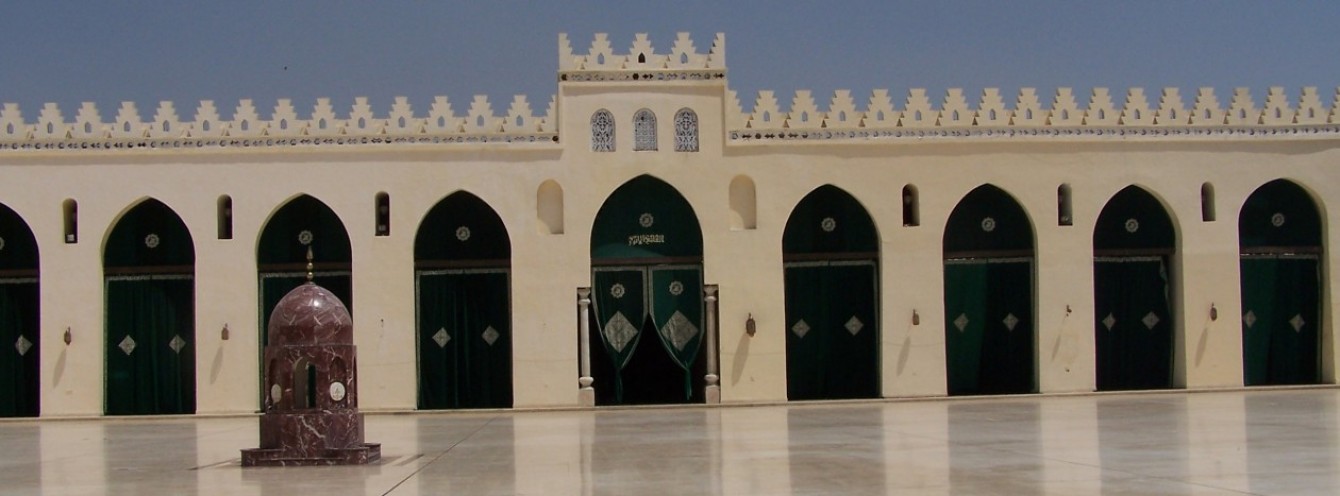
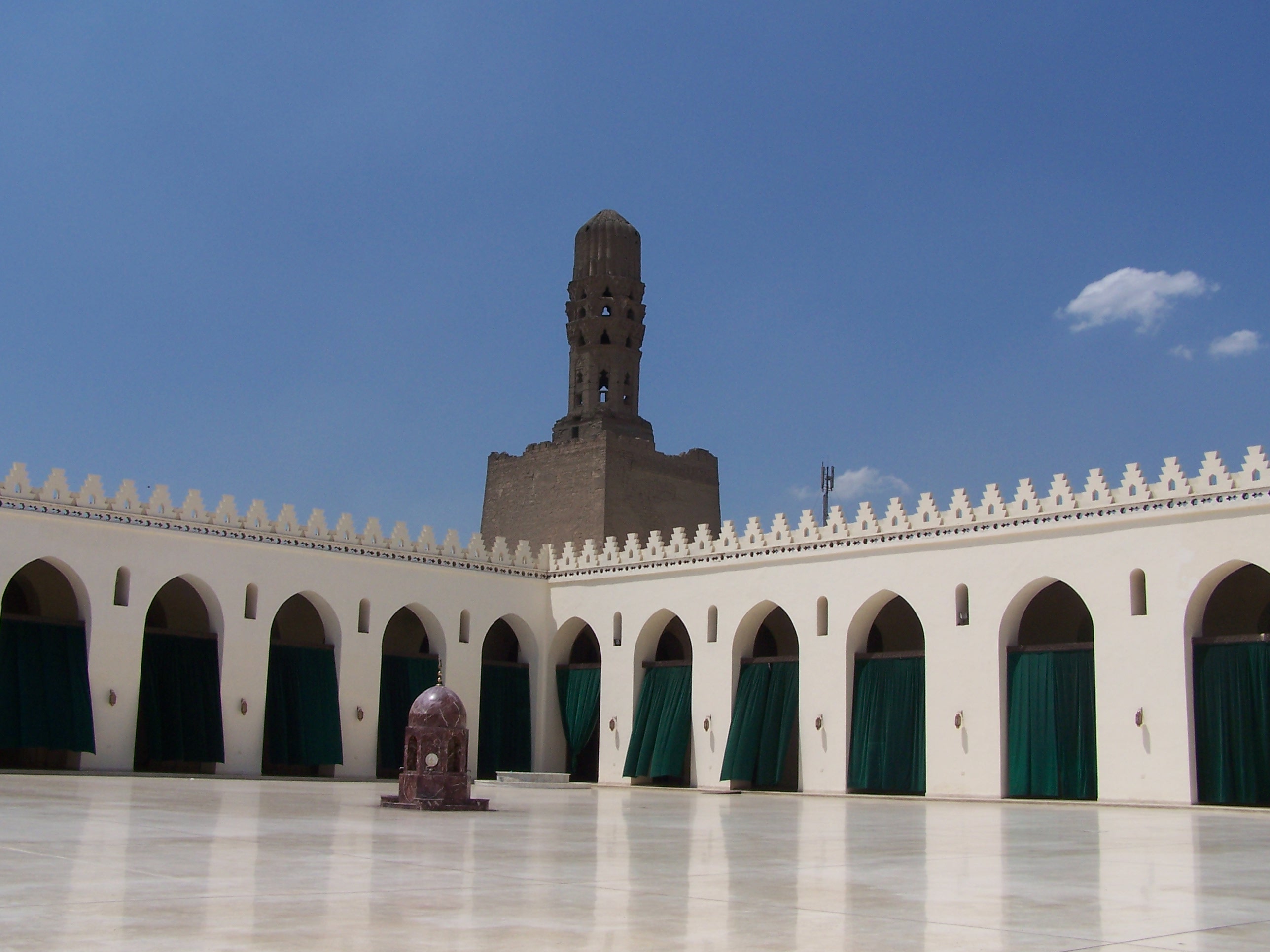
Perhaps one of the most momentous milestones in the history of the zaman of Syedna Mohammed Burhanuddin Aqa al-Hayy al-Muqaddas is the renovation of al-Jami‘ al-Anwar in Cairo. Not just once, but over a large period from his magnificent era, Moula al-Hayy al-Muqaddas repeatedly referred to this event and said, “From the day al-Jami’ al-Anwar was built barakaat has flourished in Da’wat.

جه دن سي آ جامع الانور بني چهے ته دن سي دعوة ما بركات عام تهئي چهے. 

Aqa Moula al-Hayy al-Muqaddas RA mentioned these words every time he inaugurated a masjid. In fact, during the iftitah of London’s Huseini Masjid he said, “Because of the inauguration of al-Jami‘ al-Anwar our masjids have flourished, our houses have flourished, our souls (نفوس) have flourished. There is no need for an argument here – just the translation of Aqa Moula al-Hayy al-Muqaddas’s RA bayan which he delivered on the eve of the ifititah of Masjid al-Juyushi in Cairo on the night of Imamuz Zaman’s Salgirah in 1416 H. (1995).

Aqa Moula RA read a zikr from Kitab al-Taharat about a man from the Ansar of Medina who sullied the qibla of Rasullullah’s masjid with his phlegm thus receiving Rasullullah’s SAW laanat. He compared this historical occurence to the restoration of al-Jami’ al-Anwar. The riwayat ends with the actions of the Ansari man’s wife who cleaned the area and applied saffron to it. Rasullullah did dua for this woman and said بارك الله فيها! – May Allah bring barakat towards her! Aqa Moula RA then said,

“Likewise, al-Jami‘ al-Anwar’s qibla had such an amount of stench coming from it due to the excessive amount of trash surrounding it. The door of the Jami‘ had been made into a dumping ground. Every type of garbage was placed there. Then the iftitah of Moulatena Zainab’s Zareeh took place. After that, Mamluk Aale Mohammed went to Kuwait from Misr. At that moment, I told my son, the consolation of my eyes, Mufaddal Saifuddin TUS to stay in Misr. I said, “Stay here and start the cleansing effort of al-Jami‘ al-Anwar.” He himself, started to clean the trash in attempt to find the source for where the stench was coming from around the mihrab. Finally, one person said, ‘come with me, I will show you where the stench is coming from.’ He took them behind the qibla and mihrab to a wakalat where people had taken up residence. They stayed there, placed their trash there, and even defecated there. Forty families lived there and all these things would collect there.

They had dug a hole behind the qibla of al-Jami‘ al-Anwar where all these unsanitary wastes and trash would collect. When they went to take a look at it, it was so horrible that it was almost impossible to stand there because of the immense stench. An effort was made the entire day to find some workers who would clean the area, however, after seeing the state of the place even they were not ready to do anything. Then, in front of the khidmat guzaaro present at the time, my son Mufaddal said, “I will go down and clean this. The mihrab is in such a state! We were unmindful for so long. It is a grave error on our part.” So when he intended to do this, in that moment other workers also came and began to clean. The hole was between two to three meters deep. They cleaned it and fragranced it with bukhur.

 From that day onwards the impact of the injustices upon this Jami‘ Anwar began to fade. Now look Mumineen! How fragrant is the mihrab of Jami‘ Anwar!

 This Husain al-Hakim is honoring his Da’i with the saffron of barakaat and the sa‘aadat of misk. Today, I, Mamluk Aale Mohammed, am doing dua for the khidmat guzaaro. I am also doing dua for my son Mufaddal. As Rasullullah SAW did dua for that woman (the Ansari’s wife) and said the luminous words of “barakallaho fiha” – I, Mamluk aale Mohammed am saying that – he (Syedna Mufaddal Saifuddin TUS) did the khidmat of these Jawami‘, may Allah make his effort appreciated!” (Lailat Milad Imam iz Zaman SA – Jami‘ Juyushi – Cairo 1416 H./ August 1995)

There is no need for a comparison here and it is not right on our part to compare the zaat mubaraka of Dai Zaman Syedna Mufaddal Saifuddin TUS with anyone else. However, one brief question does arise in context of  Khuzaima claiming rights to the name Fatimi Dawat. What role did Khuzaima have in the construction efforts of al-Jami’ al-Anwar – a glorious event which brought about a revolution of Fatimi inspired architecture all around Bilad-i Iman and the world? By what right does he claim to be the head of the Fatimi Da’wat when Moula Burhanuddin RA never attested to any effort on his part to increase the glory of A’emat Fatimiyyeen. These recent events which have taken place are another attempt to tarnish and sully the glory of Da’wat with the trash and rubbish of ignorance and unmindfulness – very representative to the injustices done upon Jami’ al-Anwar. However, rest assured – this too will surpass and be cleaned. The fragrance of the misk and zaafran of the zamans of Aqa Moula al-Hayy al-Muqaddas RA of Syedna Mufaddal Saifuddin TUS are experienced every day by us. Do not let this lurking stench sully their zikr and memory in any way.

« Older Entries Recent Entries »