Monthly Archives: March 2014

The Janazah Mubarak of Syedna Mohammed Burhanuddin RA (INDEX)

Khuzaima Qutbuddin and his son, Husain Qutbuddin claim that behurmati was done to Janazah Mubarakah of Syedna Mohammed Burhanuddin RA, and his absence during the Janazah namaaz and dafan was justified.

I have discussed and refuted each of these points in multiple posts. Please view them from the following links.

Reason #66: (Janazah-Post 1) – Nass is all that matters

Reason #67: (Janazah-Post 2) – Sharia’at and the maqaam and authority of the Dai

Reason #68: (Janazah-Post 3) – The Carrying of the Janazah

Reason #69: (Janazah-Post 4) – Following the Janazah

Reason #70: (Janazah-Post 5) – Lack of tawfeeq

Reason #71: (Janazah-Post 6) – Syedna Burhanuddin RA is Syedna Saifuddin TUS

Reason #72: (Janazah-Post 7) – Please Excuse Me!

Reason #73: (Janazah-Post 8) – Imam Husain SA and the janazah mubarakah of Imam Hasan SA

Reason #74: (Janazah-Post 9) – The janazah mubarakah reached Saifee Masjid.

Reason #74: (Janazah-Post 9) – The janazah mubarakah reached Saifee Masjid.

The Janazah Mubarak of Syedna Mohammed Burhanuddin RA

Post 9 – The janazah mubarakah reached Saifee Masjid.

KQ claims that he could not have attended the janazah mubarakah namaz because it was his right to lead namaaz. If he wanted he could have even managed to do that.

  • Would a hungama have occurred if he had stood in the first saff in Saifee Masjid, amongst Shahzada sahebo and prayed his own namaz? Who would have known? At least, an important sunnat would have been upheld? The wajib would have been honoured, albeit in imperfect circumstances. In hindsight, this would have been the ideal excuse to delay his claim.
  • Would a hungama have occurred if he and/or a few of his supporters had prayed on the street? There were thousands gathered in the lanes of Bhindi Bazar. People were praying as far as the main road.
  • Would a hungama have occurred, if in case the above was not possible, if he had offered janazah namaz on his own in the vicinity? He could have shown the great love he allegedly has for Moula by doing away with all decorum and praying on some street corner to uphold this sunnat (refer to reason 6)? After all, his son has incorrectly claimed that a sunnat cannot be left for safety reasons, come what may.
  • Would a hungama have occurred if he had conveniently arrived late at the masjid, only to make it to the dafan (burial)? He could have been blessed with ziyaarat of his beloved Moula’a qabr mubarak, instead of attempting ziyaarat from a vantage point far away?

All this could have been achieved without harming his claim in the least. In retrospect being part of the janazah mubarakah procession would have appeared to have strengthened it. If a Mumin can think of this, how could he, with his divine insight, claim otherwise? Not even one of his learned sons thought of seeing to one of these provisions.

Love finds a way to achieve the impossible. All of the above provisions, at the very least, one of them was achievable. When Mumineen in Mumbai were displaying their love, what did Khuzaima display? Love conquers fear, and Khuzaima was fearful; fearful that his enmity, disdain and disregard for Syedna Mohammed Burhanuddin RA should not be known. But what is in our hearts is displayed in our actions. When mohabbat and tawfeeq are absent, even the achievable eludes our grasp. No one who loved Syedna Mohammed Burhanuddin RA, and was in Mumbai at the time, missed the events listed above (apart from those who were with Khuzaima at the time, and subsequently realised their error). Even those who did not follow Moula’s directives were pulled towards their Moula seeking his forgiveness for their disobedience, because though disobedient, their mohabbat was pure which ensured their share of tawfeeq. How can a person denied such basic tawfeeq claim to be a recipient of taa’eed?

Mumineen taking barakat from the janazah mubarakah of their beloved, departed Moula RA.

Mumineen taking barakat from the janazah mubarakah of their beloved, departed Moula RA.

Reason #73: (Janazah-Post 8) – Imam Husain SA and the janazah mubarakah of Imam Hasan SA

The Janazah Mubarak of Syedna Mohammed Burhanuddin RA

Post 8 – Imam Husain SA and the janazah mubarakah of Imam Hasan SA

Imam Hasan SA had instructed his brother Imam Husain SA to bury him next to his revered grandfather Rasulullah SA. He had also said, that if there was resistance or if this were to bring about an ill or unfavourable situation, he should bury him besides his mother, Moulatona Fatemah SA. When Imam Hasan SA passed away, Aishah and Banu Umayyah came to know about Hasan Imam’s SA instructions and they took up arms and set out to deny Hasan Imam SA burial at Rasulullah’s SA side. When Husain Imam SA learnt of their intentions to deny him, he gathered his companions and they, too, took up their weapons and set out with the janazah mubarakah. When they met for janazah namaz, Husain Imam SA shoved Sa’eed b. ‘Aas, the Umayyad governor of Madinah, towards the front and said, “If it were not for the Sunnat, I would not have asked you to lead [namaz]”. Shari’at has mandated that if the ruler of the physical kingdom is present, or someone appointed by him, then he has the right over the janazah namaz. After namaz, Banu Umayyah came forward, their weapons at their sides. At this point, Abdullah b. Ja’far took hold of the janazah mubarakah and began moving it towards Baqi, towards Moulatona Fatemah SA. Imam Husain SA asked him where he was going. Abdullah b. Ja’far reminded Imam Husain SA of the instructions given by Imam Hasan SA that no ill should come about and requested him to give raza so that the janazah mubarakah could be taken to Baqee. Imam Husain SA then agreed, and Imam Hasan SA was buried next to his mother (Kitab al-Manaqib wal-Mathaalib).

This riwayat is important because it gives us a critical understanding of the role of the Imam and/or Dai in upholding the wishes of his predecessor and fulfilling his obligations towards his final rites. Let us consider the following:

  • Leading janazah namaz. This riwaayat, and other Dawat texts (Da’aim al-Islam, Mukhtasar, etc.) clearly indicate that despite the presence of haqq na saheb and zamaan na imam, the one who rules and his sovereignty has haqq or right over leading the janazah namaz of the previous zamaan na saheb. Since KQ and HQ claim that the janazah mubarakah was seized and surrounded by those who had taken control over the ‘physical’ Dawat, this rule could have applied to them. If they had actually wanted to, they could have come and prayed namaz behind someone else without it impeding their claim. Wasn’t KQ present for Shz Hatim Bhaisaheb’s janazah namaz? Did he not pray behind then? According to him Dawat had been hijacked so the namaz was not led with Syedna Burhanuddin’s RA raza mubarak, and being the alleged true mansoos, he could not pray behind anyone, so why did he? If he did then, he could have now? Even Imam Husain SA allowed Sa’eed b. Aas to lead namaz and go ahead of him. KQ didn’t come for the janazah namaz because he did not want to. As simple as that.
  • To do whatever it takes. Husain Qutbuddin likes to draw imaginary parallels between his father abandoning Moula’s janazah mubarakah and Imam Husain SA leaving Baytullah in the middle of Hajj so that there would be no behurmati. Here, when Husain Imam SA learns that dushmano will be bringing arms to his brother’s janazah mubarakah he does not stay home and allow someone else to handle the proceedings of the janazah. Instead, he, too, takes up arms and heads for confrontation. The comparison of the Ka’bah to the janazah of Moula is illogical. The different responses of Imam Husain SA to the Ka’bah and janazah situations, which HQ claims are similar, are proof that they are not the same. The janazah requires care and someone to handle the final rites; the Ka’bah does not. If Husain Imam SA left the Ka’bah to ensure that there would be no behurmati, it would have made sense for him not to take up arms during the situation with his brother’s janazah. If behurmati was the concern, then a more passive approach would have been less likely to result in unpleasant outcome. There is no one who has greater hurmat and respect for the janazah mubarakah of Hasan Imam SA than his brother Husain Imam SA.  Yet, still, Husain Imam SA prepares himself for confrontation. It is only after the janazah namaz and during the final stages of the funeral that Husain Imam SA accepts his brother’s second wasiyat and decides to lay him to rest in Baqee. He did not sit at home with the fear that something would happen to the janazah. If KQ was the haqq na saheb, nothing would have stopped him from coming to the janazah of Syedna Burhanuddin RA and he would have acted in such a way that he would ensure there would be no behurmati as did Husain Imam SA. KQ simply put did not want anything to do with Moula Burhanuddin’s RA janazah mubarakah. His insistence that the janazah was allegedly mishandled and there was behurmati is evidence that behurmati was something he was hoping for so that he could claim it was a result of his absence and bolster his false claims.
  • Haqq na saheb has never abandoned his predecessors’ janazah. It has always been the way in the Duat’s history that the mansoos Dai handles the affairs of the janazah mubarakah of his naas, predecessor, if he is present. Even those Duat who have been absent at the time of wafaat, have moved mountains and oceans to partake in the janazah mubarakah of their predecessors. When the 17th Dai Syedna al-Hasan Badruddin RA passed away in Zamarmar (near Sana’a) in 821H, his mansoos, Syedna Ali Shamsuddin RA was in Shibaam, the Duat mountain fort in Haraaz. When he received news of his wafaat, he descended to Shijjah (near present day Manakhah) and left there just before dawn and arrived at the base of Zamarmar mountain before sunset. He travelled a distance of over 100 km (as the crow flies) of mountainous terrain, with a cumulative elevation drop and rise of over 5000m, which would normally take 1 to 2 days (see here) in a little over 12 hours.

 There has been no nass on KQ. A fact that he hides behind ‘progressive’ policies, misinterpretations of Dawat texts and weekly YouTube updates. That he is no mansoos of Syedna Burhanuddin RA is evident foremost in his absence during Moula’s janazah and namaz.There are no comparisons here to be made with Husain Imam SA and his noble actions. There were, however, lessons, which KQ and his kin failed to understand or heed. At the end of the day, Husain Imam SA tow Husain Imam SA che.

Reason #72: (Janazah-Post 7) – Please Excuse Me!

The Janazah Mubarak of Syedna Mohammed Burhanuddin RA

Post 7 – Please Excuse Me!

Khuzaima attempts to excuse and absolve himself of all his duties in regards to the janazah mubarakah of al-Dai Syedna Mohammed Burhanuddin RA. In a weak attempt at veiling his failures, he claims that had he tried to fulfil any of his duties, a “hungama” (riot) would have ensued leading to the behurmati (disrespect) of the janazah mubarakah.

This is not true.

There are many ways he could have been by his Moula’s side had he wished to do so without any hungama or behurmati taking place. In fact, in hindsight, he did more damage to his claim, and his supporters, in the eyes of the world by not attending to his responsibilities.

He could have been part of all the events, mentioned below, without doing any harm to his alleged position if he had just delayed his claim. Far from being tarnished, his claim would have been enhanced by his participation. The truth is that his false claim, at the time, had not even reached most Mumineen who were too immersed in rites of grief to be reading his emails. Nothing would have happened because his ill timed claim was unknown to most when these events were in motion.

  • Would a hungama have occurred if he had quietly stayed by his Moula’s side the night Mumineen were clamouring to get a last glimpse of their Moula. His position as Mazoon would have ensured that he could have spent the whole night by his Moula’s side, as others from Moula’s household were so privileged.
  • Would a hungama have occurred if he had quietly witnessed the last respects the State Government, on behalf of the Indian nation, paid to this great leader? Nothing inappropriate would have occurred during that time when security was at its peak.
  • Would a hungama have ensued if he had chosen to walk behind the janazah mubarakah of his Moula as it left Saify Mahal? If he felt that arrangements were not adequate, he could have suggested how ideal arrangements could have been made for the janazah procession. Such suggestion would have lent support to his false claim. Is that not what he continues to remind everyone about with regards to the janazah mubarakah of Syedna Taher Saifuddin RA?
  • Would a hungama have occurred if he had ordered his believers to walk behind the janazah mubarakah of their Moula? In retrospect they would have respected him more for it. His son gives reasons for why Khuzaima himself did not attend, but what of the others that he instructed to come to Thane? Even after having listened to his bayaan, they could have still left in time to reach for the janazah mubarakah, walk behind it, see it from afar, participate in the janazah namaz. Why were they not told to go for the janazah mubarakah of their Moula, one which Husain very emotionally describes as being every Mumin’s ultimate desire?
  • Would a hungama have occurred if he had told his sons (even just one) to walk behind the janazah on his behalf? This was his practice during asharah, why not here?
  • Would a hungama have occurred if he was the last person walking behind the janazah procession at the outermost fringes of the procession, alone or with a few others?
  • Would a hungama have occurred if he had come to at least witness the janazah mubarakah procession? Did his self-claimed immense love for Moula not even tell him to do that? Who would have known if he had come to get a glimpse of his Moula, waiting at some obscure corner or standing atop the roof of a building overlooking the route?
  • Would a hungama have occurred if he had taken part in the Janazah Namaz, by at least standing in the last and final saff (row) in the lanes of Bhendi Bazaar amoungst thousands of mumineen; where he may have even gone un-noticed? After all, the last saff in a Janazah Namaz is the most afdhal (Daim ul Islam).

NOTHING would have happened.

Everyone knows the answer to all these questions. What’s worse is that he knows it as well. If he had managed to do any of the above actions it would have earned him kudos, rather than the opposite. His claim would not have been damaged in the least.

So despite the understanding that attending the janazah mubarakah would have given him much needed legitimacy, why did he not muster the strength to come?  In the manner that mohabbat attracts, enmity repels. He always harboured disdain for Moula, and on the day of Moula’s janazah, this disdain and animosity became all too apparent.

Reason #71: (Janazah-Post 6) – Syedna Burhanuddin RA is Syedna Saifuddin TUS

The Janazah Mubarak of Syedna Mohammed Burhanuddin RA

Post 6 – Syedna Burhanuddin RA is Syedna Saifuddin TUS

All throughout his life KQ disregarded the acts and directives of Syedna Mohammed Burhanuddin RA, however, Syedna Burhanuddin’s RA ‘amal mubarak during the janazah mubarakah of Syedna Taher Saifuddin RA is something he continually reminds us of. He wishes to point out the differences between the janazah mubarakah of Syedna Taher Saifuddin RA and Syedna Burhanuddin’s RA janazah mubarakah today. He fails to understand, however, that if he was the true mansoos, the greatest discrepancy between then and now would be the fact that he, the alleged Dai, did not even show up. Further, many elders insist that Khuzaima was hard to find during Syedna Taher Saifuddin’s RA janazah mubarakah. His children insist that he was ‘occupied’ in making arrangements but in their narration of Burhanuddin Moula’s ‘amal mubarak and how Moula walked barefoot behind the janazah mubarakah, they are careful to never say that he walked as well. The truth is, he didn’t walk behind Syedna Taher Saifuddin’s janazah and Allah ensured that he would not gain the barakat of walking behind Syedna Burhanuddin’s, either.

Syedna Burhanuddin RA and other members of Syedna Taher Saifuddin’s RA family

Syedna Burhanuddin RA and other members of Syedna Taher Saifuddin’s RA family

The janazah mubarakah and a vehicle in front of it

The janazah mubarakah and a vehicle in front of it

The KQ clan claims that things should have been done just as they were 50 years ago without any considerations for the differences in the situation between these two events. Let us consider the following points (this list is by no means conclusive):

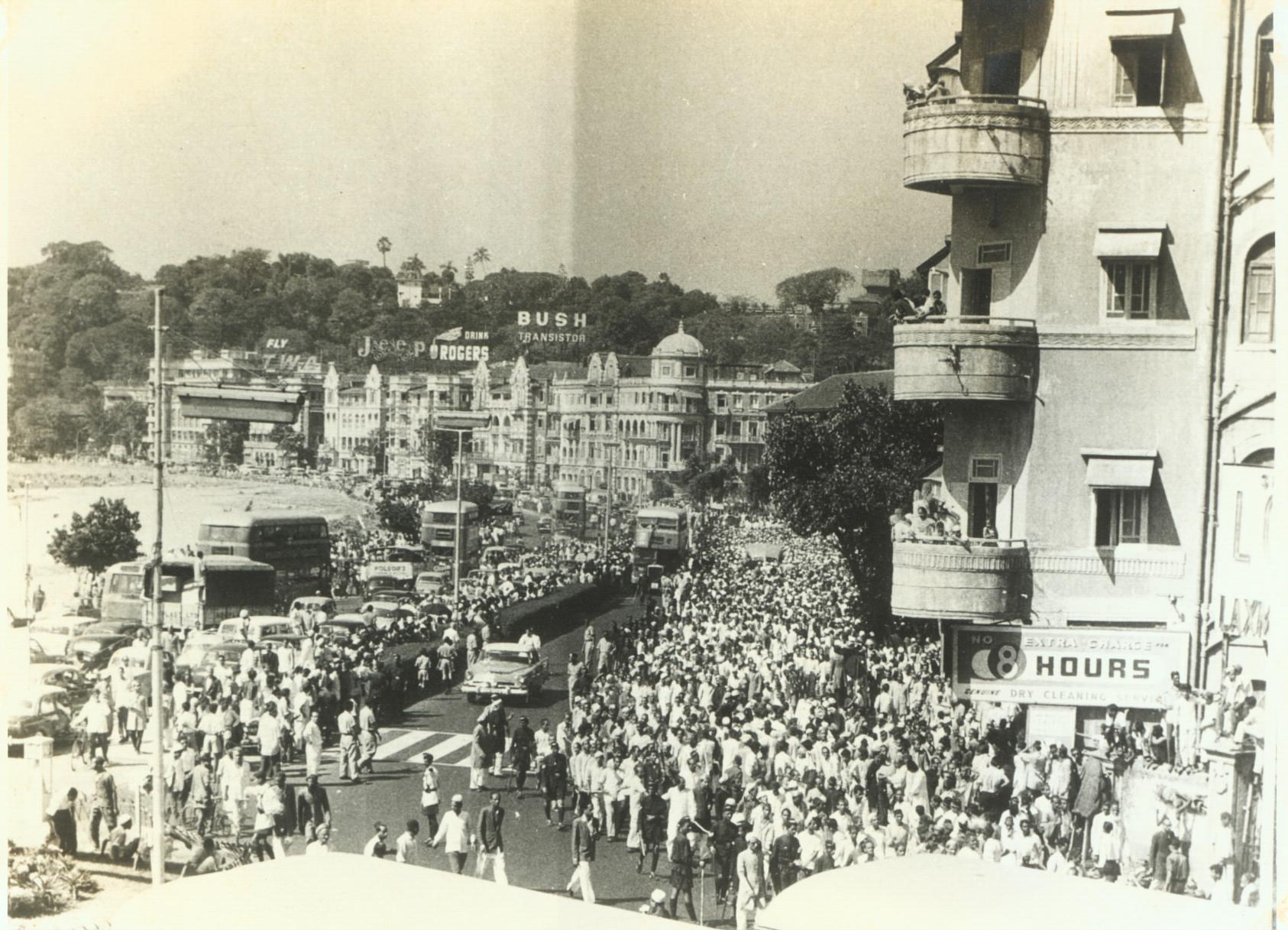
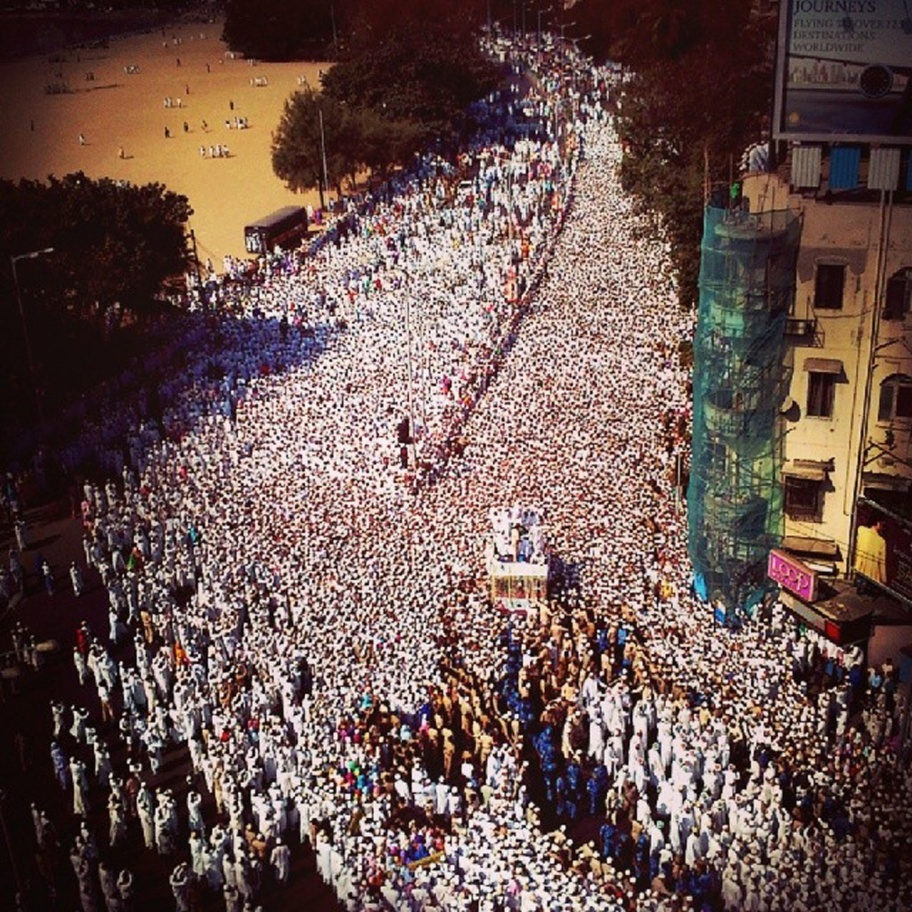
  1. Community growth. There are today approximately 19,350 Mumineen households in Mumbai and its suburbs. With a very conservative average of four people per household, that puts the Dawoodi Bohra population of Mumbai today at roughly 77,400. Using the national Indian growth rate (which is generally less than the growth rate of Muslim communities in India), if we were to back calculate to 1965, the year of Syedna Taher Saifuddin’s RA wafaat, we could estimate the Dawoodi Bohra population of Mumbai at roughly 30,604. This does not take into consideration urban migration which has been huge on population growth in Indian metropolises, specifically in trading communities such as the Dawoodi Bohras. Calculating for urban migration would easily reduce this number by half to approximately 15,000. Simply put, the Dawoodi Bohra population of Mumbai today is exponentially larger than what it was half a century ago. This is one of the reasons why there were more people at Syedna Burhanuddin’s janazah mubarakah  than his respected father’s.
  2. The world is smaller. News of Syedna Taher Saifuddin’s RA wafaat was announced on All India Radio the morning after he passed away. The jism mubarak was brought to Mumbai by train and car and the following day, after ghusl and takfeen, it was brought to Saifee Masjid whereafter it was laid to rest in Rawdat Taherah. The difficulties in transportation make it hard to imagine that more than a couple thousand Mumineen from outside of Mumbai would have arrived in time to participate in the janazah mubarakah. Word of Moula Burhanuddin’s RA wafaat was instantaneous. People from as far as London and Dar al-Salaam arrived in time to do deedar of Burhanuddin Moula RA at Saifee Mahal that very night. Thousands more arrived from international destinations in time for the janazah mubarakah which left the next morning. The highways leading into Mumbai from other Indian cities as night fell were packed with Mumineen vehicles. Train stations were full of Dawoodi Bohras. Literally, thousands upon thousands arrived to Mumbai by air, road and rail within 20 hours of Moula’s wafaat, in time to attend the janazah and namaaz.
  3. Flowering seeds of love. Syedna Mohammed Burhanuddin RA often stated in his wa’az mubaraks that he was reaping the seeds of love that his father had tirelessly sowed during his tenure as Dai. This statement indicates that the amount of love and devotion Mumineen had for Syedna Burhanuddin RA was greater than that which was for his father. Not only were the numbers of Mumineen greater, but the love and affection Mumineen had in their hearts, too, was greater.

 The images from the janazah mubarakahs of Syedna Taher Saifuddin RA and Syedna Mohammed Burhanuddin RA clearly illustrate these three points. However, instead of claiming that the janazahs were different, I would affirm that they were the same. Syedna Taher Saifuddin’s RA wafaat and its impact on the community was like no other Dai’s in the history of Dawat. In the same way, as anaa’ na saheb, sharing the glories of his father, the same can be said of Syedna Burhanuddin’sRA wafaat and janazah mubarakah: it was unprecedented and its impact on the community is unparalleled.

Janazah Mubarakah of Syedna Taher Saifuddin RA at Sukh Sagar near Chowpatty Beach, 1965

Janazah Mubarakah of Syedna Taher Saifuddin RA at Sukh Sagar near Chowpatty Beach, 1965

Janazah Mubarakah of Syedna Mohammed Burhanuddin RA at Sukh Sagar near Chowpatty Beach, 2014 (Instagram user: riteshuttamchandani)

Janazah Mubarakah of Syedna Mohammed Burhanuddin RA at Sukh Sagar near Chowpatty Beach, 2014 (Instagram user: riteshuttamchandani)

Syedna Mufaddal Saifuddin TUS behind the janazah mubarakah of Syedna Burhanuddin RA near Chowpatty Beach. The seeds of love and devotion now in full bloom.

Syedna Mufaddal Saifuddin TUS behind the janazah mubarakah of Syedna Burhanuddin RA near Chowpatty Beach. The seeds of love and devotion now in full bloom.

In the face of these kinds of numbers, and this devotion, any course of action apart from what was chosen by Syedna Mufaddal Saifuddin TUSwould have resulted in harm of Mumineen and behurmati of the janazah mubarakah. This is besides the many other hikmats in his actions. There was no better, or more shari’at-preferred course of action than this. It does not take ilhaam or taaeed to understand this, just tawfeeq and mohabbat. That nothing else would suffice in this type of a crowd is obvious for those that were blessed to bear witness to this historic occasion. For those that were sitting at home uploading YouTube videos or searching for WordPress templates, that this is not obvious, that it cannot be understood, comprehended or seen, is of no wonder.

Reason #70: (Janazah-Post 5) – Lack of tawfeeq

The Janazah Mubarak of Syedna Mohammed Burhanuddin RA

Post 5 – Lack of tawfeeq

Husain Qutbuddin claims that Syedna Burhanuddin’s janazah mubarakah ‘ma faraq parhi gayo’; that it did not happen as it should have, because KQ, the haqq na saheb, was not allowed to be there. This does not make sense. Why would Allah Ta’ala demonstrate his anger at people for abandoning KQ, the alleged haqq na saheb, by allowing disrespect and behurmati of another haqq na saheb? How could a mansoos even think that not accepting him as the true mansoos would result in the behurmati of his naas’ janazah, the very person who appointed him to that position? If anything, Allah’s anger would befall those who did not accept Syedna Burhanuddin’s wishes in his successor, not Syedna Burhanuddin himself! How is that justice? Why would Allah Ta’ala do that?

 Further, if KQ stayed away from the janazah in fear of behurmati, in all his wisdom and insight, why did he not realize that his absence was inexcusable according to our basic tenets?

 The truth, then, is that there was no behurmati or faraq (compromise) in the janazah mubarakah of Syedna Burhanuddin. Allah’s anger did befall those who did not accept Syedna Burhanuddin’s true mansoos. He distanced them for His mercy, the very being of the Dai, and did not give them the tawfeeq, strength or understanding to attend his janazah mubarakah. And He, through His ilhaam and the ilhaam of His Wali to his Dai Syedna Mufaddal Saifuddin TUS, ensured that Syedna Burhanuddin’s RA janazah mubarakah would be carried to his final resting place like no other Dai in the history of Dawat cementing in the eyes of all true believers his true maqaam and demonstrating for all the unparalleled love in the hearts of his sincere followers. Let us recall this historic day:

 Syedna Mohammed Burhanuddin’s RA janazah mubarakah, the janazah mubarakah upon which heavenly barakaat and grace was constantly showered, and the manner by which it was carried and brought to its final resting place are indications of his great maqaam and the nazaraat of Imam al-Zaman upon his Dai. Firstly, generations of Mumineen benefitted with the final deedar of the chehra mubarak of Syedna Burhanuddin RA: a barakat that they will cherish and take blessings from for the rest of their lives and even after they die. Which child would not wish to see their father’s radiant, beaming face once more before it was taken from their sight for the remainder of their lives?

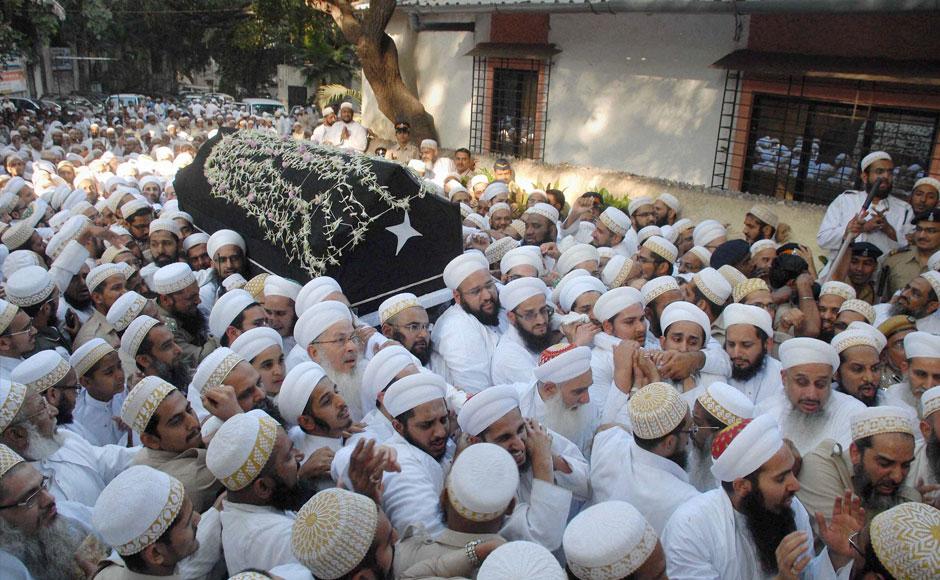
 After ghusl and takfeen, Syedna Burhanuddin’s RA janazah mubarakah was carried on the shoulders of his son and successor, Syedna Mufaddal Saifuddin TUS and other members of his family and Mumineen from Taheri masjid to the Saifee Mahal portico. There, the Indian state paid its final respects to Syedna Burhanuddin RA with a 21-gun salute. Syedna Mufaddal Saifuddin TUS, barefoot, followed closely behind the janazah mubarakah until Syedna Burhanuddin RA left the gates of Saifee Mahal for the very last time on the shoulders of his beloved children. Despite the police barriers, uniformed officers and military presence, thousands of Mumineen had managed to reach the restricted area outside the gates of Saifee Mahal. Despite having just left Saifee Mahal, the janazah mubarakah could not move forward in the huge crowd of Mumineen.
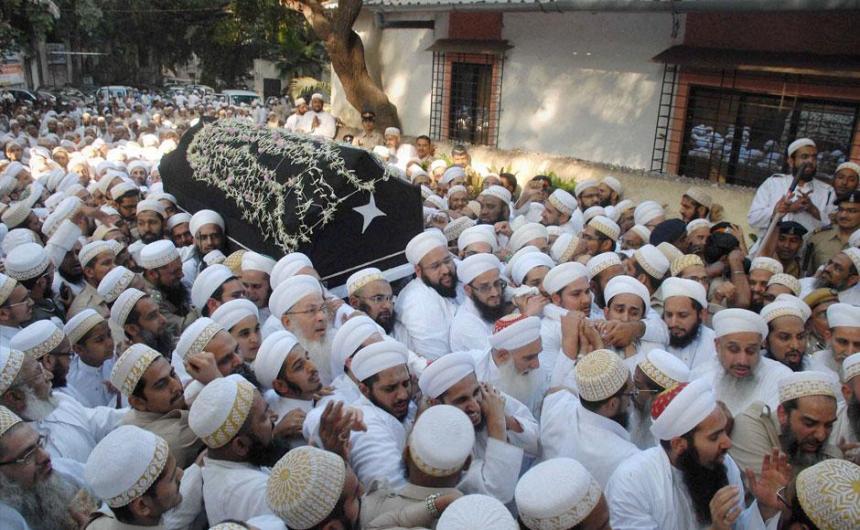
Outside Saify Mahal

Outside Saify Mahal

With great effort and care, it was placed on a vehicle specially prepared to carry Moula’s janazah mubarakah. Syedna Saifuddin TUS boarded the carriage and sat behind the janazah mubarakah. As it made its way in the sea of thousands and thousands of Mumineen, the sheer numbers of people that had gathered was astonishing. Ultimately, the janazah mubarakah reached Saifee Masjid. There, throngs of Mumineen, in the masjid, and the streets surrounding it partook in the janazah namaz of the 52nd Dai. An event they never imagined could happen; an event they gave lakho shukr na sajadaat to have participated in. After the namaz, they saw his shahzadahs and children give ta’ziyat to his successor and tears poured from Mumineen’s eyes at this heart-breaking sight. And finally, as Moula’s mubarak janazah made its way to the splendid, mausoleum he built for his father to take his place at his side for eternity, Mumineen gazed upon their Dai for the very last time.

Mumineen gaze upon the janazah mubarakah for the last time

Mumineen gaze upon the janazah mubarakah for the last time

KQ’s accusations of acting against the sunnat and not knowing the ahkaam of shari’at are all baseless. They are meant to be a smokescreen that would hide the truth: the fact that Khuzaima did not come to Syedna Burhanuddin’s janazah. If anything is to be taken as indication of lack of tawfeeq, lack of mohabbat, lack of ‘ilm it is this: history will give testament to the undisputable fact that Khuzaima Qutbuddin, his kin and his followers failed to come to the janazah mubarakah of Syedna Mohammed Burhanuddin RA.
Reason #69: (Janazah-Post 4) – Following the Janazah

The Janazah Mubarak of Syedna Mohammed Burhanuddin RA

Post 4 – Following the Janazah

Dawat texts have indicated the importance, protocol and etiquette of following a janazah either on its way for janazah namaz or towards the graveyard for burial. In this regard, Kitaab al-Hawashi, a Dawat text that is a compilation of queries made by the Hudood Kiram RA of India to the Doat Mutlaqeen RA of Yemen and their corresponding responses, contains the following:

The question: What do you say in regards to what shari’at has prescribed regarding walking behind janazahs; does one who walks in front of a janazah err or sin in doing so?

The answer: It is mentioned in Kitab al-Akhbar (Al-Akhbaar fi al-Fiqh by Syedna al-Qadi al-Noman RA) that walking in front of a janazah is discouraged when the janazah is that of an enemy [of Dawat] because of the presence of angels of anger. As for a Mumin, there is no concern as to where you walk in relation to the janazah because the angels of mercy engulf it. Walking behind it, however, is preferred.

The thousands of Mumineen who partook in Syedna Mohammed Burhanuddin’s RA janazah, even if standing hundreds of meters away were truly showered by the mercy and rehmat of Allah Ta’ala and his firishtah. Those, however, who despite being in Mumbai, failed to come, failed to even catch a single glimpse of this noorani manzar, or at Masajids/Halls where there was Live AV relay, they are indeed mehroom.

Providing more evidence of his ignorance of Dawat texts, Husain Qutbuddin attempts to further disgrace Syedna Burhanuddin’s RA janazah procession and his memory by claiming that sitting in a vehicle was against shari’at. Syedna al-Qadi al-Noman RA states in Kitab al-Muntakhabah, an important compilation of shari’at ahkaam (important aspects of Fatemi jurisprudence) uniquely composed in verse form:

And walking behind a janazah is preferred, and walking barefoot holds complete reward.

Yet, walking with shoes and riding a mount, when following a janazah, is also permissible.

Syedna al-Qadi al-Noman RA has stated that when accompanying or following a janazah it is permissible to ride upon a mount instead of walking behind it. How can Husain Qutbuddin claim that ‘basic hukm ma faraq parhi gayo when he himself is unaware of this basic hukm?

Reason #68: (Janazah-Post 3) – The Carrying of the Janazah

The Janazah Mubarak of Syedna Mohammed Burhanuddin RA

Post 3 – The Carrying of the Janazah

Da’aim al-Islam has clearly established that carrying a janazah by foot, upon the shoulders of men is Sunnat and the preferred means. Yet, this is not all that Da’aim states. It is ironic that Husain Qutbuddin, who attempts to criticize someone given charge of a Mumin’s janazah for not referring to Da’aim, is himself unaware of Da’aim as well as other Dawat texts. In the very same paragraph in Da’a’im where it is mentioned that the janazah should be carried, it is explained that a janazah can also be taken upon an animal (i.e. camel or other riding animal) if the situation calls for it. In fact, that is how the narration begins. The text from Da’aim is as follows:

[Narrated] from Ali SA, he has given permission that a janazah can be carried on an animal or carriage. This is allowed if there are not a sufficient number of people to carry it or there is some other excuse or justification (‘uzr). The sunnat, however, and that which is [normally] instructed of is for it to be carried by men. 

The two options given by Amirul Mumineen SA are clear. The janazah should be carried by men and when not possible, either due to there being too few men or some other reason that prohibits carrying the janazah on shoulders, it can be carried by a carriage. Mukhtasar al-Aathar, Kitab al-Wadiyyah (by Syedna Ahmad Hamiduddin al-Kirmani) and Kitab al-Muntakhabah all reiterate this guidance.

It is in accordance with these explicit instructions of Shari’at that Hudat Kiram have always acted. In 1987, when Amirul Jamea al-Muqaddas passed away, Syedna Mohammed Burhanuddin RA flew to Cairo to lead his janazah namaz. After namaz in Anwar, the janazah mubarakah was carried to Ra’as al-Husain’s zareeh mubarak and then placed in a vehicle. Syedna Burhanuddin RA, seated in another car, followed the janazah to Marj. There, Amirul Jamea al-Muqaddas was buried outside the Qubbah Mubarakah of Moulana Malek al-Ashtar RA.

Husain Qutbuddin attempts to highlight the importance and hurmat of a Mumin’s janazah in his YouTube Q&A sessions and states that Syedna al-Qadi Noman RA has emphasised that a Mumin’s janazah should be carried on one’s shoulders. His questions why this was not considered for Moula. Using his own rhetoric, something that applies for every Mumin should have been applied for the shahzadah of a Dai:

When Shahzadah Mohammed al-Baqir Bhaisaheb passed away in February, 2009, KQ led prayers over his janazah and presided over his funeral and final rites. After namaz in Saifee masjid, KQ instructed that the janazah be taken to Mohammed Ali road using the alley besides Rawdat Taherah. Once on the main road, KQ had the janazah placed in an ambulance; family members got in the ambulance and sat besdies it. KQ himself got into his Mercedes and then drove to Naryal Wadi where Shahzadah al-Muqaddas was finally laid to rest. Did Husain Qutbuddin forget that his own father allowed for a janazah to be placed in a vehicle, despite the relatively shorter distance and lack of concern over numbers and crowd control?

 His:

  • inability to identify references in Dawat texts that clearly allow what he claims is not allowed by shari’at,
  • incapacity to understand the meanings of these texts,
  • failure to realise that his own father has done what he claims is against the sunnah;

All these things indicate that it is he and his father who lack tawfeeq and divine inspiration from Allah Ta’ala.

Reason #67: (Janazah-Post 2) – Sharia’at and the maqaam and authority of the Dai

The Janazah Mubarak of Syedna Mohammed Burhanuddin RA

Post 2 – Sharia’at and the maqaam and authority of the Dai

 The attendance of the janazah and namaz upon it are obligatory. Due to this importance, shari’at has specified rules and guidelines for how a Mumin’s funeral and janazah should take place, and like all aspects of life, it has acknowledged that the circumstances of funerals and janazahs are not always alike. Shari’at provides various means to cater to the different constraints and issues that raise in different janazah situations. This is why shari’at is known as sharia’at samhaa’: a religion that is encompassing and tolerant. More importantly, shari’at is led by Saheb al-Shari’at, the imam or dai of each time who carries out and administers the dictates of shari’at with authority given to him by Allah Ta’ala and his ilhaam.

 An example of this is an incident that occurred during the period of Syedna Mohammed Burhanuddin RA, the 49th Dai which Syedna Mohammed Burhanuddin RA (52nd Dai) describes in one of his wa’az mubaraks (Asharah Mubarakah, 1418 H, 3rd Majlis). During his grandfather’s (49th Dai) time, two senior members of the community passed away in Surat and their janazahs were brought to the Nawapura masjid. Various opinions were shared as to how the janazahs should be placed until an argument broke out. When Syedna BurhanuddinRA (49th Dai)reached the masjid door, two shaikhs came to him seeking judgement as to how the janazah should be placed during the single namaz, both offering different suggestions. Syedna said nothing. When he reached the the two janazahs, he gave instructions that one be moved away.  He led namaz separately for each of the janazahs. In his bayaan mubarak, Syedna Mohammed Burhanuddin RA (52nd Dai) states:

There is bayaan [in Dawat texts], that if there are two janazahs, or four, then namaz can be prayed upon each of them individually or all of them together. It is not obligated (faridat) that namaz should take place on them all together. Everyone present was astounded; this is fasl al-khitaab (final decision; ultimate authority). Because Syedna Burhanuddin (49th Dai) had realised that much has already been said; this is not the appropriate time to furnish a response to their queries. Upon witnessing this act, Syedi Mohyiddeen stated: “behold the strength (quwwat) of this saheb, he is endowed with fasl al-khitaab!”

Among the many lessons the bayaan mubarak of Syedna Burhanuddin (52nd) and the actions of Syedna Burhanuddin (49th Dai) offer, three are of direct relevance here.

  • Firstly, as mentioned above, Shari’at allows for multiple courses of actions depending on varying situations.
  • Secondly, it is the haqq na saheb that chooses the correct course of action for a particular situation and makes a final decision based upon what is provided for in Shari’at. He ensures that what is obligated by shari’at is carried out and where shari’at has given provision and choice, he chooses the most appropriate course of action.
  • Finally, Dawat texts must be seen as a collective corpus of literature; bayaans cannot be chosen according to one’s own preference in order to support one’s preferred interpretation.

The provision that when two or more janazahs are placed in a masjid, namaz can be held on them separately is not found in Da’a’im al-Islam. In fact, Da’a’im only refers to the following statement by Moulana AliSA: “When multiple janazahs have been assembled [in a masjid for janazah namaz], [the Imam should] pray a single namaz upon them together. [The janazahs of] men should be placed near him, and [the janazahs of] women should be placed towards the Qiblah.” Da’aim is clear: namaz should be prayed on all janazahs together. It is only in other Fiqh (jurisprudence) texts that this provision for praying namaz separately on each janazah is given. In Mukhtasar al-Aathar, Syedna al-Qadi al-Noman RA, the very author of Da’aim, states: “When multiple janazahs have been assembled [for namaz], the imam can lead prayer upon them together… And if he wishes to pray namaz upon them individually, then that is also permissible.“

The Dai’s actions are always in accordance with shari’at and reflect the meanigs of Dawat texts as a collective entity. His very being is shari’at. Therefore, whatever course of action he chooses is the most appropriate course to be taken. It is the most preferred, most afdal.

Reason #66: (Janazah-Post 1) – Nass is all that matters

The Janazah Mubarak of Syedna Mohammed Burhanuddin RA

Post 1 – Nass is all that matters

 A Dai’s greatest responsibility is finding, preparing and appointing, through nass and tawqeef, the Dai that will take his place. This individual is like him in all ways and has all the attributes and qualities required to lead the Dawat. He is guided by the ilhaam of Allah Ta’ala and his wali and therefore everything he does is right and haqq. For those that are willing to see, it is obvious beyond any doubt that Syedna Mohammed Burhanuddin RA had appointed Syedna Mufaddal Saifuddin TUS as his mansoos and the 53rd Dai through nass and tawqeef. Syedna Mufaddal Saifuddin TUS is his heir and successor, and like him, as Dai today, every action and statement of his contains wisdom and hikmat. It is nass that establishes the righteousness of the Dai’s actions, and not vice versa. It is the presence of this nass and tawqeef that informs us that all of his actions are a result of the ilhaam he receives.

The importance in attending a Mumin’s Janazah

Attending the janazah of a Mumin holds great thawaab and reward (Husain Qutbuddin continues to remind us; let us give some bayaans that he does not refer to). Participating in tajheez and takfeen (the preparation of the body for burial), carrying the janazah, partaking in the janazah namaz, and being present at the burial are all great, rewarding acts; they reflect a Mumin’s respect and affection for his departed brother. In fact, in Tanbih al-Gaafeleen, Syedna Hatim bin Ibrahim RA states:

Know, that a Mumin is obligated to honor certain rights of another Mumin: rights, the fulfilment of which, he cannot be excused of.  They are that he should: always continue giving him advice, answer his call, discourage his backbiting, forgive his mistakes, accept his excuses, honour his agreements, visit him when ill, and follow or escort his janazah [after his death].

 Here, Syedna Hatim RA clearly states that a Mumin cannot be excused from honouring these rights of a fellow Mumin, no matter the reason.

 The importance and obligatory nature of the janazah namaz is further highlighted by Syedna Badrul Jamali RA in his kitaab, Majaalis Mustansiriyyah.  He provides a list of the seven obligatory (faridat) and 12 non-obligatory or customary prayers (sunnat). The seven obligatory prayers are as follows:

  1. Namaz at one’s place of domicile (home). They are 17 raka’ats in each night and day.
  2. Namaz during travels (safr). They are 11 raka’ats in each night and day.
  3. Juma’a namaz [during the period of zuhoor]. It does not take place unless there are four people with the imam.
  4. Namaz of Khowf (prayed during battle). A portion of this namaz is prayed behind the imam and a portion is prayed on one’s own.
  5. The namaz of an obligatory Hajj.
  6. The namaz of an obligatory Umrah.
  7. Namaz upon a janazah. It is obligated upon everyone who comes to know about it from among Muslimeen until one among them leads prayer and the rest follow him.

 If shari’at has obligated attendance of the janazah namaz of a Mumin, and has considered it among a Mumin’s right, what is there to be said of the importance of the namaz of the Dai’s janazah? Further, what can be said of a man who claims to be the Dai’s mansoos, but fails to attend his janazah, providing excuses for what Syedna Hatim RA has said is inexcusable? It is an esteemed tradition that every mansoos leads his predecessor’s janazah namaz.

 Amirul Mumineen SA describes one who comes across a janazah and fails to recite salaam upon it and assist in carrying it (let alone someone who purposefully abandons it) as an ‘aajiz: one who is weak and helpless. Situations might arise where every Mumin in a city cannot attend every departed Mumin’s janazah, but his bond of emaan, love and respect for his fellow Mumin make up for any lack of attendance in such a case. Fard al-Kifayah, or the provision that the faridat of attending the janazah is upheld by all Mumineen when a few do it on their behalf applies to these situations. However, when a Dai’s janazah procession takes place in his city, a Mumin who loves his Dai and Moula, would not be found anywhere else but at his Moula’s side. No excuse or situation would stop him from doing so.

« Older Entries Recent Entries »