Monthly Archives: January 2014

Reason #22: Ph.D in Dawat ni Dushmani

Mumineen, the followers of Syedna Mufaddal Saifuddin TUS, were recently fortunate enough to hear a bayan mubarak of Syedna Mohammed Burhanuddin RA delivered in 1409H. In this bayan mubarak Syedna Burhanuddin stated that there are people who believe that the tenets of Shariat Mohammediyah need to be modified in order for one to succeed in this ‘ultra-modern age’. There are people who believe that doing business without dealing in interest is ‘impossible’ today. 

            One would assume that such detractors belong to a segment of people who have spent their lives speaking and acting against the directives and guidance of the Dai Mutlaq. People who do not believe that he is the vicegerent of the Imam nor agree with the fundamental premise of faith: ‘whatever he says or do is Haq’. To this league belongs Abdeali Qutbuddin, who in his Ph.D. thesis ‘The Principles of Finance in Fatimi Tayyibi Law’ writes (pg. 5):

“Combined with the distorted perception of Fatimi Tayyibi financial principles among members of the Dawoodi Bohra Community today these developments have resulted in a distorted implementation of Fatimi Tayyibi financial principles which has damaged the Community financially, economically and socially” (my emphasis).

The dissertation was submitted in 2003, 38 years into the reign of al-Hayy al-Muqaddas Syedna Mohammed Burhanuddin. It is blatantly apparent that he considers Syedna Mohammed Burhanuddin’s perception and implementation of Fatemi fiqh (jurisprudence) as distorted. He even has the audacity to state that Syedna’s actions have damaged the community.

            Has he forgotten the verse of Syedna Moiyadh al-Shiraazi RA ‘The Imam’s intention is the betterment of humankind, one cannot even contemplate the notion that anyone apart from him harbours such intentions’? Perhaps Badat Taherah could help him remember.

If Abdeali believed that Syedna Mohammed Burhanuddin was Imam al-Zaman’s Dai Mutlaq then he should have argued how Syedna Mohammed Burhanuddin correctly applied the principles of Fatemi fiqh and raised the financial, economic and social standards of Mumineen to unprecedented heights. However, his choice of words reveals how he and his family truly saw our beloved 52nd Dai Mutlaq.

            Has he not studied Kitaab al-Hawaashi and seen how the erudite scholars of Dawat addressed the Dai Mutlaq when seeking answers for questions related to jurisprudence? They began their questions with ‘O most superior of all those who have encouraged us to love wisdom and the wise, what do you have to say regarding…?’, ‘O ray of the sun of guidance, what are your words regarding…?’, ‘O one who has delved deep into the oceans of knowledge, what is your answer regarding…?’ and other similar forms of address. Has he not read the introductory passage of the ‘Masaail Fiqhiyaah’ section (Questions pertaining to jurisprudence) of Syedna Taher Saifuddin’s Rasaail Ramadaniyah? These texts establish the pivotal role of the Dai Mutlaq in Fatemi fiqh and reveal that his words and actions are an embodiment of it. How can he justify labeling Syedna Mohammed Burhanuddin’s understanding of Fatemi fiqh as distorted?

            In 1399H, Syedna Mohammed Burhanuddin called Mumineen towards al-Multaqa al-Fatemi al-Ilmi in Surat. The Multaqa was the turning point of Syedna Mohammed Burhanuddin’s golden era. In it he reaffirmed the fundamentals of our faith and unequivocally stated that all forms of interest are haraam. He made it clear that Mumineen should abstain from all practices and transactions that even remotely involve interest. Is he arguing that Syedna Mohammed Burhanuddin’s directive for Mumineen to free themselves from all forms of interest is a distorted implementation of Fatemi jurisprudence?

            Would any Mumin condone his son writing such words about the Dai Mutlaq? But here, not only was Khuzaima proud of his son’s pseudo-accomplishment but went on to hold a reception for Mumineen college students from Mumbai to ‘celebrate’ his writings opposing the Dai Mutlaq.

            Mumineen tend to the secular and religious education of their children with the intention that they do the khidmat of the Dai Mutlaq to the best of their abilities. Using one’s education in the opposition of the Dai Mutlaq is the height of ignorance, regardless of how many Ph.Ds are nailed to your walls. Moulana Imam Ahmed al-Mastur AS writes:

Know my brother, that any field of knowledge or literature that does not guide its seeker towards pursuing the hereafter or aid him in reaching it, will yield dreadful consequences for him and will stand as an argument against him on the Day of Qiyaamat.’

 These consequences are beginning to show themselves.
Reason #21: Hypocrisy Personified

All throughout the preposterous arguments presented on Khuzaima’s website, he claims that ‘conspirators’ have taken control of Dawat and its institutions and have released and issued publications for their own benefit, including the official nass mithaal shareef issued by Syedna Mohammed Burhanuddin RA and other proclamations, including the tarteeb and mithaq mihtaals, issued with Moulana Burhanuddin’s RA raza mubarak.

He does this to discredit and undermine the nass and the numerous kalemaat nooraniyah of Syedna Burhanuddin RA stated in the shaan and maqaam of Syedna Mufaddal Saifuddin TUS. If the Dawat, Vazarat and all its institutions were no longer under the control and command of Syedna al-Dai al-Muqaddas RA, if his speech and awareness were impaired, then why did Khuzaima during Ramadan al-Mu’azzam in Secunderabad in 1434 H request for du’aa from the Dai’s administration? If he knows that Moulana RA neither has control over the administration or awareness to respond, why send any form of communication to his office or his person and seek blessings and du’aa? Moreover, upon receiving a response from this office, why highlight its importance and barakat to the extent that Mumineen in the masjid were instructed to place the du’aa mithaal shareef on their heads and frame copies of it and place it on their walls? (Listen to Aziz’s speech below.)

On one hand, Khuzaima dismisses all statements and proclamations issued by Syedna Burhanuddin RA as unacceptable since according to him Moulana RA was not in charge of Dawat, and on the other hand, he goes to extreme measures to display to the Secunderabad Mumineen his fake and insincere reverence for Moulana’s RA mithaal.

Al-Dai al-Ajal Syedna Mufaddal Saifuddin TUS is the only mansoos of al-Dai al-Ajal Syedna Mohammed Burhanuddin RA. Khuzaima used, and continues to use, Syedna Burhanuddin’s RA authority and legitimacy in order to bolster support for his false claim and fancies for material gain while hiding his true animosity and contempt.

Hypocrisy personified.

Reason #20: The Maqaam of Dai al-Asr – (Part Two)

The website and the material presented under the instructions of the Muda’ee Khuzaima repeatedly purport that al-Dai al-Ajal Syedna Mohammed Burhanuddin RA was, Na’uwzobillah, incapacitated during the final years of his life. That he believes, or expresses, that Moula RA was ‘unaware’ of his surroundings, not only during the specific instances of nass but with regards to the general functioning of Dawat, is doubt and disbelief in the very maqaam of al-Dai al-Mutlaq, as has been mentioned in the post below.

In the audio clip posted on FateliDawat.com that is cited as an example of Khuzaima’s unparalleled understanding and ma’rifah of the Dai al-Asr, he eulogizes Syedna Mohammed Burhanuddin RA with a bayt mubarak of al-Dai al-Ajal Syedna Taher Saifuddin’s RA composed in the description of  al-Dai al-Ajal Syedna Noor Mohammed Nooruddin RA. He says that Moulana RA is The Light of Allah Ta’ala who has merely taken the form of a human being. On one hand, he claims Moulana Burhanuddin RA is a divine radiant being who has chosen to take human form, and on the other he now states that this same Moula RA, like any other common human being, is imprisoned by the shackles of his physical form and ailments, powerless to stop the alleged ‘exploitation’, ‘hijacking’ and ‘falsehood’ being carried out due to his illness. This is a blatant attack on the maqaam of the Dai and is an assault on his capacity to take care of Imam’s Dawat.

There are numerous examples in the history of Hudat Kiram RA that highlight the fact that they have often accepted conditions of vulnerability and debility for various reasons and hikmat. Imam Ali Zain al-Abedeen SA allowed himself to be bound by shackles and fetters, yet demonstrated that if he wished, he could release himself from his imprisonment.

What is important to understand is that no matter the physical limitations the Imam or Dai accepts upon himself, at no point is the Dawat in jeopardy or are any of its essential functionalities compromised. That Khuzaima would suggest that not only Moula’s RA jism mubarak, but his Dawat was hijacked is an insult to Moulana Burhanuddin RA and an outright denial that there is hikmat in Moulana’s RA physical condition.  During his final hours, Rasulullah’s SA physical jism mubarak was weak and frail. Yet despite this condition and severe illness, upon hearing someone leading namaaz in his mehraab, with the assistance of Amirul Mumineen SA, he headed to the masjid and pulled that individual out from the qiblah. Rasulullah SA would not allow that man to lead a single namaaz; how could Khuzaima accuse Rasulullah’s SA Dai RA of allowing others of exploiting his Dawat and appointing someone as his successor without his raza and blessings?

Reason #19: The Maqaam of Dai al-Asr – (Part One)

During the Asharah Mubarakah of 1429H in Colombo, Syedna Mohammed Burhanuddin RA quoted a bayaan mubarak of Syedna Taher Saifuddin RA in which he narrates the nass and subsequent events prior to the wafaat of the 49th Dai, his father Syedna Mohammed Burhanuddin RA. This bayaan mubarak is pivotal in highlighting the great maqaam of the Dai al-Asr, regardless of perceived manifestations of his physical form and condition, and explains the belief and aqeedo a Mumin should have during such situations.

 [It was] very difficult to speak, if it was anyone else, they would not have been able to utter a word. That was the intensity of the pain. All day and night, he spent 24 hours in this condition. No one else would have been able to even make a sound; such an extreme condition. But regardless, Burhanudin Moula’s RA (49th Dai) declaration of nass was with great potency and splendor (aa shaan si nass kidi)…

 Then, Bawajee Saheb (Syedna Taher Saifuddin RA) says, “everyone began discussing what to do next”. “Shall we take Moula home from here? We should not keep him here in this condition.” At that point, Kakaji Saheb Abdeali Bhaisaheb said, “Bhai, everyone is of the opinion that we should take Bawaajee Saheb (49th Dai) home.” “I, Mamlook e Aale Mohammed, had conviction and ikhlaas (sincerity of faith)”— meaning Syedna Taher Saifuddin, he is the reference here in Mamlook e Aale Mohammed. I spoke to Kakaji Saheb and told him, “I will only take Bawajee Saheb (Syedna Mohammed Burhanuddin RA, 49th Dai) after I have asked him if we may do so”. “If he says yes, then we will take him [home].” “If my father says that we should take him, then only will we do so.” This is what Syedna Taher Saifuddin RA said. “I have yaqeen (conviction) that this Saheb (49th Dai) is the recipient of ilhaam (divine inspiration from Allah Ta’ala and the Imam). Ilhaam is always at his aid, with the Dai. Taaeed always accompanies him. I am aware that his physical condition is that of illness, yet whatever he says is correct and appropriate.”

Khuzaima’s website quotes that “Syedna Taher Saifuddin RA related the story of the 49th Dai Muqaddas Syedna Burhanuddin RA who had a paralytic stroke toward the end of his life and lost his speech”. By doing so the Qutbuddin cult is drawing parallels between the 49th Dai and the 52nd Dai, and insinuating that both Dais were unaware of their surroundings and unable to speak. Like most of their statements, however, their lack of knowledge and their unfamiliarity with Syedna Burhanuddin’s RA kalemaat nooraniyah (in this case even Syedna Taher Saifuddin’s RA) has worked against them. If they accept that the conditions are similar (although Syedna Burhanuddin, the 49th Dai is said to have suffered a very severe illness prior to his wafaat), they must accept the other parallels that are established by the bayaan mubarak of Syedna Taher Saifuddin RA regarding this incident. They are:

  1. The Dai Mutlaq cannot be equated with an ordinary human being; this is the belief afforded to us by Fatemi texts and kotub al-Dawat and confirmed by Syedna Burhanuddin’s RA own words above. The Qutbi cult sites medical reasons and various other conditions to highlight that it would be improbable, nay impossible for the Dai to speak or act out of his own will, specifically on the day of Nass e Jali. But in the bayaan mubarak above, Syedna Mohammed Burhanuddin RA, very clearly states that “beeja hoi to boli bhi na sake” thereby differentiating between the afflictions upon a normal and the Dai.
  2. Secondly, Syedna Taher Saifuddin RA, regardless of his father’s physical ailment, seeks judgment and decision from him alone: ‘bawajee saheb ne mein puchu ke hamme aap ne lai jaiyye?’ A Mumin’s belief, as Syedna Taher Saifuddin’s RA own words clearly show, should be that no matter what the perceived physical condition of the Dai may be, it is he who should be sought for all decisions. Khuzaima’s claim that he was waiting for Moula’s RA health to improve to seek judgment from him regarding the supposed controversy of the nass indicates his lack of conviction and ma’rifah of the Dai’s maqaam; no wonder he is foolish enough to claim it for himself. If Syedna Taher Saifuddin RA was determined to seek his father’s instructions for the simple matter of whether he should be taken home or not, then surely the matter of nass and the future of Dawat should have been raised by Khuzama—since he had doubts—to the Dai’s hadrat imamiyah.
  3. Finally, Syedna Taher Saifuddin RA states, “mein jaanu chu ke zaahir ma to beemaari ni haalat che, magar ye kehse te baraabar”. He clarifies that his respected father, Syedna Mohammed Burhanuddin, the 49th Dai, and like him the 52nd Dai, despite being in a physical state of illness, their words are true and correct. Those who would claim otherwise are in direct contradiction to Syedna Taher Saifuddin’s RA kalemaat nooraniyah. On the day of Nasse e Jali, Syedna Mohammed Burhanuddin RA clearly states repeatedly, “Mufaddal Bhai ne, nas nu taaj pehnawu chu”.  This is apart from the nass he proclaimed in the hospital in London, which they deny as well on the grounds of incapability due to medical reasons.

No matter how the Mudda’ee and his conspirators endeavour to manipulate and misrepresent Dawat texts and the words of Doat RA, Haqq and the maqaam of the Dai al-Asr, like the shining afternoon sun, cannot be hidden from those who can and are willing to see.

Reason #18: Black & White

I claim no intricate knowledge regarding Dawat theology or its sophisticated legal doctrine. But I do know what I see, and I believe in what I see. And what I see is Black and White.

1.       Black is repeatedly claiming ‘maney’ (me). White is voicing ‘mamlook’.

2.       Black is repeating ‘my belief’… White is belief in Moula.

3.       Black is leaving Moula’s janaazah. White is staying by its side.

4.       Black fears. White sacrifices.

5.       Black is claiming grief. White is showing it.

6.       Black is claiming saathey rakha. White is silently saathey rhaya.

7.       Black is demanding rutba. White is serving it.

8.       Black is quoting trust numbers. White is earning trust.

9.       Black is claiming knowledge. White is applying it in Dawat’s service.

10.   Black is feigning superiority. White is humility.

11.   Black is claiming time for ziyaarat. White is ensuring that others are blessed with it.

12.   Black is copying Moula. White is serving him.

13.   Black demands his place next to Moula. White always stands behind him.

14.   Black is idle chatter. White is dignified silence.

15.   Black is inarticulateness. White is eloquence.

16.   Black is tarnishing your predecessor. White is celebrating him.

17.   Black is feigning remembrance. White never forgets.

18.   Black mentions enemies. White attracts friends.

19.   Black misuses children. White cherishes them.

20.   Black demands ta’at. White is ta’at personified.

In this case, life is indeed black and white.

Reason #17: Analysis of Syedi Aminji b Jalal Text Regarding Nass e Khafi with reference to Nabi Idris AS

Analysis of Syedi Aminji b Jalal Text Regarding Nass e Khafi with reference to Nabi Idris AS and Syedna Mohammed Burhanuddin’s Waaz Mubarak on the Subject

The FatemiDawat website’s fundamental premise lies on the alleged claim that nass occurred in private. It aims to substantiate this claim by referring to Syedi Aminji b Jalal’s QA text. This is referred to as follows:

“Nass in private from the Dai to his Mansoos without any other witnesses is valid. Syedna Taher Saifuddin RA explains in his risalat 1363H (p.144), on the authority of Syedi Ameenji b. Jalaal QA and Syedna Daud b. Qutubshah QA, the private Nass performed by the 7th Dai Syedna Ahmad bin Mubarak RA on 8th Dai Syedna Husain bin Ali RA. After Syedna Ahmad RA’s wafat, his successor the Syedna Husain RA himself declared that he had been appointed by his predecessor in private without any witnesses, for reasons pertaining to the welfare of Dawat. Syedna Husain RA also asserted that there was no one at par with him in ‘ilm and knowledge. He presented a book of haqiqat he had written (kitab al-Īdāh wa l-Bayān) and challenged anyone to produce anything similar. The excerpt relating to this account with translation is in the documentary evidence section below”

The actual text proves that there were witnesses to the nass of the 8th Dai Syedna Husain RA. A linguistic analysis of the text proves this. Actually, there is just one word which alters the meaning of the text fundamentally.  (Discussed in detail Reason #2 & #10).

“Fa ma ash’hada al shohadaa’aa zaaheran.

The sentence WITHOUT the word ‘zaaheran’ (openly, publicly) at the end would offer the meaning that Khuzaima futilely wishes it does. It would read that:

‘Syedna Ahmed RA did not engage or seek witnesses to the nass.’

However, the complete sentence is:

“Fa ma ash’hada al shohadaa’aa zaaheran.”

The word “zaaheran” adds to the sentence and changes it to read:

‘Witnesses were not engaged to testify ‘openly’.’

Their testimony was not requested or called for publicly. If there had been no witnesses, there would be no need for this additional word. Syedi Ameenji bin Jalal QA would have sufficed with just “Fa ma ash’hada al shohadaa’aa” 

****

Rather than just depending on a semantic reading of the text, there is no better rendering of the text, other than what Syedna Mohammed Burhanuddin RA said in reference to it in Ashara Mubaraka in 1426H in the first waaz:

“Syedi Amin b Jalal QA says…..the reason for writing Kitab ul Idhaah wal Bayaan, was that the Dai who wrote the kitaab, the Dai before him did not openly perform nass (te na aage na Dai guzra te nass ZAAHERAN noti keedi) the people did not know…..this Dai, Syedna Hussain RA, the author of this kitaab, he thought, ‘How do I show others that nass has been conferred upon me?’. These are wise and articulate people. So I chose the same path chosen by Idris Nabi.”

 Syedna Mohammed Burhanuddin RA clearly draws a definitive parallel between the actions of Syedna Hussain RA with that of Idris Nabi. So what exactly did Idris Nabi do? Syedna Taher Saifuddin RA refers to this in The book Agharul Majalis where he says:

“Allah Taala states in his book that Idris was truthful and was a nabi. We elevated him to a high position. It is related that the Imam who appointed him, did so discretely from the people of Dawat, [but] in the presence of his ‘noqaba’ (hudood) ‘sirran un ahle dawate hi be mah-dharin min noqabaa ehi.”

Idris Nabi AS used the ‘astrolabe’ to show to others he was Nabi, whereas Syedna Hussain RA wrote The book Idhaahe wal Bayaan to corroborate that he was the mansoos of his predecessor. The conclusion of this analysis is that Syedna Mohammed Burhanuddin RA, in highlighting the similarities between the conditions and actions of both Syedna Hussain and Idris Nabi AS, explains the parallels by which Nass was conferred on both Moulas, and how they set about proving it. Nass was conferred privately to Idris Nabi AS but several of his noqaba were witness to it. Similarly, when we analyse the precise wording of the text in the risaala and the wording of Syedna Mohammed Burhanuddin’s RA words in waaz with reference to the text in question, we can clearly understand that although the nass on Syedna Hussain RA was a discreet one, it was still conferred in the presence of a number of witnesses.

Therefore, it is NOT a ‘private nass’ in the sense in which the website claims it to be.  One should also note that the need to either use an astrolabe or write a kitaab, does not mean that nass did not happen in the presence of other individuals. Both Idris Nabi and Syedna Hussain opted, through Ilhaam and Ta’eed, to utilize the astrolabe and kitaab respectively, to establish their nass to others. This does not mean that the astrolabe or the kitaab is the reason or the cause why Idris became a Nabi or Syedna Hussain RA became a Dai. They may have chosen to call upon the testimony of the witnesses of their respective nass’, but chose this path based on what Allah Taala and Imam ul Zaman guided them to do.

Reason #16: Syedi Mukasir Saheb; An Example To Follow

Khuzaima Qutbuddin argues that the Dai, Mazoon and Mukasir are one and the same and all three can see with the Noor of Allah Taala. His website also states the following: “Syedna Qutbuddin’s supporters are with Syedna Mohammad Burhanuddin, and he is with us. We are mumineen, true followers of Syedna Mohammad Burhanuddin, and true adherents to the misaaq, fulfilling our qasam of walayat to Dai Mazoon Mukasir.” What justification can they provide for Syedi Mukasir Saheb Husain Bhai Saheb Husamuddin accepting Syedna Mufaddal Saifuddin TUS as the mansoos of Syedna Mohammed Burhauddin RA?

He writes that al Maula al Ajal Syedi Qadi Khan states that the obedience (ta’at) of the Dai, Mazoon and Mukasir are compulsory. Are Mumineen wrong in following Syedi Mukasir Saheb in accepting this Nass? (Please refer Reason #5 below, which will clarify Syedi Mukasir Sahebs acceptance of the Nass on Syedna Mufaddal TUS, and how he carried out the rusumaat (traditions) of the public Nass at Raudat Tahera, while Khuzaima was absent.)

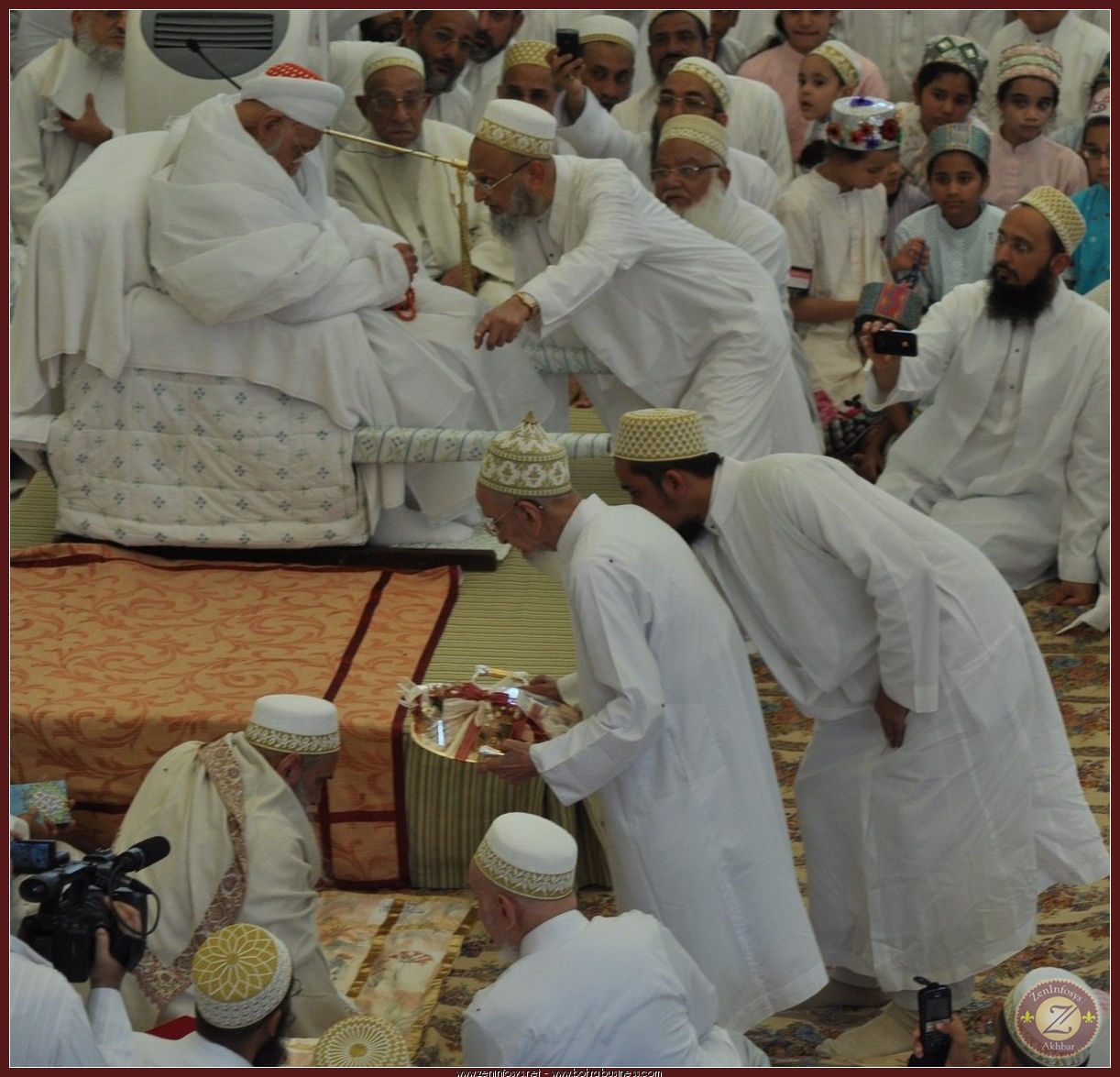
Syedni Mukasir Saheb doing talaqqi of Syedna Mufaddal Saifuddin TUS

Syedi Mukasir Saheb doing talaqqi of Syedna Mufaddal Saifuddin TUS.

Syedni Mukasir Saheb guiding Syedna Mufaddal Saifuddin TUS to Syedna Burhanuddin RA, and Syedna Burhanuddin RA seen welcoming him

Syedi Mukasir Saheb guiding Syedna Mufaddal Saifuddin TUS to Syedna Burhanuddin RA, and Syedna Burhanuddin RA seen welcoming him.

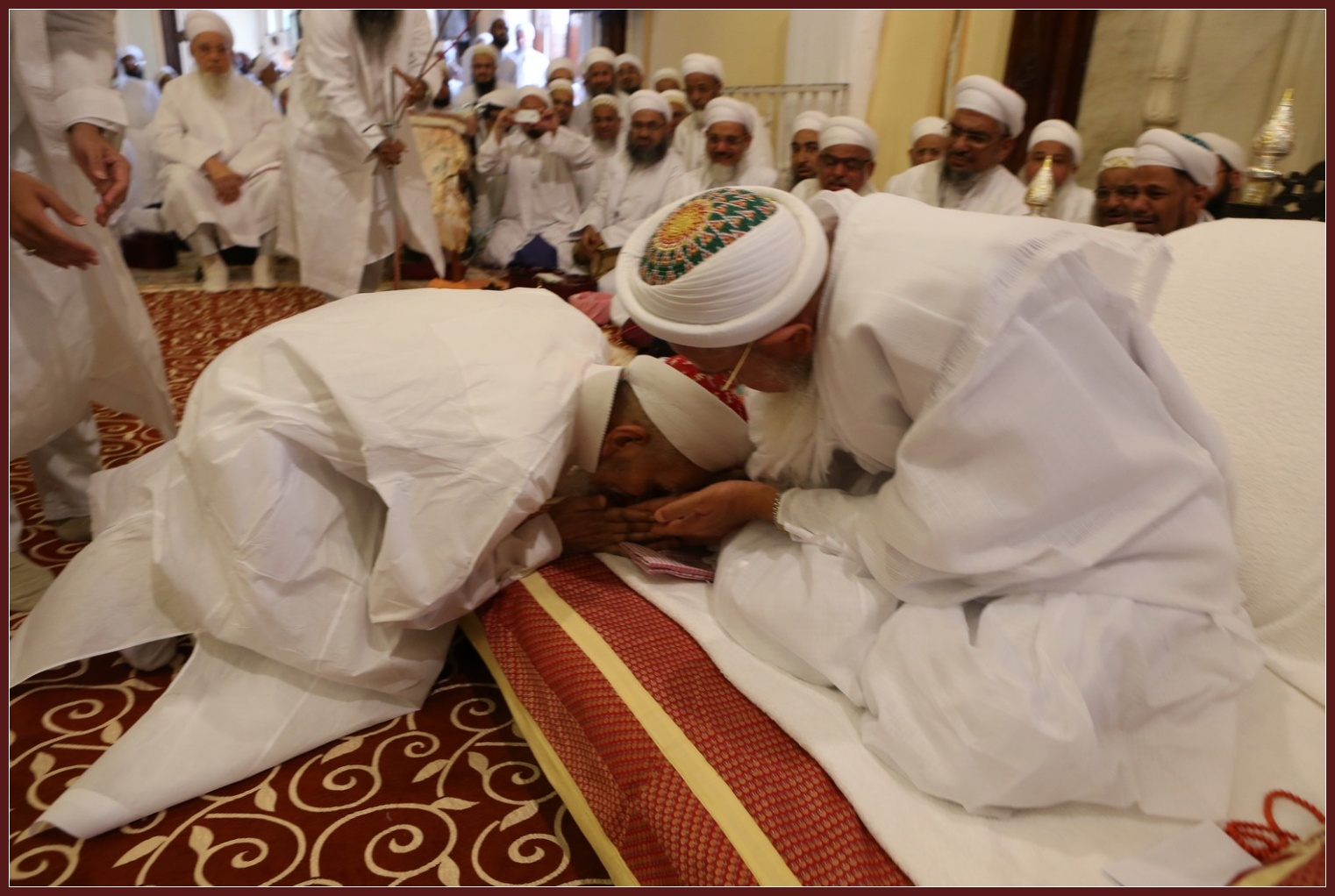
Syedna Mukasir Saheb doing wadhawa on Syedna Mufaddal TUS after Nas.

Syedi Mukasir Saheb doing wadhawa to Syedna Mufaddal TUS after Nass.

On Sunday, 25th Rabi al Awwal 1435, during the Sadaqallah Majlis of Syedna Mohammed Burhanuddin RA, Syedi Mukasir Saheb Husamuddin (despite his age and health), stood and did a bayaan in the hazrat of Syedna Mufaddal Saifuddin TUS:

  • He did shukr araz that had had the good fortune of serving 3 Dais, Syedna Taher Saifuddin RA, Syedna Mohammed Burhanuddin RA, and Syedna Mufaddal Saifuddin TUS.
  • He said the Syedna Mufaddal TUS was the mansoos of Syedna Mohammed Burhanuddin RA and the Nusoos (plural Nass) from the time of Ghadeer e Khum have reached him.
  • He then went on to say that he was Syedna Mufaddal Saifuddins TUS humble servant, and would remain in his khidmat till his last breath.
  • Syedi Mukasir Saheb then clarified the ikhlaas ni tasawwur saying “maraatib na maalik aap cho” (you are the owner of the maraatib (rutba) (of Dawat), and then recited an ayah of the Quran (Aale Imran:26) saying it is solely the Dais right to give and his to take.
  •  He ended by saying that the impostors that do inkaar  (reject) of the True Nass in reality have done inkaar  (rejected) of ALL the previous Nass, and are mustahiq (worthy) of la’nat.

Immediately after completing is bayaan, he gestured allegiance and kissed the ground before the feet of Syedna Mufaddal Saifuddin TUS and did salaam and qadambosi. At that moment, I couldn’t help but remember this quote of Imam Jafar al Sadiq AS:

When an Abd (servant – of Allah) performs Sajda, Iblees (the devil) screams, “This man obeyed, and I disobeyed, He performed the Sajda and I refused!”. (Kitab al Taharaat – Introdution).

Maybe Khuzaima should take advice and learn humility and obedience from Syedi Mukasir Saheb, he who has lived alongside Syedna Mohammed Burhanuddin RA for 99 years.

Syedni Mukasir Saheb doing bayaan on 25 Rabi Awwal 1435.

Syedi Mukasir Saheb doing bayaan on 25 Rabi Awwal 1435.

Syedni Mukasir Saheb doing salaam to Syedna Mufaddal Saifuddin on 25 Rabi Awwal 1435.

Syedi Mukasir Saheb doing salaam to Syedna Mufaddal Saifuddin on 25 Rabi Awwal 1435.


Reason #15: Nass-e-Jali 1432H, A rendering in English

On the 19th of Ramadhan al-Moazzam this event was chronicled in a mithaal shareef released by the administrative office of the Dawat – Al-Wazaratus Saifiyah – entitled‘Barakato Bayaan-e-Fadhlin Kabeer.’ In this document of some 40 pages is described the significance of nass, examples of nass conferral throughout history and some of the peerless virtues of Syedna Mufaddal Saifuddin (tus) that show him to be the rightful recipient of the nass of Syedna Mohammed Burhanuddin (tus).

Please read renditions of some of the articles of this document from these 2 links:

http://akhbar.mumineen.org/archive/deen/fatemi-dawat/nass-e-jali-1432h-a-rendering-in-english/

http://akhbar.mumineen.org/archive/fatemi-dawat/nass-e-jali-1432h-part-ii-raudat-tahera/

Reason # 14: Khuzaima as the Son of Syedna Taher Saifuddin RA

Many have pondered around the fact that Khuzaima was the son of Syedna Taher Saifuddin RA especially since he [Khuzaima] has exploited that relationship to express validity for his claims. However, the spiritual relationship between father and son far outweighs the same physical relationship. This fact is attested to by not only the Kutub of Da’wat but by the Qur’an itself. On his website, Khuzaima tries to use this relationship of spiritual father and son, both with Syedna Taher Saifuddin RA and Syedna Mohammed Burhanuddin RA, to prove that he is righteous in his claims as their successor. However, we must look at the wisdom left to us by Aqa Moula al-Hayy al-Muqaddas Syedna Mohammed Burhanuddin RA who clearly taught us the interpretation of many zikrs from the Qur’an. For instance, Aqa Moula RA often compared the era of Syedna Taher Saifuddin RA to that of Nabi Nuh SA in terms of its longevity. Among all the Mursaleen (messengers/prophets), Nuh Nabi had the longest era (dawr). Similarly, Syedna Taher Saifuddin RA’s era was fifty-three years long – the longest era on the ‘arsh of Da’wat for any previous Dai. Therefore, Moulana Mohammed Burhanuddin RA would say that –

Nuh Nabi was considered Shaykh ul Mursaleen and Syedna Taher Saifuddin RA was considered Shaykh ul Duat il Mutlaqeen

This comparison possibly further reminds us of the main zikr of Nuh Nabi’s era – that of his building of a safina (ark) of which its zikr appears in the Quran in Surat al-Hud (41-43). Khuda Taala says,

Surat al-Hud 41

Surat al-Hud 41

And [Nuh Nabi] said, “Embark in the safina; in the name of Allah is its course and its anchorage. Indeed, my Lord is Forgiving and Merciful.”

Surat al-Hud 42

Surat al-Hud 42

And it (the safina) sailed with them through waves like mountains, and Noah called to his son who had separated from them, “O my son, come aboard with us and be not with the disbelievers.

Surat al-Hud 43

Surat al-Hud 43

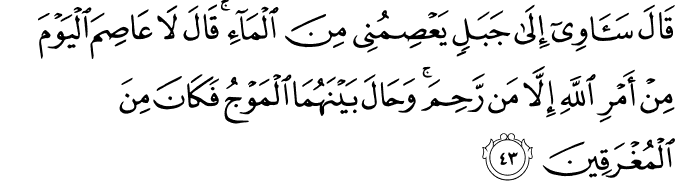
The son said, “I will take refuge on a mountain to protect me from the water.” Nuh said, “There is no protector today from the decree of Allah , except for whom He gives mercy.” And the waves came down between them, and he was among the drowned.

Surat al-Hud 44

Surat al-Hud 44

And it was said, “Oh earth, swallow your water, and oh sky, withhold [your rain].” And the water subsided, and the matter was completed, and the safina came to rest on the Mount Judee. And it was said, “may the unjust be made to go far away.”

Surat al-Hud 45

Surat al-Hud 45

And Nuh called upon his Lord and said, “My Lord, indeed my son is of my family; and indeed, Your promise is true; and You are the most just of judges!”

Surat al-Hud 46

Surat al-Hud 46

Khuda said, “Oh Nuh, indeed he is not of your family; indeed, he is one whose deeds are not righteous (‘amal ghayr salih), so do not ask me for that about which you have no knowledge. Indeed, I advise you, lest you be among the ignorant.”

What the Qur’an Majid teaches us here is that biological kinship becomes meaningless when the spiritual relationship between father and son is severed through disobedience.  Khuda Taala explicitly states in these abovementioned ayats that Nuh Nabi’s son is no longer his kin because of the deeds he has done, chiefly refusing to join Nuh in the safina and instead taking refuge on a mountain. Therefore, Khuzeima’s claims that he is the son of Moulana Taher Saifuddin RA are no longer relevant or valid according to Da’wat’s philosophy. He severed those ties many years ago as we all have come to learn. 

As for mumineen, we are greatly blessed that Taher Saifuddin RA  reminded us that he was the qaptan of Da’wat’s safina. Furthermore,  Aqa Moula Syedna Mohammed Burhanuddin RA also continuously reminded us that he was steering the safina of Da’wat and not to ever worry about the colossal waves that might try to rock it. He heeded us to rest assured because he was our qaptan and was steering us through this life. Today, the admiralship of Aqa Burhanuddin TUS’s safina is in the hands of his mansoos, Syedna Mufaddal Saifuddin TUS because Aqa Moula al-Hayy al-Muqaddas Syedna Mohammed Burhanuddin RA publicly and privately appointed him as his heir and the 53rd Dai, not once but several times. We shall all sit with a peace of mind in his safina with no worries for the present fitnat which hasn’t even rocked this vessel. We know that soon  all stormy waters will be clear. However, those who refused to climb aboard this safina, like Khuzaima, have deprived themselves of any real kinship with the qaptans and passengers of this glorious vessel. 

Reason #13: Humility Vs Self Centeredness

(Response to Khuzaimas Reference to “Firishta Karta Wadhi Gaya”)

It is appalling how Khuzaima misreads history. He uses the words which Syedna Hatim mentioned in favour of Syedna Ali b Mohammed that “arba ala l-mala’ika,” higher in station than the celestial angels.”, to underpin the status of a mazoon. However it was precisely because Syedna Ali b Mohammed, despitebeing mazoon, put forward the son of Dai al-Zaman as being more worthy of the rutba of mansoos. The reference to the zikr of firishta, (see Quran, Sura Al Baqara, Ayat 30-32) is that when Allah created Adam, they exhibited their hesitation to submit to Adam, hinting that Adam and his descendants would wreak havoc on earth and cause bloodshed and they would suffice in carrying out the ibadat of Allah, hence why was there a need to create Adam and humanity? The angels were mistaken on a number of points. They assumed that Allah did not know what Adam and his descendants would do, questioning the omniscient entity that is Allah. Secondly, by implication, they were more knowledgeable and more aware of what the future held for humanity. This was a direct contestation of Allah’s authority. Thirdly, they held a narcissistic view that somehow Allah required their ibadat and since they were fulfilling that function, there was no need to create others.

Syedna Ali b Mohammed RA held the complete opposite view. Instead of basking in self-adulation and being self-centered, he thought of himself as nothing but a humble servant of Syedna Hatim and that another individual, the son of a Dai was far more worthy of the rutba of mansoos. It was for this reason – his ability to pass over his own achievements and focus instead on the qualities of others – that Syedna Hatim RA said “firishta karta wadhi gaya”.

This individual has always been an example of hubris and vanity. In hardly any of his unintelligible discourses or in his actions, has he attributed anything to Syedna Mohammed Burhanuddin. On the other hand, Syedna Mufaddal Saifuddin has NEVER spoken about himself and instead the focus of his every thought, every sentence, every action, every bayaan, every waaz has been “Moulana Mohammed Burhanuddin”. Even now, when he is the undisputed 53rd Dai al Mutlaq, his every moment revolves round the zikr of Syedna Mohammed Burhanuddin. When Syedna Mufaddal Saifuddin recited Shahadat of Imam Hussain last Friday, it was within the context that “this is how Syedna Mohammed Burhanuddin recited the Shahadat of Imam Hussain”. The angels realised the error of their ways and repented, but here the claimant continues to be intoxicated with his own delusional claims to angelic virtue.

« Older Entries Recent Entries »