Reason # 46: Of Titles And Entitlement – ‘Al-Walad al-Ahab’

On the fatemidavat.com website Khuzaima Qutbuddin and his children allege:

“Syedna Burhanuddin: “my beloved son”—Prefacing Syedna Qutbuddin’s name, Syedna Burhanuddin said three times over, “my beloved son.” The term “son” has great significance in the Dawoodi Bohra Fatimi-Tayyibi theology, for it denotes the relationship between a Dai and his successor; in the same way as a father produces and raises his son to take his place in this world, so the Dai prepares his successor to take his place in the world of religion. The kitab the second Dai Syedna Ibrahim wrote for his successor is named ‘kanzul walad’ (A son’s [walad] treasure). Why else would Syedna Burhanuddin call his brother his son, and that too three times?”

In the claim above and in other instances, the Fatemi Davat website writers have repeatedly tried to portray that the bestowal of titles, honorifics and endearments on Khuzaima equate to nass being conferred on him. Such bestowals are not proof of such designation: only an attested nass with witnesses is. When nass is conferred, they may embellish the stature of the mansoos, as they would of any person receiving them. However, on their own they are not evidence of nass.

The Case of the Honorific: Al-Walad al-Ahab (The Beloved Son)

The Dai al-Zamaan is the spiritual father and mother of all Mumineen. Many a time we have heard Syedna Mohammed Burhanuddin RA refer to himself as our baawaa shafeeq. The term Waalid al-Jamee‘ (Father of All) was used to refer to Syedna Burhanuddin in speech and writing by all shahzadas, brothers and sons alike. In turn, he saw us as his spiritual children and has many times addressed us as such. His address of Ae mara pyara pyara farzando still resonates in our ears. It is therefore no surprise that the term al-Walad al-Ahab ‘beloved son’ be utilised by Doat Mutlaqeen RA to convey their affection for their prominent followers, especially those that hail from their own or previous royal houses. The Dai in their case is not only their spiritual father but also their pater familias (head of the household).

Syedna Mohammed Burhanuddin RA has addressed many amongst his Qasr Aali (Royal Family) and Bait Zainee as al-Walad al-Ahab. It was an expression of his affection and regard for the addressee, and was often used to refer to the individual in public, especially when he was the Amil Saheb of the city that Syedna was bidding farewell to, or during the course of a bayaan or wa’az. A number of sahebo are alive today who were the recipients of this honour rendered verbally. Those that have received it in writing via official correspondence are far more. It has been used for Syedna Burhanuddin’s brothers, shahzadahs, grandchildren, nephews and even more distant relations.
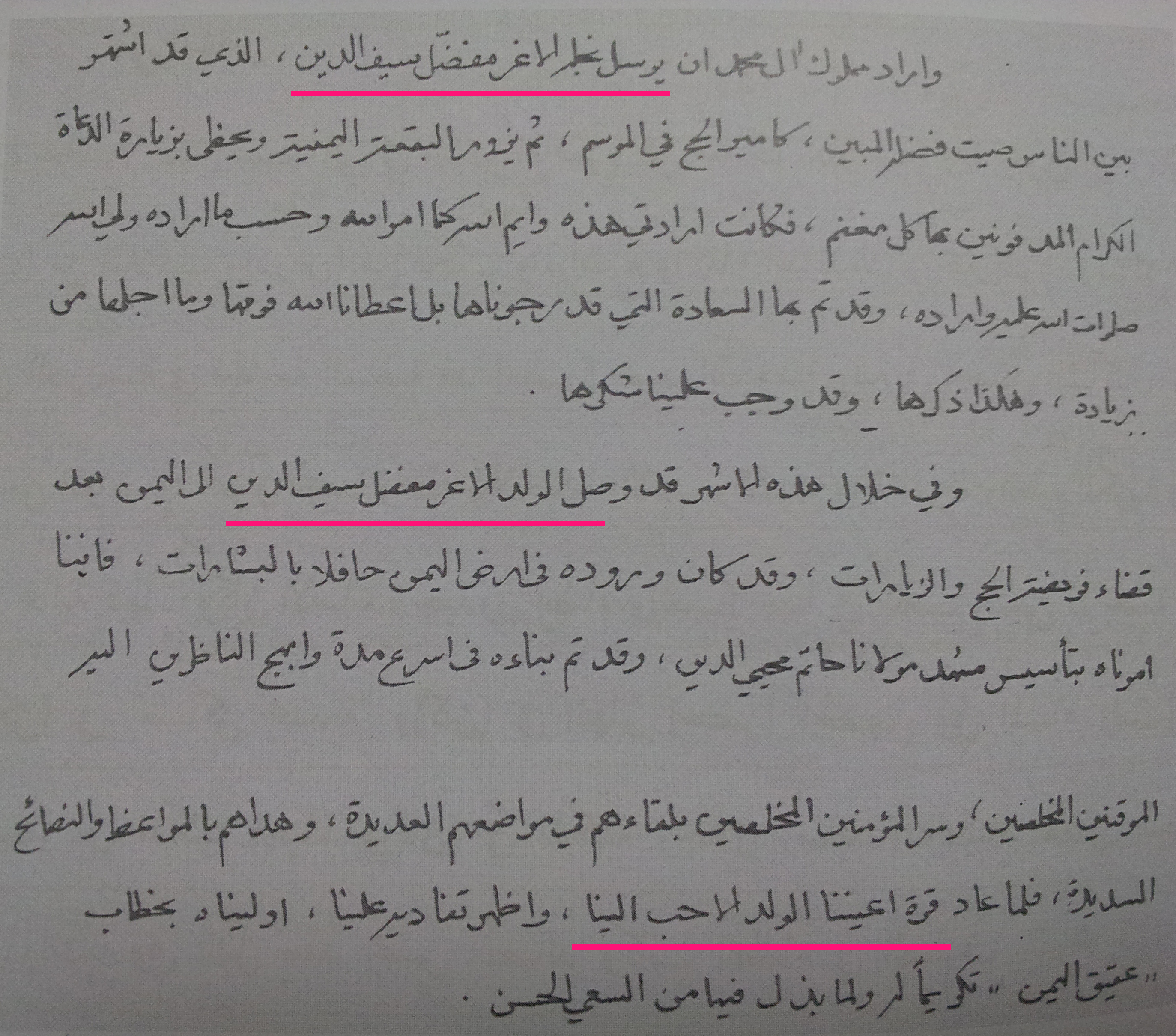
Syedna Burhanuddin referring to Syedna Mufaddal as al Walad al Ahab - Misal Shareef 1391H

Syedna Burhanuddin referring to Syedna Mufaddal as al Walad al Ahab – Misal Shareef 1391H

Their website makes much out of it being used for Khuzaima but it must be noted that he was born 26 years after Syedna Burhanuddin. Syedna was 53 when Khuzaima was appointed Mazoon at the age of 27. The address of al-Walad al-Ahab is testimony to Syedna’s affection for his much younger brother, treating him as a son, rather than just as a brother. There is much ado about the repetition of the honorific three times over. There could be a number of reasons for this repetition. Perhaps it was in deference to the rutba of Mazoon being conferred, or as a public display of affection. We can no way claim to know the reason with certainty, but neither can they. What is known with certainty is that if it was repeated even 30 times over it does not equal to conferment of nass.

Instead of alluding to the son having reached the standing of his father, as the website purports, the title al-Walad al-Ahab reminds the humble of the contrary; about the gap between the father and his son. The father or spiritual father in this case who is at the pinnacle of spiritual maturity and wishes that all under him continue to ascend towards the peak that he stands on. This meaning resonates with a narration from the epistles of Ikhwan al-Safa.

A sage was asked: Which of your children are most beloved to you? He replied: The youngest amongst them till he matures, and the ailing amongst them till he is cured, and the distant amongst them till he returns.


The narrative shows us that on the contrary, the most beloved amongst children are ones furthest from maturity or optimum circumstances. Khuzaima is not the first in history that has mistaken a display of love and concern for declaration of superiority or preference over peers. His argument mirrors one made by Zaid bin Imam Ali Zainulabedeen.

Zaid claimed that he was authorised to take up arms against the Omayyad Caliph, even when his noble brother Imam Mohammed al-Baqir warned him against doing so. When Zaid was questioned about why he did not heed the authority of his Imam, he feigned ignorance of the Imamate of Imam Baqir stating: “I find it hard to believe that my father would cool piping hot marrow before feeding it to me, but would not spare me from the heat of hell fire, which is what I would face if I would disobey the Imam of my time”. His questioner replied that there is historical precedence for this occurring because both Yaqub and Yousuf Nabi did not disclose the superiority of Yusuf Nabi over his siblings in fear of their jealousy for him leading to animosity. There is no denying though that Yaqub Nabi loved all his children and Yusuf Nabi his brothers.


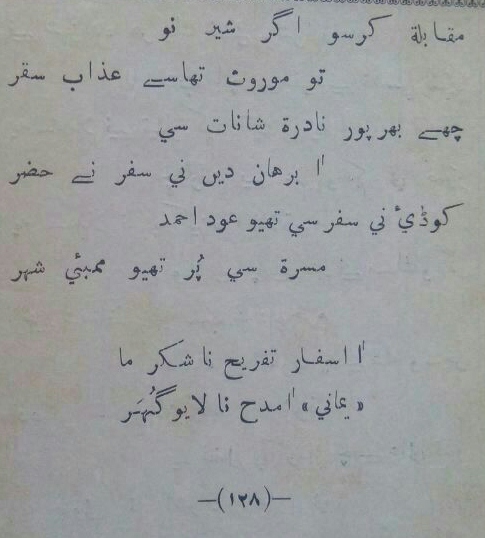
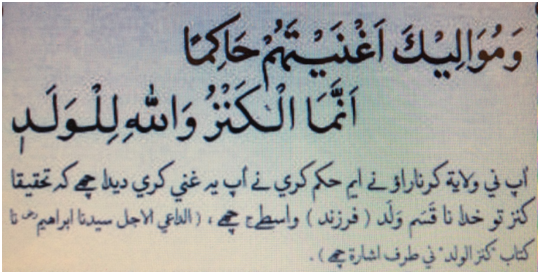
Furthermore, their text misleadingly plays on the words of this honorific as if it alludes to the illustrious book: Kanz al-Walad (The Son’s Treasure), and hints at Khuzaima being the recipient of its associated privilege. It is only a mansoos’s privilege to be privy to the secrets of this book, taught to him by his predecessor. However, does it seem appropriate that allusions to standings and privileges associated with this lofty book would be conveyed with the use of an honorific that is common to many in Syedna’s greater household? Reference to its privileges would not be expressed with an honorific, so commonly shared. A reference to it would be conveyed delicately and elegantly, reflecting the elegance and exclusivity of the book itself, befitting the privilege of the Dai’s Mansoos, Syedna Mufaddal Saifuddin TUS. Syedna Mohammed Burhanuddin states in his eid qaseedah shareefah 1432 H. (the year in which nass was publicly declared)

 Syedna Mohammed Burhanuddin RA addresses his Imam stating:
image

You have bestowed a bounty upon Mumineen by unequivocally declaring that the Kanz (Treasure) is indeed for the Walad (Son), and no other.

Therefore, it is obvious that love and endearment alone displayed by haq na sahib for anyone among his kin is not equal to appointment in rutba or superiority over others or preference. This was true then and it is true now. It is true for every title, honorific and endearment accorded to Khuzaima by Syedna Taher Saifuddin RA, Syedna Mohammed Burhanuddin RA and Syedna Mufaddal Saifuddin TUS. If he had stayed true to them, to the love, trust and responsibility they endowed him with, he would have merited the respect that such titles, honorifics and endearments accorded to him. Instead, in overreaching his bounds he has lost the virtue of all previous privileges.

It is my most sincerest wish and hope that the youngest and most ‘beloved’ son mature, be cured, and return.
Reason #45: Enemies Bear Witness

This post adds to the arguments put forward so far against the Fatemi-Davat website regarding its claim that nass can take place without witnesses (see Reason #2 below).

Benefitting from a narration found within Syedna Taher Saifuddin’s RA risaalah shareefah, Tazkerat Labeeb (1369 H), we see that even past enemies of Dawat, regardless of what attacks they leveled against nass being conferred, knew that nass could never take place without witnesses. In the arguments that follow within the narration, neither Syedna Abdulqadir Najmuddin RA (47th Dai Mutlaq), nor Syedna Mohammed Burhanuddin (49th Dai Mutlaq), nor Syedna Taher Saifuddin RA   allow any provision for nass taking place without witnesses. This post by no means seeks validation about the elements of nass from those alleging otherwise. Instead it aims to portray that witnesses to nass are such an integral element of nass, that not only did those who opposed its validity understand this and appreciate it, they based their entire case on the invalidity of certain appointments on this point.

Parts of Syedna Taher Saifuddin;s RA narration are summarised below.

Syedna Taher Saifuddin RA states:

I recount here what I have heard from my illustrious father Syedna Mohammed Burhanuddin RA:

Syedna Burhanuddin RA narrates that his esteemed father Syedna Najmuddin RA (47th Dai Mutlaq), at the instigation of Munafeqeen was addressed a letter which said: “Every claimant must prove his claim by bringing forth witnesses to such in the form of two honest and just individuals. Would you name two witnesses that would testify to Syedna Mohammed Badruddin RA having conferred nass upon you.”

Syedna Najmuddin RA graciously replied to this letter providing the names of two such witnesses. Subsequently, and much to the chagrin of Munafeqeen, his honoured son, Syedna Mohammed Burhanuddin RA read out aloud the contents of Syedna Najmuddin’s reply in his wa’az mubarak.


The enemies of Dawat concentrated their efforts on what they felt would be the most important pivot regarding the validity of nass: WITNESSES. Contrary to what the fatemidavat.com website purports, there cannot be, nor has there ever been, a nass without the same.

Reason #44: Flawed Conclusion- A Lawyer’s perspective

(A Lawyer’s perspective)

I read with interest, the newspaper article in Hindustan Times where former Chief Justice of India, Justice Ahmadi states that he believes that Khuzaima Qutbuddin’s claim of 53 dai is principled. According to Mr. Ahmadi, he himself has examined some historical documents in which historical facts about the community and the events since the nass (choosing the successor) conferred by Syedna Burhanuddin on Syedna Qutbuddin in 1965 have been recorded“.

Based on his examination he concluded that Khuzaima Qutbuddin’s stand of 53rd Dai is principled. Mr. Ahmadi while drawing his conclusion has overlooked some of the very basic principles of laws which I list below.

The analysis below is from logical and legal standpoint. Out of fairness, I find it right to state that I have not seen historical documents shared by Khuzaima Qutbuddin to Mr. Ahmadi.

1.         Audi alteram partem (Latin phrase)

It means “hear the other side too”, or “hear the alternative party too”. “Audi alteram partem” is the basic principle of  justice or equity. The principle includes the rights of a party to have a fair opportunity to challenge the evidence presented by the other party, to summon one’s own witnesses and to present evidence.

It is apparent from the language of the news article that Mr. Ahmadi has not attempted to share the historical documents with the representatives of Mufaddal Moula TUS and sought their response on the same. It is a common wisdom in law that no opinion should be formed without having the response from the other party.

Moreover, the so called historical documents which is examined by Mr. Ahmadi is not even the evidence of nass. It is (in his own words) “historical facts about the community and the events since the nass” (emphasis added on the underlined words). In any case it is common knowledge now that there is no evidence or witness to so called nass on Khuzaima Qutbuddin as it is done in private as claimed by him.

2.         Testimony of Eye Witness

I cannot emphasise enough the importance of eyewitness in the law, particularly in Sharia. More so, when number of eyewitnesses are testifying the same thing, the authenticity of the same is beyond any doubt. There were at least 5 male witness (3 Shahzada Sahebs, Dr. Moiz Bhaisaheb and his son Abdul Qader Bhaisaheb). Even the highest burden of proof is satisfied if 5 male witness testify the same thing which they have witnessed with their eyes and heard from their ears.

Mr. Ahmadi while drawing his conclusion has clearly undermined the testimony of each and every Shahzada Saheb, Dr. Moiz Bhaisaheb and his son Abdul Qader Bhaisaheb who was present in the London Hospital while Burhanuddin Moula R.A. conferred nass upon Mufaddal Moula TUS.  All of them have unequivocally testified that Burhanuddin Moula RA. had in their presence conferred nass on Mufaddal Moula TUS which they heard very clearly.

Moreover, it seems that Mr. Ahmadi also have a reason to believe that Shahzada Qaid Johar Bhaisaheb and Shahzada  Malik ul ashtar Bhaisaheb is not telling the truth when they also affirm that Burhanuddin Moula RA. has done nass on Mufaddal Moula TUS few years back and kept them shahid (witness) to the Nass specifically advising to keep the nass secret.

3.         Documentary Evidence:

The events of the nass are recorded on three folios carefully protected and conserved, written by Miyasaheb Shaikh Ibrahim al-Yamani. At the end, Burhanuddin Moula RA has himself signed the folio attesting what is written is true and accurate.

Mr. Ahmadi while drawing his conclusion has certainly overlooked this documentary evidence or believed that this documentary evidence is fraudulent (as claimed by Khuzaima Qutbuddin).   The authenticity and genuineness of this document can be very easily confirmed beyond any doubt by the use of technology.

It baffles the mind, how Mr. Ahmadi, who is a former chief justice of India, can overlook these vital principles of law in forming his conclusion. Moreover, the conclusion formed by him is based on historical documents containing historical facts about the community and the events since the nass (note that there is no evidence of nass on Khuzaima Qutbuddin as it is done in private as claimed by him). On the basis of these so called historical documents and to the exclusion of clear affirmative evidences and disregarding some of the basic principles of equity and justice, Mr. Ahmadi has formed his flawed opinion.

All of the above together with other evidence points only in one direction i.e., Burhanuddin Moula RA has appointed Mufaddal Moula TUS as his mansoos and the 53rd Dai.

Reason #43: MiyaSaheb Shk Ibrahim Yamani’s Madeh

The website claims:

Shaikh Ebrahim Yamani is one of the witnesses/shahids listed on the letter. All through his life, his words and actions show his knowledge of Syedna Burhanuddin’s nass on Syedna Qutbuddin, not on someone else. Both before 1388 and after, he gave extra reverence to Syedna Qutbuddin, even expressing to him his anticipation of Syedna Qutbuddin’s Dai-ship. Why would he do so if he had secret knowledge of a different nass? Moreover, he wrote many publicly recited madehs for Syedna Qutbuddin, in one of which he says, for e.g., “tamay dawat ni raha na qutub chho” normally said only of the Dai.

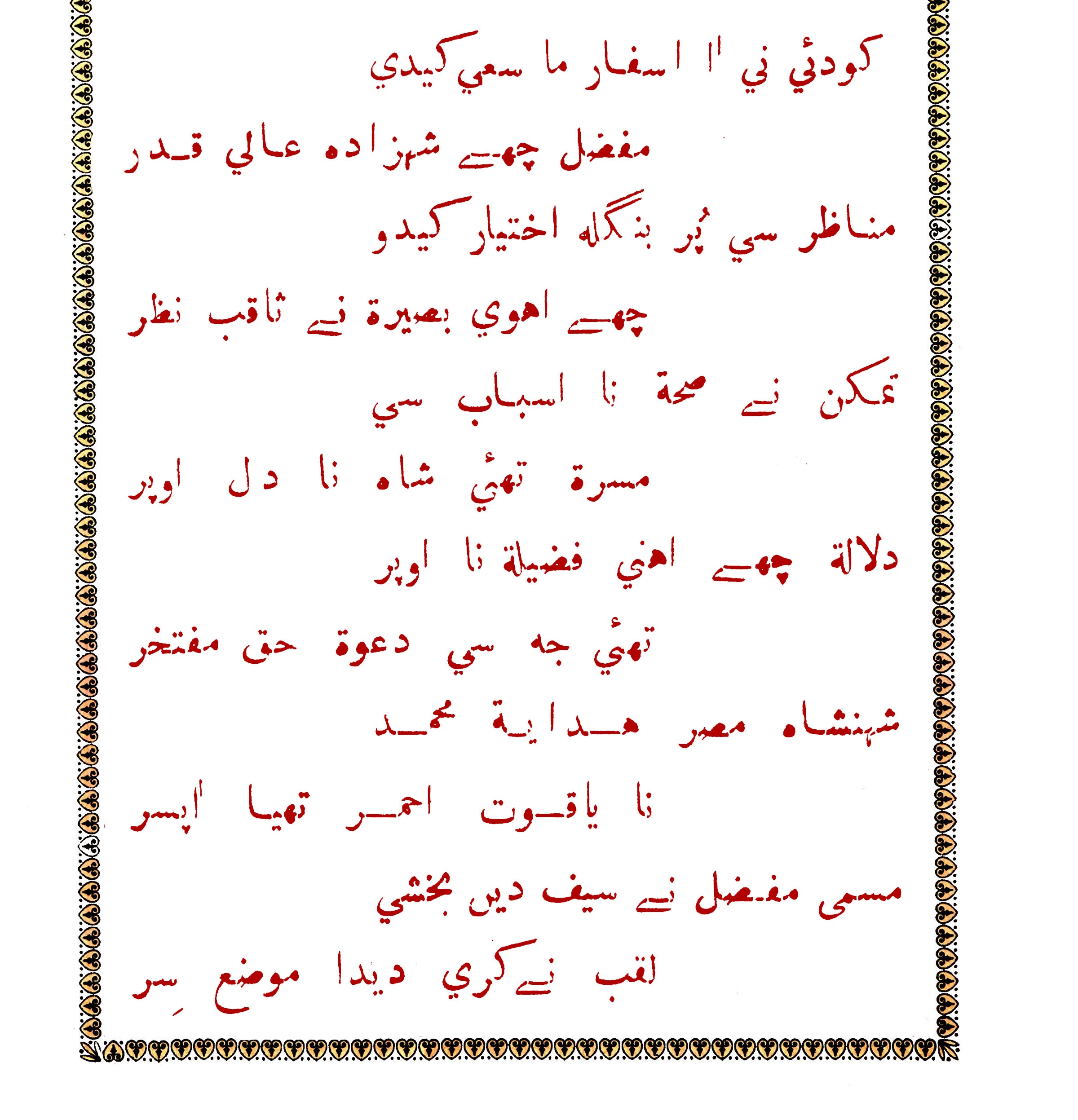
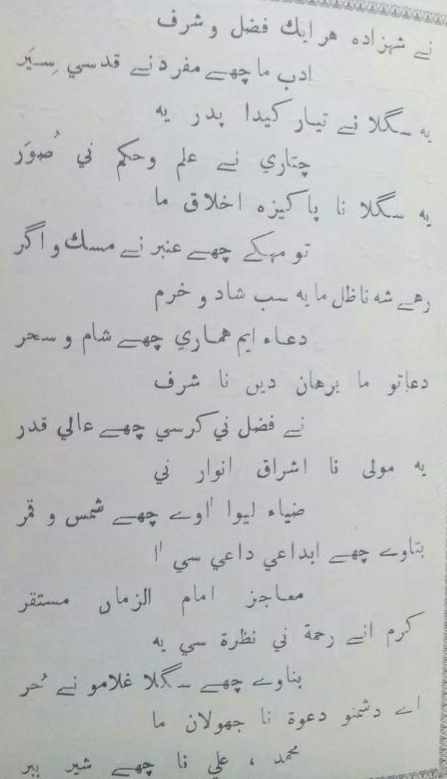
Since Khuzaima is trying to justify his false claim about Miyasaheb Shk Ibrahim Yamanis madeh in his praise, it seems only fitting to post a madeh by the same author, in which he refers to the eminence of Syedna Mufaddal Saifuddin TUS during the Kodaikanal trip of 1393H (approximately five years after Miyasaheb was informed about the nass).

1

2

3

Miyasaheb speaks of the endeavours of Syedna Mufaddal SaifuddinTUS during this trip and refers to his ‘baseerat’ and his discerning vision (2nd verse). His khidmat is evidence of his ‘fazilat’ which is a source of pride for Dawat ul Haq (4th verse). He describes Syedna Mohammed BurhanuddinRA as the king of Misr and its red ruby yaqut e ahmar as his son (5th verse). The expression ‘red ruby’ is synonymous with the maqam of Mansoos, as evidenced by Syedna Taher Saifuddin’s RA bayaan mubarak. He spoke of the challenges of facing rebellion and dissent within Dawat, but despite these trials, Allah enabled him to prepare his son and Mansoos ‘Mohammed’;

aa misal, Mohammed ni misal Yaqoote Ahmar (red ruby) tayaar keeda

There are numerous instances where Duat have been referred to as Yaqoote Ahmar. Syedna Tayyib ZainuddinRA has been referred to as the red ruby from the progeny of Syedi Hassanji BadshahQA, as well as Syedna Noor Mohammed NuruddinRA as the yaqoote ahmer from the family of Moulaya RajQA (Hadiqat ul Tarikh 1369H). Hence, Miysaheb Yamani’s description of Syedna Mufaddal Saifuddin TUS is a evident hint to the position he was destined to inherit.

Furthermore, he indicates that Syedna Mufaddal Saifuddin’s TUS laqab mubarak (Saifuddin) is by design and holds a hidden meaning within (6th verse). This meaning has become clear since the revelation of the 1388H nass as recorded by the aforementioned author in which Syedna Mohammed BurhanuddinRA distinctly divulged to the three witnesses that he had given the title of ‘Saifuddin’ to his mansoos, in remembrance of his father Syedna Taher SaifuddinRA.

Miyasaheb Yamani also describes him as mufrad, which means ‘unique’ (7th verse). More specifically, it means unique without any parallel. In other words, he is unique in that he had the distinct privilege of being Mansoos with no other parallel.

He then goes onto praise Syedna Mohammed BurhanuddinRA and refers to his throne of ‘fazal’ and ‘sharaf’ as ‘aali qadr’ amongst the Duat (11th verse). The immediate meaning is that this chair of fazal and sharaf is of a majestic significance. However, a closer inspection of the verse reveals the double meaning intended for the discerning reader. Mufaddal is a derivative of fazal and ‘aali qadr’ is also the name bestowed upon Syedna Mufaddal Saifuddin TUS by his grandfather.

Syedna Aali Qadr Mufaddal SaifuddinTUS would one day inherit the throne of Dawat and Duat and by doing so, his future ascension to this office would be testimony to the shaan of his predecessor Syedna Mohammed Burhanuddin.

These verses stem from Miyasaheb Yamani’s knowledge of the eventual rutba that would be acquired by Syedna Mufaddal SaifuddinTUS. When viewed in the context of both the Nass e Khafi and Nass e Jali on Syedna Mufaddal SaifuddinTUS, we understand the significance of what Miyasaheb has expressed. In his own way, Miyasaheb Yamani was intimating that Syedna Mufaddal Saifuddin was Syedna Mohammed Burhanuddin’s mansoos.

However, Khuzaima’s claim to the rutba of Dai cannot be based on the madeh of Miyasaheb Shk Ibrahim Yamani. He claims that verses intended for him were composed after 1388H and therefore the 1388H nass did not occur, as Miyasaheb Yamani would not have praised Khuzaima in the way that he did. This argument presupposes that these verses for Khuzaima somehow indicate that he was mansoos. By any logic, this is a fallacious argument.

Shaikh Ebrahim Yamani is one of the witnesses/shahids listed on the letter. All through his life, his words and actions show his knowledge of Syedna Burhanuddin’s nass on Syedna Qutbuddin, not on someone else. Both before 1388 and after, he gave extra reverence to Syedna Qutbuddin, even expressing to him his anticipation of Syedna Qutbuddin’s Dai-ship. Why would he do so if he had secret knowledge of a different nass? Moreover, he wrote many publicly recited madehs for Syedna Qutbuddin, in one of which he says, for e.g., “tamay dawat ni raha [millstone] na Qutub[pivot] chho” normally said only of the Dai. (From the website)

On the contrary, Syedna Taher Saifuddin RA refers to Syedna Qutbuddin Shaheed RA, as “the pivot of all pivots” (in his marsiyah shareefah Ya Qutba Deenillahe). This indicates that there were positions and individuals within Dawat who did have pivotal roles to play. However, it is the Dai who is the pivot of all pivots, around whose existence all of Dawat revolves. This verse therefore does not mean Miyasaheb Yamani afforded ‘extra reverence’ to Khuzaima. If he did, it was by virtue of the office he was assigned to by Dai al-Zaman. It is merely a literary extrapolation of his laqab (Qutbuddin) – quite distinct from the ‘hidden meaning’ inherent in Syedna Mufaddal Saifuddin’s laqab shareef. This one line of verse does not and cannot equate to nass.

Khuzaima also claims that the supposed Nass’ on him was done in secret (Nass e Khafi), how then would Sh Ibrahim Yamani know of this alleged Nass to mention it in his literature? In actual fact, if he is insistent that Miyasaheb Yamani intended something other than what is apparent in praising Khuzaima, then he should offer far greater weight and importance to what Miyasaheb has recorded in his own hand regarding the nass of 1388H. It is hypocritical to give preference and weight to one work of an author and completely dismiss his clear documentation of a very significant event as a forgery. One can’t pick and choose facts. 

Reason # 42: Where was the Hero And Champion In This Critical Time?

… it was the year 466/467H. The era of the 18th Imam Mustansir Billah AS. A dark shadow was cast upon the Fatimi dynasty. It was under the constant threat of corrupted viziers misusing their powers for their own political gain. Unable to fulfill their insatiable appetites, food stocks depleted and people suffered. Cairo was on the brink of a civil war. A man named Baladkawsh (a Turkish warlord) took siege of the city. No one was allowed to enter or leave Cairo.

In this critical time, Imam Mustansir AS called out to his most trusted Ameer al Juyush (leader of the armies), Syedna Badr al Jamali RA, and summoned him to Cairo at once.

On receiving this news, Syedna Badr al Jamali gathered his armies, horses, weapons, and warships and set out from Armenia (Rūm) to Cairo. The seas were rough and treacherous. No man besides himself would dare to sail upon them, but he was driven by his khaalis niyyat and seeking the ta‘at of the Imam, in the name of Dawat. He reached Cairo and took control of the city within one night and power was restored. He reached the hazrat of the Imam and was blessed with his deedar, and was given the title of “Saif al Islam” (the sword of Islam). 

(Uyun al Akhbar, Vol 7: Syedna Idris Imaad al Din RA)

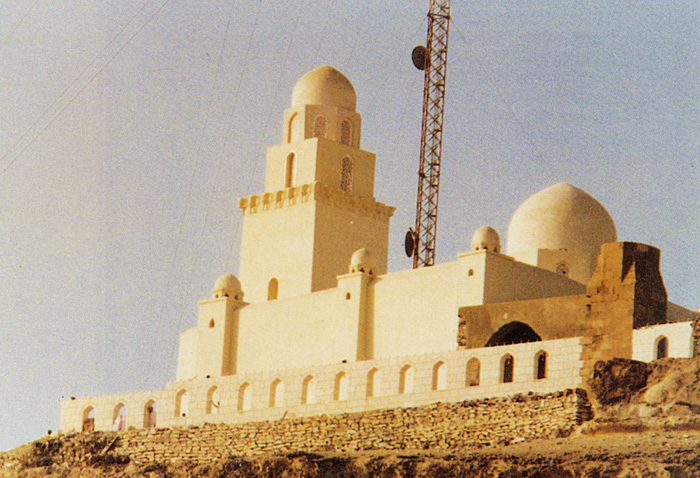
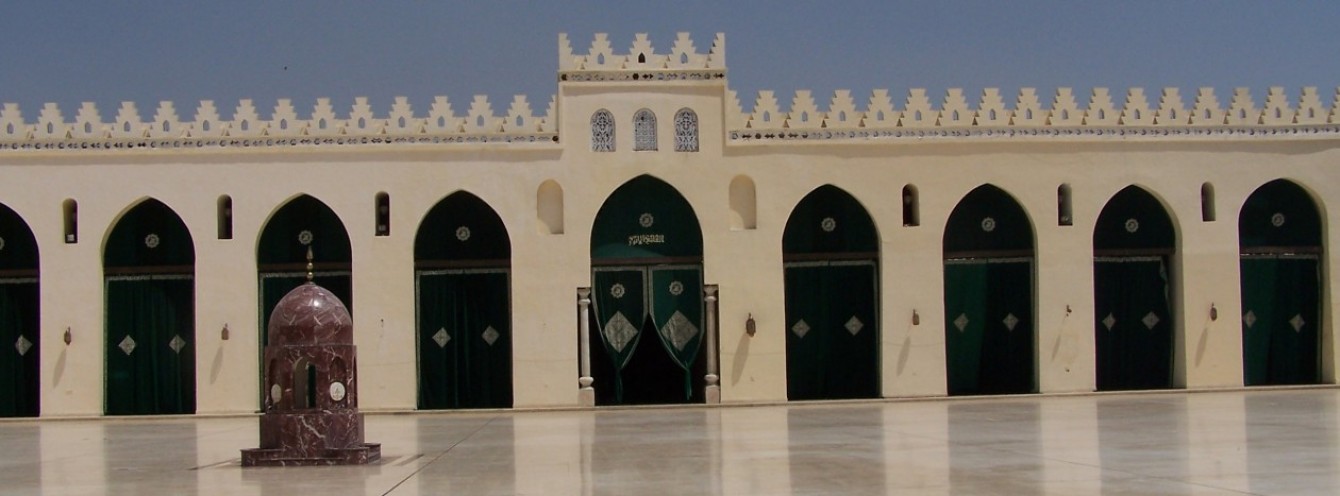
Al Jame' al Juyushi, Cairo; built by Syedna Badr al Jamali. Later restored by Syedna Mohammed Burhanuddin RA.

Al Jame’ al Juyushi, Cairo; built by Syedna Badr al Jamali. Later restored by Syedna Mohammed Burhanuddin RA.

The anecdotal reference above can be understood again in the year 1432 H. This is the year when Khuzaima and his website allege that the Dawat and the office of Syedna Mohammed Burhanuddin RA was ‘under siege’ by his Shehzadas, whom were taking advantage of Syedna Burhanuddin’s ill health to manipulate the office of their father, the Dai, for their own political gain. They claim that Syedna was being put to traumatic experiences, was forced to do things and attend functions against his own will.

Let us reflect back to history of the Fatemi dynasty mentioned above since it seems that a direct comparison can be made. When Moulana Badrul Jamali saw that Haqq na Sahib appeared to need madad, he rose to the occasion and provided him with his full capacity. He travelled from across the medieval Muslim world with his fleets and armies to aid Imam Mustansir SA. If Khuzaima was indeed the Mansoos of Syedna Mohammed Burhanuddin RA and his ‘most beloved;’ if he was his alleged “second in command;”then why didn’t he rush to the to the aid of Dawat and the Dai at such a crucial moment?

Moulana Badrul Jamali’s RA’s actions are not one isolated event in Da’wat. If you look at the entire history of Da’wat this is the right course of action for any Mu’min, especially for one claiming to be the future haq na saheb. Let us reflect back on the true source of knowledge for our beliefs, Aqa Moula Mohammed Burhanuddin RA. When we look at the battle of Khandaq we remember his words – Moula RA use to say that ‘when ‘Amr b. Abde Wad was able to jump and cross the khandaq and all seemed very dark, during this ‘critical time’ it was only Ameerul Mumineen SA who came to Rasullullah’s aid. The ‘others’ stood idle and mocked Rasullullah SAW saying, “he is sending us to go for battle while staying back himself!”

Self-determination, selflessness, and bravery are all attributes of true madad. It is obligatory on every Mumin in mithaq, “tame Imam ane Imam na Dai ne yaari deso. Tame Imam ane Imam na Dai ne tark yaari to nehi karo.” If Khuzaima indeed saw that Aqa Moula Syedna Mohammed Burhanuddin RA was in peril and being harmed by his children for three years, wasn’t it incumbent on him to come to his Moula’s RA aid and yaari. Why such tark yaari on his part? Why scheme in the background? Why didn’t he ‘sail the treacherous seas’ just as Syedna Badr al Jamali did for the protection of Dawat and the Dai? Why wasn’t he there for Moula in his time of need in this so-called ‘critical time’? Why didn’t he exercise his political clout and use the media (which he is trying to do at the moment) for the Dawat and his Moula? The answer is unfortunately obvious.

Similarly, why did he run-away from Raudat Tahera before Syedna Mohammed Burhanuddin RA arrived, when he knew that Syedna had suffered a stroke and was weak? Why did he spend most of the last three years away from Moula RA?

In the battle of Uhud, when everyone left Rasulullah SAW alone, it was Moulana Ali AS that was there to help and protect him. Rasulullah SAW did dua for Moulana Ali AS:

“Oh Allah, help he who helps Ali, and (do not) help he who doesn’t help him.”

Similarly Ameerul -Mumineen Ali SA has famously said,

ان الفتى من يقول ها انا ذا ❊ ليس الفتى من يقول كان ابي

A true brave youth is one who says ‘this is me.’ On the contrary, he is not one who says ‘this is who my father was.’ 

It is evident to us that Khuzaima was never there, and never really cared for Syedna Mohammed Burhanuddin RA during his lifetime, especially during his final years when a true successor would have done everything in his power to do so. If he truly cared for Syedna al-Hayy al Muqaddas in the ways he mentioned, he would have fought to protect the Dawat from the ‘siege’ and sacrificed his life for his Dai. It is obvious that Khuzaima Qutbuddin was too busy planning his fitnat. Again we must also re-emphasize here how he didn’t participate in the  janaza, again contrary to the seerat of Ameerul Mumineen.

In conclusion, it is obvious that Khuzaimas claims about Moula RA are false and the Dawat was not under any such seige. Moula RA was being surrounded by his true Mansoos and those who loved and cared for him the most. 

Syedna Mufaddal Saifuddin TUS is the true “Badr al Jamali”. HE is the “Saif al Islam”.

Reason #41: Regarding The Mutation Of The Misaaq And Deviation From Haqq

An Anonymous Source

Clever and cunning…two words often used to describe Mua’wiya and his close aide and confidante Amr bin al Aas. Cleverness and cunningness- two words never used to describe how righteousness has been proven in the past. Haq na sahib is divinely assisted and armed with burhan (proof) which slashes deceit like a sword and vanquishes persisting doubts.

The following allegations which mask some deceitful and malicious thoughts need to be analyzed and read critically to comprehend the hidden agenda which seeks to corrupt our most basic tenets and doctrines.

The FatemiDawat site says in regard to the misaaq:

“Mutation of Misaaq and Shari’at to suit personal agenda

Misaaq. Most important point: Very soon after Sh Qaid Joher bhaisaheb announced “Nass” on Shz Mufaddal bhaisaheb, Shz Mufaddal bhaisaheb had his own name inserted into the misaaq following the name of the Dai, adding to and modifying the misaaq text. The misaaq text is inviolable and cannot be tampered with under any circumstances. One who violates this trust cannot be haqq-na-saheb.”

A close reading of the above text unveils the following claims:

1.  Shehzada Quaid Johar BS announced Nass.

2. Shehzada Mufaddal BS inserted his own name into the Misaaq following the name of the Dai.

3. This amounts to adding to and modifying the misaaq text.

4. The Misaaq Text is inviolable and cannot be tampered with under any circumstances.

5. One who violates this trust cannot be haqq-na-saheb.

******

1.

A web spun with threads of deceit isn’t hard to unravel. Since the intention is to clarify matters related to the Misaaq and not the announcement of nass (which anyhow doesn’t need any more clarification although it was previously claimed that the announcement was done by Dr. Moiz BS); let us proceed to the second claim. It is alleged that Syedna Mufaddal Saifuddin inserted his own name into the Misaaq.

2.

A specific ibarat (text) was sent by Syedna Mohammed Burhanuddin’s Vazarat (office) which functioned under His direction with His permission and blessings containing the proper text to be recited following Syedna Burhanuddin’s name containing the Mansoos’s name in the Misaaq. Any claim to the contrary should be backed with proof since the allegation is very grave and is tantamount to saying that every namaz and religious matter, rite and custom conducted in the last few years was without Syedna Mohammed Burhanuddin’s RA Raza Mubarak and thus invalid. Questioning and doubting the validity of the actions of the al Dai al Mutlaq and the affairs of His Vazarat should not be a mumin’s concern.

3.

The third and fourth claims imply that the Misaaq text literally is as sacred as the Qur’an. It is inviolable and any kind of tampering with the original text would be considered to be a violation of haqq. The fifth claim is very comprehensive and says that anyone (that includes the al Dai al Mutlaq) who violates this trust cannot be haqq na sahib.

First of all it should be understood that the Misaaq is for the Haqq na Sahib of the age and after his appointment and open declaration of his successor, for both Naas (appointer) and His (appointee) Mansoos. Rasulullah’s actions related to Nass on 18th of Zilhajja and the Misaaq taken afterwards and oath of allegiance administered over a period of three consecutive days would otherwise be meaningless if it’s only purpose was to reaffirm public loyalty to the Nabi S.A. The Misaaq was as much for the Wasi as for the Nabi. It has been the practice (which all who take our history ‘zahir’ books seriously know very well) of many Duat Mutlaqeen RA to take a verbal oath and pledge of loyalty and obedience for the Mansoos at the time of Nass from all those present. This is later endorsed in the public Misaaq.

The Misaaq as argued earlier has never been on behalf of the Mazoon and Mukasir. If at the time of recital of the Misaaq text, either or both positions are empty (which might occur and has happened a number of times in the past), no names are taken. The physical presence or absence of appointees to the rank of Mazoon and Mukasir has no bearing on the validity of the Misaaq as will be ascertained by anyone versed in our doctrines and theology. In the recent past, this was the case when Misaaq was administered in the interim period after the demise of the Mukasir, Syedi Saleh Bhaisaheb Safiuddin and before the public appointment of Syedi Husain Bhaisaheb Husamuddin to the same rank.

The declaration that “Shz Mufaddal bhaisaheb had his own name inserted into the misaaq” implies some kind of wrongdoing and mischief making which is absolutely incorrect. According to our tenets and beliefs we only give Misaaq to the Imam and His representative the al Dai al Mutlaq. The Dai and His successor although two separate persons, in theological belief are united by the same office that one occupies and the other submits to through complete ikhlas, piety, devotion and selfless service; both appearing as one light to the eye of the discerning beholder. This is not true for all those who occupy the lesser ranks of Mazoon and Mukasir. As is evident in our times the current Mukasir Syedi Husain Bhaisaheb Husamuddin stands steadfast in His devotion and loyalty to the Mansoos Maula while the Mazoon has deviated from his vows. In this case; if the claim that the Misaaq is for all three maratib is allowed…how can a person be loyal to two opposing sides?

Since our tenets and doctrines establish without doubt that Misaaq is an oath of allegiance taken on behalf of the Dai and His Mansoos (when declared publicly) it stands to reason that their names would be included in the text. Syedna Mohammed Burhanuddin’s RA Amal Mubarak in including the name of His Mansoos served to illuminate the past actions of Du’at Mutlaqeen and exposed the hypocrisy of some who refused to give Misaaq since they doubted that the actions of Syedna Burhanuddin RA had been divinely inspired by ilham.

4.

The Misaaq has undergone some variations since it was first institutionalized. Syedna Taher Saifuddin RA himself has mentioned that various forms of Misaaq text were extant during His time. Some were in Arabic from the time of the Fatemid Empire before the seclusion period. Others belonged to the Yemen period and later on in India there were a number of translations from the various Arabic forms. There was some resemblance in the meaning but expressions used were different. It is apparent that the meaning and spirit of the Misaaq has never changed although it might be administered in any language with the permission of the haqq na sahib on whose behalf it admits the faithful to the Dawat. Quite unlike the Qur’an which might not be translated or modified in any way.

Our traditions hold that Maulatuna Hurratul Maleka RA appointed Syedna Zoeb RA as per the instructions of Imam Aamir AS and the Misaaq has been administered for the Dai representing the Imam from that era onwards. The Dai has absolute authority during the seclusion period including the administration of the Misaaq, admittance and exclusion of whomsoever He might choose from the fold of Dawat. Thinking that examples from the past actions of earlier Duat Mutlaqeen have not been recorded in writing and thus cannot be produced as evidence, the present claimant in his hatred and animosity towards the larger than life proof of the Imam, Syedna Mohammed Burhanuddin RA himself; has unveiled his own duplicity. By insinuating that even Syedna Mohammed Burhanuddin RA couldn’t add the name of His Mansoos in the Misaaq; the ex-Mazoon has crossed his limits because he is now claiming that he knows the limitations of al Dai al Mutlaq i.e what exactly a Dai can or cannot do.

Reason #40: The Lack of Understanding

(Submitted via email)

Syedi Abdeali Imaduddin QR has taught us, je kahe ya kare, Haqq che saraasar. Whatever Moula says or does, is unquestionably and unequivocally Haqq (true and right). Even our littlest madrasah-going children understand this. Khuzaima and his children do not.

Syedna Mu’ayyad al-Shirazi’s RA qaseedah mubarakah, ‘Ya Sabah al-Khamees Ahlan wa Sahlan’ is recited regularly in Dawat majaalis and oft-quoted by Syedna Burhanuddin RA during his wa’az mubarak.  In one such bayaan mubarak, Syenda Burhanuddin RA explains a particular bayt from the qaseedah:

 Abd Abd

Now, he illustrates his own merit and stature. Syedna Mu’ayyad describes his own self, “Who am I, this is Moula, and who am I?”

انا رضوانُ عَبدُ عَبدِ معدٍّ    *    لستُ عن طاعتي له اتخلا

[He says] that, “I am Ridwaan”, which is the name of Jannat’s keeper and guardian. Ridwaan is an angel. “I am Ridwaan, I am “‘abdo ‘abde Ma’ad”. I am the servant of the servant of my Moula Ma’ad (Imam Mu’izz). [Which means] I am the servant of His son, the Wali al-´Ahd (mansoos and Crown Prince). After him, I am in the next rutbah [in the hierarchy of Dawat]. Lasto ‘an ta’atee lahu atakhalla. My obedience is for my Imam; a day will never come in which I will be absent of this obedience. Before him, I will always bow my head. (Moharram al-Haraam, 1420H/2000)

This is the definition and reading of the bayt as established by Syedna Burhanuddin RA. However, Bazat Tahera (BT), daughter of Khuzaima, blatantly disregards this understanding in her 2005 publication regarding the poetry of Syedna Mu’ayyad al-Shirazi RA.  With reference to this bayt, she says:

I have read the second ´ – b- d (ع ب د) as ‘ubd (عُبد) in the plural (cf. Lane), meaning the best servant, or the most lowly servant… for I could not understand the meaning of the sentence when reading this word as ‘abd (sing., “servant”), which is the reading in the Tayyibi oral tradition.

BT acknowledges that the Tayyibi oral tradition, the tradition of the Doat Mutlaqeen RA, Syedna Taher Saifuddin RA included, reads the verse in a particular manner, yet she defies it opting to use her own logic and understanding instead. In this very publication, she describes Burhanuddin Moula RA as “a living exponent of poetry in al-Muayyad’s Fatimid da’wa tradition” (p. 330). Would he not, in your own words then, be in a better position to explain the meanings of Syedna Mu’ayyad’s RA verse? This publication went into print after Syedna Burhanuddin’s RA above bayaan in which he explicitly defines the verse and explains the meaning, leaving no room for misunderstanding. What was it that she was unable to understand then?

Unfortunately, this is not her only transgression on the maqaam of the Dai al-Mutlaq in this publication. Elsewhere, she claims that Syedna Idris Imaduddin RA erred in the historical placement of a letter sent to Syedna al-Mu’ayyad RA and has the audacity to say that it would have been “better placed”(p. 95) in the time period that she suggests. No doubt, BT and her siblings will be able to fill pages of journal articles with verbose academic prose and complicated arguments justifying their actions (she provides five reasons for why it would be better placed). This post is not about modern academia or the quality of their scholarship; it is about highlighting their inappropriate beliefs and ´aqeedah given to them by KQ. Regardless of a Mumin’s profession and occupation, he or she would never accept, let alone propagate and publish, something that is antithetical to his or her belief or contradictory to Moula’s bayaan. The fact is, one that is obvious to the most adnaa Mumin Mukhlis, that KQ and his children did not accept the authority of the Haqq na Dai and therefore were not willing to accept his words and actions.

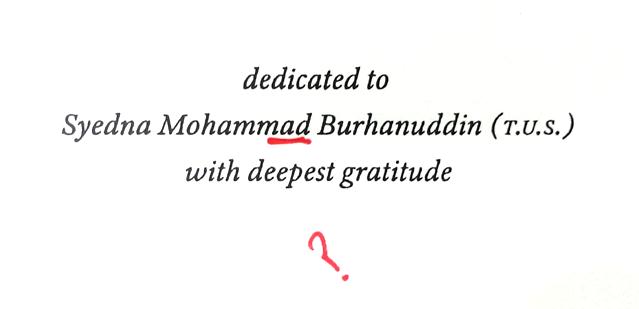
Their disregard goes to the extent that BT does not even spell Syedna Mohammed Burhanuddin’s RA name correctly, even when claiming to dedicate an entire publication to him. Surely, this cannot be a typo? (It’s not because this spelling is consistent in this publication and the one above.) Surely, she would be able to catch such a glaring mistake, especially when it’s the only name on the entire page? Or do they think they understand how to spell Moula’s RA name better than him?

Mohammed

Mohammed as spelt by Syedna Mohammed Burhanuddin RA

Mohammad

BT spells Moula’s name wrong

Do not see these as insignificant details for these breadcrumbs lead to Khuzaima’s treachery. They indicate that from the very beginning, Khuzaima has raised and nurtured his children with a complete disregard for Syedna Mohammed Burhanuddin RA. KQ illegitimately authorized the use of Dawat texts so that they could make a name for themselves in the niche Ismaili field. It is ironic that they would make their claim to fame with the works of the very Doat RA that they have the audacity to correct and criticize.  And during this time, their father Khuzaima led them further and further away from Syedna Mohammed Burhanuddin RA: the true source of ALL knowledge. The FateliDawat site states that KQ encourages his children ‘to publish their research on Aal-e-Muhammad in acclaimed university presses, in order to make the eminence of our mawali known to all the world’. I’m no Harvard graduate, but proposing ulterior meanings than those provided by the Dai and suggesting that Syedna Idris RA could have ‘better placed’ historical incidents doesn’t seem to be celebrating their ‘eminence’.

And so  despite their many degrees, doctorates and dissertations, in spite of all of their academic publications, illegitimate access to Dawat kotub aaliyah and ‘Skype’ sabaqs—they were not able to understand the most fundamental Fatimi Tayyibi principle: that Dai ‘je kahe ya kare haq che saraasar’.

Syedi Abdeali Imaduddin’s QR chorus then is a fitting conclusion to this post.

Samjhu to samjho, na samjhu na samjho.

Those with understanding—understand. Those who lack it—do not.

UPDATE ON 8 Feb 2014

In his recent YouTube videos, Husain Qutbuddin proudly states that Moulana Burhanuddin RA, when granting him raza mubarak for further higher education at Cambridge, stated ‘haqq ni waat thaabit karjo’: that he should establish Haqq, what is True and Right. He claims that he and his siblings have been doing just that throughout their careers in Western academia.

So they claim legitimacy for their academic endeavors through Moula’s RA raza. Surely, when Moula RA said ‘haqq ni waat thaabit karjo’, he didn’t mean for you folk to go to these fancy universities and offer ‘better’ meanings for Dawat texts than those given by Moula RA? That doesn’t reflect ‘haqq ni waat thaabit karjo’, does it? Isn’t Moula’s RA own being, his very zaat, Haqq? Then anything or anyone who opposes him, whether it be in the meanings of a single verse or the clothes that they wear, is Baatil. They defied him in his life, and today defy his memory and his legacy.

Reason #39: Ali b Ibrahim was the Ex-Mazoon of Syedna Abduttayyib Zakiuddin

“Never in the 900-year history of Dawat has any Mazoon turned away from Dawat” – 

The Claimant, Ali b Ibrahim was Mazoon in the time of Syedna Abduttayib ZakiuddinRA

Note to reader: The historicity of Ali b. Ibrahim in this entry may not reflect the ideas and beliefs of other religious communities. Therefore, please take caution before reading if your personal view and narrative of Ali b. Ibrahim is different.

(Please refer to Reason #3)

Syedi Shaikh Qutub b. Suleiman writes in Muntaza al-Akhbar that:

“Ali b. Ibrahim, though from the Dai, in the second rutba (al Mahal al Saani), led himself to be tempted and seduced by material gain. He lay claim to the position of the Dai as he had done so before. He desired his Maula’s respected position for himself. He bragged about the wealth he had accumulated through improper means. He claimed that he was more deserving of being a Dai than Syedna Abduttayyib Zakiuddin RA…he transgressed all limits in his attempt to secure this position. He thought that with the help of his Shaitans– a builder and a diver- he would fulfill his desire. But what happened was the opposite; The house was protected by its lord. He began to corrupt the people of Da’wat, instigate Mumineen against the Dai, bind them using spells of Haroot and Maaroot, he misled them with fabricated narrations of Taim and Adee, and entice people through their inclinations. He created a great deal of disorder in Da’wat. When Syedna Zakiuddin heard about his actions he removed him and three others from the hierarchy of hudud.”

The FatemiDavat site proclaims that:

“Ali bin Ibrahim, who did daawo of being Dai in Syedna Abdut Tayyeb Zakiyuddin’s time, was high in the tarteeb, but nowhere does it state that he was the Mazoon”

The Fatelidawat website has attested again and again that “Never in the 900-year history of Dawat has any Mazoon turned away from Dawat”. Despite numerous references to Ali b Ibrahim being the ex-mazoon of the 29th Dai, Syedna Abduttayyib ZakiuddinRA in the annals of Fatemi history, the website conveniently dismisses the fact that he was in the position of mazoon when he challenged and rebelled against the Dai of his time.

The accounts of the DoatRA which are related in Muntaza ul-Akhbar are accurately documented by one of the most eminent scholars and historians that flourished under the tutelage of Syedna Abdeali SaifuddinRA, Syedi al-Shaikh QutubQA. The website has attempted to discredit the author of this seminal book despite the due reverence afforded to the author by Syedna Taher SaifuddinRA (see Reason #10 for details).

Syedi al-Shaikh QutubQA has listed where available, the dates when Duat have conferred Nass on their successors and where available, the dates and instances where Mazoons, Mukasirs and other Hudood have been appointed. In several places, he has referred to the appointments of Mazoons as being appointed as ‘second’ to the Dai, or in the ‘second position’ or ‘second place’ (see reason #3). One example of this is the appointment of Syedna Musa KalimuddinRA (36th Dai) as Mazoon by the 35th Dai Syedna Abduttayyib ZakiuddinRA. In Muntaza ul Akhbar, Vol 2,pg 279, Syedi al-Shaikh QutubQA says:

“He [Syedna Abduttayyib Zakiuddin 35th Dai] appointed his son, Dai Kalimuddin “second to him

The 35th Dai appointed him his Mazoon in 1085H. This is further corroborated by what Syedna Taher SaifuddinRA has referred to in his risaaala (Nahr ul-Noor il-Sha’sha’a’ni 1374H p170) where he says that “Syedna Abduttayyib Zakiuddin RA appointed Syedna Musa KalimuddinRA in the rutba which followed his, which is the rutba of Mazoon”.

Another instance is where Syedna Taher SaifuddinRA, in doing zikr of Syedna al-Khattaab, refers to him as ‘second in Dawat to Syedna ZoebRA (Risaala Sharifa, Balaaghul Duat il Fatemiyeen 1376H, pg 160) It is well known and well documented that Syedna al-Khattaab was the Mazoon of Syedna ZoebRA.

If we were to forgo any and all of the references to mazoons as ‘second’ to the Dai in all the history books of Dawat, the irony is that Khuzaima has repeatedly emphasised on his website that the position of the Mazoon is second to the Dai. Below are just some examples from his website:

  1. It indicates the exalted position of the Mazoon in Allah Taala’s Dawat-ul-Haqq, depicting him as the second of the three hudood (Dai, Mazoon, Mukasir) through whom the Imam-uz-zamaan is present in the period of satr.
  2. It also indicates the Mazoon’s exalted position by stating that he is the second of the three rutba-na-sahebo (Dai, Mazoon and Mukasir) who are continuously aided by Allah Taala’s light.
  3. The Mazoon is the second highest in the three rutbas of Dawat by whom the Imam is said to be present. 

Therefore his audacious claim that “No Mazoon in 900 years of Dawat al-Satr history has ever gone against the wishes of the Dai”, is not only outrageous but just shows his and his self-attested family of ‘academics’ subjective and manipulative reading of the facts of history. 

It leads us and any other layman to conclude that Khuzaima only accepts facts when they appear to bolster his baseless claims, and rejects them when they are detrimental to his assertions. His delusional attitude is continuously being reinforced by his relentless rejections of verified facts and actual events. You cannot force someone when he just refuses to open his eyes, to see the sun or accept its existence even when it is at its zenith. His reality is skewed by the one dimensional lens he sees from – the lens of an all-consuming greed for power and lust for something which can never be his. Anything which threatens this warped reality, he will instinctively reject, irrespective of its authenticity.  For a Mumin Mukhlis, whose heart and intellect have been tuned to the frequency of ikhlaas and mohabbat, only a sign is sufficient for them to distinguish reality as it actually is.
« Older Entries Recent Entries »