“Syedna Burhanuddin’s Mazoon of 50 years is swearing an oath on the Quran that Syedna Burhanuddin did nass on him”
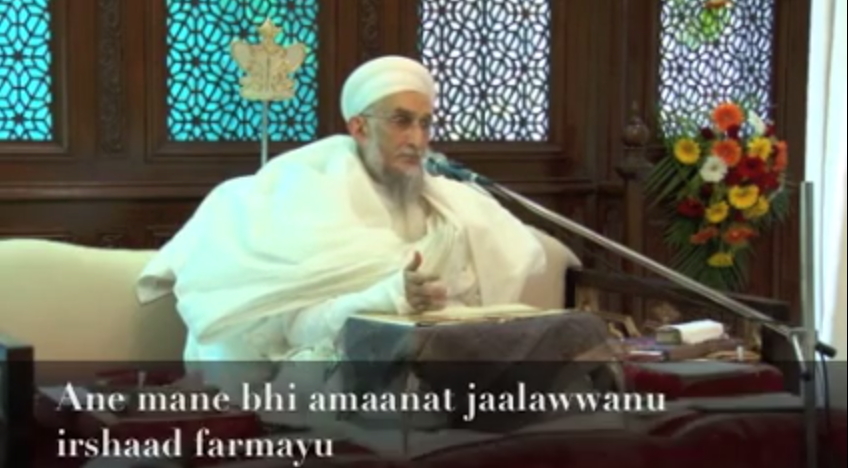
A video has been posted which shows the claimant holding up a Quran, one which apparently belonged to Syedna Taher Saifuddin and disrespectfully waving it about, saying that he swears by ‘this Quran’, that he is the 53rd Dai. This is reminiscent of what happened during the battle of Siffeen. Syedna Al-Qadi Al Noman RA explains in detail that when Moawiya saw that the battle was going to be lost and that victory was soon to be in favour of Amirul Mumineen, he craftily placed the Quran on the heads of spears and called both sides to resort to the command of the Quran. He had no intention to establish the truth or to clarify who the rightful Imam was. Rather his sole design in this was to safeguard his corrupt interests. He knew that every ayat and every sura would testify in favour of Moulana Ali AS and there could be no possible refutation. Syedna Al-Qadi Al-NomanRA clearly argues that Moulana Ali ASdid not need to resort to referring to the Quran. He was Quran e Naatiq – what he said and did was the right and only valid interpretation of the teachings of the Quran.
There is no record of a Dai having to swear by the Quran to prove that he was the rightful Dai, for every Dai is the sura of the Quran. There has never been a need to for it as the Nass e Jali of the previous Dai establishes his successor as Dai; the swearing on the Quran is meaningless and deceptive. Anyone can hold the Quran and falsely swear by it. Khuzaima has repeatedly shown that he has never respected the authority and maqaam of Syedna Mohammed BurhanuddinRA, who, as Syedna Taher Saifuddin RA repeatedly said was a sura of the Quran. It would not be beneath him to falsely swear by it. All he is doing is preying on the uninitiated and naive by attaching sentimental value to the Quran in his hand, by saying it belonged to Syedna Taher Saifuddin.
Syedna Khuzaima Qutbuddin was Syedna Mohammed Burhanuddin’s Mazoon until his wafat. No one can dispute this. Mazoon’s aala shaan is attested in Dawat kitaabo. Therefore, you must accept that what Syedi Mazoon Saheb is saying about Nass is the truth (and that what shehzadas are claiming counter to that is fabricated).
Following Syedna Burhanuddin, Syedna Qutbuddin possessed the highest shaan in Dawat in rank, in imaan, ilm, akhlaaq, taqwa, riyazat, bandagi, sabar, siyasat, guidance, vision, wisdom, fairness, integrity, sincerity, khidmat, compassion, caring for mumineen’s well-being. Balance. Eg. wa’azo and bayaano, dealings with complicated Dawat issues in past (eg. Udaipur), Dawat ni khidmat ma jaanfishani, right guidance of hundreds of individual mumineen, founding and supervision of clean charities such as Zahra Hasanaat and QJSP (Qutbi Jubilee Scholarship Program).
As has been the case all along, empty claims have been the norm on this website. Numerous assertions have been rolled out that Khuzaima is characterised by a number of virtues and that his ‘shaan’ is second only to Syedna Mohammed BurhanuddinRA. There is evidence from no other than Syedna Mohammed BurhanuddinRA himself that undermines Khuzaima’s integrity and character, if not completely discrediting him. I refer to the bayaan mubarak of 1409H in Nairobi in which Syedna Mohammed BurhanuddinRA explicitly states his position as Al Dai Al Mutlaq and that he has the final word in passing any and all judgements. Syedna Mohammed BurhanuddinRA completely exonerated those innocent individuals who were implicated in the events of Africa. I refrain from talking about them in detail, as the Khuzaima camp – just as they have done with everything else – has labelled the entire episode a ‘fabrication’. However, to all the Mumineen world over who heard their beloved Moula’s voice a few days ago in the recording of the bayaan mubarak of 1409H, it is as plain as day as to what Syedna Mohammed BurhanuddinRA said and clear that the events of Africa did actually happen. He said, (exact words)
“ek waqt Bhai Qutbuddin ney bhi em
(1)khayal thai gayu, aney em
(2) yaqeen thai gayoo, aney
(3)zehn ma lai leedu key aa saazish….”
A number of salient points are evident. In whatever transpired in Africa, Khuzaima was misled. He was gullible and impressionable in being led astray by those who were less than trustworthy. In fact these people were referred to as ‘munafeqeen’ by Syedna Mohammed BurhanuddinRA. He lacked good judgement and clarity in believing – with wholehearted conviction (yaqeen) – that those who were innocent and wrongly accused were guilty. He lacked the ability to discern between right and wrong, and instead gave into his own emotions.
Would a Mazoon of the stature and character claimed by the website, have allowed himself to be duped and hoaxed into believing munafeqeen? Would a Mazoon even correspond and communicate and listen to a munafiq? Where are there signs of the attributed ‘wisdom, siyasat, vision, fairness, integrity and balance’in this bayaan? The words of Syedna Mohammed BurhanuddinRA also beget the question “How many other instances have there been where Khuzaima has given into temptation, lacked clarity of judgement, been convinced of his own assumptions and communicated with munafeqeen and consequently been mislead?”
The website has furiously spun a tale of solemn virtue for a man whose word was not accepted by Dai al-Zaman. Not only did Syedna Mohammed BurhanuddinRA not accept his version of events, but actually accepted the word of a humble and loyal Mumin. He says,
“I believed Husain bhai and I unequivocally declared that he and his entire family are innocent of these accusations. I accepted his diyafat, honoured him with a shawl and prayed for his wellbeing.
After having done all this and after all that has transpired till now, if someone is still in doubt as to whether Husain bhai may have lied to me and was subsequently pardoned [even though he lied], then it is tantamount to having doubt in my judgement and the appropriateness of my actions. This stands true regardless of the rank and station of the person harbouring that doubt.”
To add insult to injury, the FateliDawat website continues to affirms that Syedna Mohammed Burhanuddins ‘final decision’ was not good enough for them, quoting their latest update:
“Qutbuddin Mola accepted Burhanuddin Mola’s decision to close the matter, and has NEVER spoken of it until today”.
(By today they mean 30th January 2014, when he’s actually being repeating the same story for decades, including the dat their website was launched). Why even talk about it today? Can he not simple accept what the 52nd Dai has so clearly decided?
There are innumerable accounts of Khuzaima’s tendency to lie, engage in immoral and unethical behaviour, volatile temperament, complete lack of compassion for others, inadequate judgement and even doubt on his fidelity. However, rather than list these – which again the Khuzaima camp will dismiss as fabrications – I have merely highlighted what is crystal clear in the bayaan mubarak of Syedna Mohammed BurhanuddinRA. If they wish to refute the above, then doing is a refutation of the words of Haq na Saheb, and they are contesting the very institution of Wali ullah. What claim to legitimacy will they be left with?
The FatemiDawat website (Q&A section) tries to justify the announcement of Nass by Khuzaima on the 17th/18th of January 2014:
“Why did Qutbuddin Maula TUS wait until now to disclose that he is the true mansoos and not two years ago?
Qutbuddin Mawla obeyed the farmaan of Syedna Burhanuddin RA and kept his nass private/khangi. Two years ago, when Shehzada Qaid Johar bhaisaheb announced that nass was conferred on Shehzada Mufaddal bhaisaheb, Qutbuddin Maula maintained his charge of secrecy and patiently waited for Syedna’s return from London to speak in private. Then it became known that Syedna has suffered a debilitating stroke impairing his speech and awareness. With sabr and fortitude, Qutbuddin mawla kept obeying the farmaan to keep his nass secret with the hope that Syedna Burhanuddin would recover from the stroke and correct the falsehood done during his illness”
The rather lengthy essays with loads of false information that suddenly appeared on their site on the 17th of January are obvious that its work had been compiled, scanned, uploaded, & proof read well in advance. Instead of praying for the long life of Aqa Moula al-Hayy al-Muqaddas RA, it would seem seem that they were eagerly waiting for Syedna Mohammed Burhanuddin RA to shut his eyes forever and launch a few hours after Aqa Moula’s RA demise. This action perhaps makes any human being’s skin crawl with disgust.
Surely Khuzaima wouldn’t have created this site on his own, thus, he must have instructed someone to do it on his behalf. If so, he would have had to reveal this alleged amanat of Nass to the designer of the site and the content compilers. Isn’t that doing khiyanat (betraying) the amanat that Syedna al Muqaddas RA entrusted him with, prematurely before its time to reveal it?
Why was this domain created on 18 November 2013 (2 months in advance) and registered to someone in San Antonio Texas in the USA with the IP address linked to postal code 78218 (information has been made private soon after launching). If Khuzaima was to reveal at Syedna Mohammed Burhanuddins RA death? Was he planning his fitnat ahead of time, eagerly waiting for Syedna’s death?
Date of creation from WHOIS.
If Khuzaima was to reveal his claimed amanat through a Youtube video, on Saturday 18th of January 2014 morning (while Syedna Mufaddal TUS was taking the Janazah for dafan), then why did his two daughters kidnap their husbands children 24 hours (on Friday 17th January) prior to this announcement? Had they too been informed about this amanat before hand, before the instructed time? Isn’t that khiyanat of the amanat as well?
If Khuzaima was waiting to reveal this secret of Nass after the demise of Syedna Burhanuddin RA, then why is history witness that throughout his 50 year span, generations of mumineen are witness (India, Dubai, USA) to his children and khidmat guzars constantly referring to him as the 53rd Dai, or the successor of Syedna Mohammed Burhanuddin, so much to the extent that they declared his son Taher the 54th! If Khuzaima was to keep this amanat secrect, why did his family and friends know this secret? If it indeed was an amanat meant for the 18th of January 2014, why did he allow his clan to make these statements public? He should have silenced them until the intended day arrived.
If he did tell his family and khidmat guzaars this secret (which he did), what makes them so special to know this information? Why did his children in secret conversations & sabaqs inform their nearest and dearest that the Nass on Syedna Mufaddal TUS is wrong and Khuzaima is the real mansoos. Why not inform others as well?
If the revelation of this amanat was NOT meant for the death of Syedna Burhanuddin (on the 17th/18th of January 2014), then why didn’t he reveal it in Burhanuddin Moulas RA lifetime and clear all doubts? Surely he could have requested to meet Moulana Mohammed Burhanuddin RA for a few minutes, just like he went into his ghurfah mubarak after his demise, without any hindrance.
Syedna Mohammed Burhanuddin did suffer a stroke, but his health did improve, as he did a short bayaan on the 2nd of Moharram 1433H (Mumbai), heard many araz, performed Nikahs (London 1433H), blessed many Ziyafats and accepted Wajebaat araz in Shehre Ramadan (Khandala 1433H). Khuzaima had 2 years to get a private audience, if he wasn’t too busy travelling away from Syedna Mohammed Buhranuddin RA, planning his fitnat globally.
These are all rhetorical questions.
Everyone knows “why” Khuzaima did what he did. He did what any sly, power hungry man would. He planned well in advance for 50 years, until the right time arrived. That day was the 17th of January 2014, when mumineen “lost” their Moula who was their life, and Khuzaima “found” the chance of a lifetime.
UPDATED 30 Jan 2014:
To confirm that Khuzaima did intend to make this announcement after the the demise of Syedna al Muqaddas, the FateliDawat website updated their statement on 30/01/2014 saying:
Due to Burhanuddin Mola’s own farmaan, Qutbuddin Mola could not disclose Burhanuddin Mola’s nass upon him earlier. After Burhanuddin Mola’s wafaat/demise, it was his duty to Burhanuddin Mola, and his responsibility to Imam uz zamaan, to make his nass known immediately.
This has been answered above.
UPDATED 3rd Feb 2014:
The former Cheif Justice AM Ahmadi supports Khuzaimas false claim. Quoting from the article, this is what he has to say:
Ahmadi, a Dawoodi Bohra who was the chief justice of the Supreme Court between 1994 and 1997, wrote to Qutbuddin’s family, even before the late Syedna’s demise this month, expressing his opinion and support, he told HT over the phone. The former chief justice resides in Delhi and is currently in Ahmedabad.
“Syedna Qutbuddin’s family had shared certain historical documents with me, some of which are written in Arabic, in which historical facts about the community and the events since the nass (choosing the successor) conferred by Syedna Burhanuddin on Syedna Qutbuddin in 1965 have been recorded. I examined the documents and believe that Syedna Qutbuddin’s stand of the 53rd Dai is principled,” said Ahmadi.
Why did Mr Ahmad write to Khuzaima before Syednas demise? Evidently, Khuzaima was propagating his claim of Nass much before the 17th of January 2014. This also adds up to doing khiyanat (betraying) the ‘so called’ amanat of Nass that Syedna al Muqaddas RA entrusted him with, prematurely before its time to reveal it.
Muqaddas Mukasirsaheb Saleh bhaisaheb Safiyuddin yeh Syedna Burhanuddin ne araz keedi keh “kem aap yeh Syedi Mazoon Saheb ne Mazoon banaaya tej waqat Nass bhi zaahir na kari didhi?” Syedna Burhanuddin replied “talvaaro chali jaate” – this shows that certain key people knew about Syedna Burhanuddin’s Nass on Syedna Qutbuddin, and it explains why Syedna Burhanuddin did not make the Nass public.
There is an obvious contradiction. If Khuzaima claims this Nass was done without any witnesses and no one else knew. How did Mukasir Saheb Saleh Bhai Saheb know about this?
UPDATED 8th Feb 2014:
The FatemiDavat site published the official statement (posted 8 Feb 2014) of Khuzaima in reply to Syedna Mufaddals TUS paighaam of 4th Rabi al Akhar 1435.
Syedna Qutbuddin Saheb TUS, in accordance with Syedna Burhanuddin Saheb’s RA wishes, revealed that he was the chosen successor immediately after Syedna Burhanuddin’s RA sad demise.
Khuzaima has made it clear that the “Amanat of Nass” was to be revealed AFTER the demise of Syedna Burhanuddin RA, then the arguments posted above are sufficient to prove that this is a blatant lie. He has technically done khiyanat of the amanat. The fitnat was planned well in advance.
UPDATED 11 FEB 2014
More proof that Khuzaima did not keep the Amanat of this alleged Nass. He informed his children and grand children many years in advance. Thus, his claims to have revealed it after Syedna Burhanuddins nass is completely false.
This video sheds light on the subject:
Updated on 14th Feb
Khuzaima in his latest video updated today continues to say this Amanat of Nass was supposed to be kept secret, but the above mentioned evidence proves that he didn’t keep it so.
One Lailatul Qadr, in the year 1363H, Syedna Taher Saifuddin, as per his usual practice, lead mumineen in the night prayer in Badri Mahal masjid, in Fort, the headquarters of Dawat-e-Hadiya. He sent his son Syedna Qutbuddin, to lead the prayer in Husainy Masjid on this auspicious night. When Syedna Qutbuddin returned near the end of the night at shafa time, those who had gone in his service came for shukr araz to Syedna Taher Saifuddin, who had just returned to his private chambers in Badri Mahal and was on the masalla. He turned towards them, while they were doing araz to him that your shehzada lead the prayer with great shaan, and said, “Khuzaima ni doa mustajaab che” (Khuzaima’s supplications are always heard/ Another translation: God always responds to Khuzaima’s supplications). Syedna Taher Saifuddin’s declaration for Syedna Qutbuddin is extremely significant.It is a weighty statement and has a specific connotation in our faith, Dai ni zikr maa chhe ke “Dai ni doa mustajaab chhe.” In his Ashara bayan in Mumbai in 1381H when mentioning how his doa had resulted in Syedna Qutbuddin being granted shifa, Syedna Taher Saifuddin said that “Dai ni doa mustajaab che” (A Dai’s supplications are always heard)
The argument above is based on a flawed assumption. As the reference to the words of Syedna Taher Saifuddin RA clearly shows, the Dua of a Dai is ‘mustajaab’. There maybe a reference that Syedna Taher Saifuddin RA has stated that Khuzaima’s Dua is ‘mustajaab’. However the inference that as a result, Khuzaima is Dai is principally flawed.It does not follow that every individual whose dua is ‘mustajaab’ is a Dai, as otherwise every individual whose Dua has been specified by Hudaat Kiraam as ‘mustajaab’ can lay claim to being a Dai.
This is not a deductive argument where the premise of the argument guarantees the truth of the conclusion.
Premise 1 is that “Khuzaima ni Dua mustajaab che”.
Premise 2 is that “Dai nu Dua mustajaab che”
Therefore: “Khuzaima is Dai” – FALSE CONCLUSION
Why?
Amirul Mumineen AS once said whilst addressing his Shia during a Khutba, “The month of Sherullah, filled with barakat and maghferat, is upon you…...your Dua in this month is mustajaab”.
In Kitab al Najah, 16 types of supplications and prayers are mentioned and described as being “mustajab”.
Syedna Al Qadi Al NomanRA has refered to the Dua of a miskeen (beggar) as being ‘mustajaab’ in Daim ul Islam. Imam Jafar us SadiqAS says “Do not belittle the dua of a miskeen (one in need) for your sick, as their dua is ‘mustajaab’ for your sick, even though it might not be ‘mustajaab’ for themselves”.
According to the logic employed in his argument above, even a miskeen (beggar) can lay claim to being a Dai, a miskeen who might not necessarily even be a Muslim. Of course Syedna Taher Saifuddin’s statement that – the Dua of a Dai is mustajaab – is an irrefutable fact, for if a miskeen’s Dua can be mustajaab, then it would be blasphemous to suggest that a Dai’s is not. Otherwise the argument would be as follows:
Premise 1 “Dai ni Dua mustajaab che”
Premise 2 “A beggar’s Dua is mustajaab”
If we use his logic, then the conclusion becomes preposterous.
There are inherent fallacies in his logic as they are forcing a causal connection which is just not there. Mumineen mukhleseen work on the simple argument:
Premise 1 “Syedna Mohammed Burhanuddin conferred Nass on Syedna Mufaddal Saifuddin”
Premise 2 “Syedna Mohammed Burhanuddin’s actions are a manifestation of Imam ul Zaman’s Ilhaam”
Therefore: Syedna Mufaddal Saifuddin is Mansoos and the 53rd Dai Mutlaq.
In continuation of 23’s argument against Muddai Khuzeima’s claims that
“Shahzada Mufaddal Bhaisaheb’s acknowledgement of Syedna Qutbuddin as his Maula and himself as Syedna Qutbuddin’s ghulam (in a letter written by Moulana Mufaddal Saifuddin TUS to Khuzeima in an anonymous year) is proof of nass”
2. Historically, the Appointed Offices of Da’wat Are Always Respected In Their Hierarchical Order Despite The Reality Of The Hidden Rutbas
This concept, despite the wordy heading, is really not that hard to understand because Aqa Moula Syedna Mohammed Burhanuddin al-Hayy al-Muqaddas RA has simplified it for us in his previous bayan mubarak. In fact, all the true arguments against Khuzeima’s fitnat can directly be taken from Aqa Moula al-Hayy al-Muqaddas’s RA bayaan Mubaraka. It is unfortunate that the children of Khuzeima did not regularly attend Ashara Mubarak with Maghnatis Ilahi (Magnet) Syedna Mohammed Burhanuddin RA – they might have not gone astray.
Therefore, regarding the letter that Moulana Mufaddal Saifuddin TUS wrote to Khuzeima Qutbuddin when he occupied the esteemed rutba of Mazoon, it is representative of Moulana Mufaddal Saifuddin’s TUS humilty, khuḍu‘, and respect for the marātibof Da’wat. He begins the letter with official language of Da’wat which is awarded to a Mazoon by Dai Zaman’s grace – not by his own accord and that is the khitābo of Molaya and Syedi as well as al-Mawla al-Ajal. Every mumin knows there is a difference between these titles of Moula and the one used for Dai -even madrasa children. These titles do not mean nass theyu che- rather they are the traditional appellations attached to the title of the Mazoon. Furthermore, by expressing himself as ghulām, as the letter shows, it should be read more closely. Clearly, Aqa Moula Mufaddal Saifuddin TUS distinguishes his relationship with Aqa Moula Syedna Mohammed Burhanuddin TUS as عبد سيدناط ع and for Khuzeima غلامك (your servant). Mumineen never write غلام سيدنا ط ع when they sign their letters, rather only مملوك سيدنا ط ع or عبد سيدنا ط ع as used by Syedna Mufaddal Saifuddin TUS for Aqa Moula Mohammed Burhanuddin TUS in this letter and NOT for Khuzeima. This distinction is very important because Mumineen’s sole pride sprouts from being the عبد of Moula TUS and no one else – it isn’t a shared commodity. You can only be the عبد of one person.
Secondly, if Khuzeima was suppose to keep the nass quiet as was allegedly instructed to him – then how would Syedna Mufaddal Saifuddin TUS even know about it since he was quite far back in the hudood ni tartīb if we are to argue for the sake of Khuzema’s claims? Surely, the use of غلام here in this letter clearly appears as a sign of humility and respect – which any true ‘Abd of Moula TUS would do to give acknowledgement of the rutba of Mazoon which Dai Zaman had bestowed. We did it for all these years despite the absence of Khuzeima from most Da’wat functions. We taught our children in madrasa the same thing while tolerating his deviance. We did it because our Bawa Shafiq Syedna Mohammed Burhanuddin RA, Dai al-Haq, instructed us to – not because Khuzeima was deserving of the respect. Furthermore, we often tell Shehzadas that we are their humble servants. There is a significant terminology difference in Da’wat’s official language between ‘abd and ghulām and they are not completely synonymous in Arabic nor are they always used interchangeably. عبد renders the meaning of slave – which in turn denotes a relationship between master (Moula) and slave while غلام is traditionally not used as such as you will see below.
Another point to be noted is the date of this letter is unknown, however, Nass on Moulana Mufaddal Saifuddin TUS had not been made public until recently and therefore, it was hidden at the time this letter was written. Therefore, Moulana Mufaddal Saifuddin TUS acted as Da’wat’s history and tradition has emphasized. All hudood offer the utmost respect to those in a higher position than themselves according to the tartīb of Da’wat (see previous point). Therefore, it makes more sense that we read Syedna Mufaddal Saifuddin’s TUS actions in the letter and the use of غلام as that which any hadd would do in respect of the position of Mazoon. Tradition would require to write his letter as such – hiding his position. It is an iqrar of the rutba shareefa of mazoon and not of some alleged nass. It has always been part of Da’wat’s tradition to respect the hierarchy of hudood – this is and always has been sacrosanct.
An example of this is evident in a letter from Imam Mansoor SA to Ustaadh Juzer QS. In a letter written to Ustaaz Juzer, Imam Mansur asks him to release several palace pages (غلمان the plural of غلام) that he had locked up and punished for an ill-deed that they had done. From the window of their confinement, these pages saw Imam Mansur SA pass by and they asked him to intervene and request Juzer to release them. Imam Mansur SA was the mansus at that time and Ustaadh Juzer was aware of this fact, however, nass was hidden publicly at the time. So, after hearing what the pages had said, he said nothing and walked on. He had every right to release them, but protocol was observed as is the tradition of Da’wat. After returning to the palace he wrote a letter to Ustaadh Juzer. Following the protocol required for the azamat of the hierarchy of the stratified order of Da’wat, Imam Mansur wrote a letter to Juzer. The english translation is as such:
May Allah be forgive you. May he be benevolent towards you and complete his grace to you. Allah knows that I avoid things and I loathe speaking about any matter. However, when I remembered your righteousness, your affection, and my closeness to you, I considered that endearment erases bashfulness and requires that I be not stingy with you in giving sincere advice…. (Trans. Hamid Haji)
This letter was further interpreted and its pearls of wisdom were bestowed upon us by the grace of Aqa Moula al-Hayy al-Muqaddas RA in Ashara Mubaraka 1420 Fifth Majlis. In reference to these lines, Aqa Moula RA said,
Juzer, this letter of mine is not official. You are well aware of how removed I am from the matters of the state. Imam Qa’im (present Imam) runs the state in the manner in which he pleases. I am completely removed; I stay separate from all these things. I am writing this letter, however don’t think it is because I am asserting a certain right of rule, or because I am the hujjat (mansus) and that is why I am writing it to you. Rather there is an affection between you and I and I know your disposition that is why I am writing to you….
Despite being the hidden Mansus, the Hujjat of Imam Qa’im, a secret that Juzer was well aware, Imam Mansur wrote a polite request to Ustaadh Juzer asking him release the pages. He had the right to tell Juzer to do it immediately and Juzer would have complied as he was a loyal servant to four Imams. However, even though Imam Mansur was in the most ‘Aala and Afḍal rutba after Imam Qa’im, these are the words and etiquette that he used when writing to Juzer. He had to hide his rutba, he could not manifest it openly, even with Juzer who was privy to its knowledge. Is this not the same traditional and age old etiquette and character that we see in the letter from Moulana TUS to Khuzeima!Although- please do not make an association of Molaya Ustaadh Juzer QS with Khuzeima. Moula Mufaddal Saifuddin TUS was using the titles and descriptions that were awarded to Khuzeima by Dai Allah il Ameen Syedna Mohammed Burhanuddin al-Hayy al-Muqaddas RA. Again, these rutbas, titles, and addresses are the grace of Dai Zaman Syedna Mohammed Burhanuddin RA were never Khuzeima’s property as he continuously purports.
Unfortunately, the personality of Khuzeima Qutbuddin seems to demand these rights and for some reason attribute them as his own property deserved through his own merit i.e. “I am the first Mazoon to do khidmat of Da’wat for fifty years…” – I ask, didn’t Iblis also do khidmat for several thousand years – however, due to his mistake of failing to believe in Adam – he is now damned for eternity. Why is Khuzeima and his children following this role in history and leading others astray with them? The truth and haq is so obvious. May his deceived followers see the truth which is as bright as the sun and join back with their brothers and sisters as is the Khushi of Syedna Mufaddal Saifuddin TUS.
So in conclusion, we must remember the zikr of Syedna Zoeb RA, the first Dai. Moulana al-Hayy al-Muqaddas RA often compared his accession to the Rutba of Da’wat to the zikr of Khuda’s tajalli on Tur Pahar. All the higher mountains wished that Khuda do tajalli on them, however, Khuda Taala chose Toor Pahar (Toor Mountain) on the account of its humility. Likewise, there seemed to be many hudood holding higher rutbas than Syedna Zoeb RA in Yemen when Imam went into satr. Imamuz Zaman SA chose Syedna Zoeb SA because of his khushu‘ , khuḍu‘, and true humility. This is the only true fact that I see when I read this letter from Moulana Mufaddal TUS to Khuzeima and it shows no proof that Aqa Moula Syedna Mufaddal Saifuddin TUS acknowledged nass on the muddai.
On his website, Fatemidavat.com, Khuzaima Qutbuddin and his children have provided a letter from Aqa Moula Syedna Mufaddal Saifuddin TUS to Khuzaima. They allege that the official addresses and titles which Moula TUS has used for Khuzeima is evidence that he TUS had accepted Khuzeima as Burhanuddin Moula’s RA successor. They write,
“Shahzada Mufaddal Bhaisaheb’s acknowledgement of Syedna Qutbuddin as his Maula and himself as Syedna Qutbuddin’s ghulam (in a letter written by Moulana Mufaddal Saifuddin TUS to Khuzeima in an anonymous year)”
This so called compelling material evidence is quite insignificant when placing and contextualizing it with the history of Da’wat from which we derive our culture, our heritage, and our practices. This allegation, like all the points on Khuzeima and his children’s website, falls short of any actual proof because they are cherry-picked and largely disjointed with the entire history of Da’wat, its traditions, and the ‘Ilm of Aale Mohammed SA in general. Therefore, cherry-picked arguments without proper detailing, sometimes can seem compelling, however, they really point towards the narcissism and disillusioned personality of Khuzeima which has been coming to light in the past few days since he claimed to be what he is not – not just recently but throughout the entire dowr (era) mubarak of Syedna al-Hayy al-Muqaddas. The points below will explain why his argument is once again flawed.
1. The Future Dai and Mansus Is Not Always The First in Tartīb and Certainly Not Always The Sahib Who Is In The Position of Mazoon.
Historically, it has not always been the case that the future Dai has been the first in tartīb after Dai Zaman. In fact, the most eminent and aala tartīb of Da’wat – the Dai – is something that only Khuda Taala and his Imam can award. It is solely from his faḍl and gives to whomever he desires. Rutba, therefore, isn’t something to be claimed, rather it is given by Dai Zaman. Thus, the tartīb of Da’wat, although sacrosanct, does not necessarily delineate that the first person in tartīb after Dai Zaman is going to be his successor. In fact, Da’wat’s history has repeatedly showed us otherwise. The ‘entitlement’ of the rutba is something that Khuzeima Qutbuddin seems to be erroneously and unfortunately fixated on. Moula aape, na aape, tame iraad to nehi lawo?
In fact, the notion that Mansus Alaihi na Sahib is not always the first person in Da’wat’s tartīb after Dai Zaman is an idea which is quite apparent throughout the history of Da’wat. For instance, in the era of the 42nd Dai, Syedna Yusuf Najmuddin RA., Syedi Qutub bhai QS writes in Muntaza‘ ul-Akhbar that “in the final days of Syedna Yusuf Najumuddin RA., the tartīb of the hudud kiram was in this order; the first was al-Mazoon al-Ajal Syedi al-Shaykh Adam Safiyuddin. After him was the Mukasir of Da’wat, Syedi al-Shaykh ‘Abdul Qadir Hakimuddin QS, and after him the Ra’as ul Hudood and the most afḍal and ‘aala of them, al-mansus ‘alayhi (the one who has been appointed by Nass) al-Dai al-Amjad Syedna Abdeali Saifuddin RA…”Despite the fact that he was mansus, Moulana Abdeali Saifuddin RA was not first in tartīb, however, according to Syedi Qutub QS he was the highest and most eminent because of the fact that he was mansus. There was no connection between the rutba sharifa of mazoon and mukasir with the rutba of Da’wat – which is continuously alleged by Khuzeima Qutbuddin and his children as proof of his nass. Where did they go wrong?
Thus, we have witnessed this similarity in the zaman of Syedna Mohammed Burhanuddin al-Hayy al-Muqaddas RA also. Although, Syedna Mufaddal Saifuddin TUS was not first in Da’wat tartīb, he was the most ‘aala and afḍal hadd – however – because of his true humility, he always respected the higher offices of Da’wat with the utmost dignity and respect. Every Shehzada of Syedna Taher Saifuddin RA and Syedna Mohammed Burhanuddin RA will attest to this well-known fact and we have seen to this day how he respects Mukasir Saheb Syedi Husain BS Hussamuddin. Therefore, it comes at no surprise that he would use the same titles, appellations, and terminologies that every one in Da’wat is suppose to use for the Sahib in the position of the Mazoon.
This point should be noted before reading on to part # 2 above. Please continue to part 2 above.
Mumineen, the followers of Syedna Mufaddal Saifuddin TUS, were recently fortunate enough to hear a bayan mubarak of Syedna Mohammed Burhanuddin RA delivered in 1409H. In this bayan mubarak Syedna Burhanuddin stated that there are people who believe that the tenets of Shariat Mohammediyah need to be modified in order for one to succeed in this ‘ultra-modern age’. There are people who believe that doing business without dealing in interest is ‘impossible’ today.
One would assume that such detractors belong to a segment of people who have spent their lives speaking and acting against the directives and guidance of the Dai Mutlaq. People who do not believe that he is the vicegerent of the Imam nor agree with the fundamental premise of faith: ‘whatever he says or do is Haq’. To this league belongs Abdeali Qutbuddin, who in his Ph.D. thesis ‘The Principles of Finance in Fatimi Tayyibi Law’ writes (pg. 5):
“Combined with the distorted perception of Fatimi Tayyibi financial principles among members of the Dawoodi Bohra Community today these developments have resulted in a distorted implementation of Fatimi Tayyibi financial principles which has damaged the Community financially, economically and socially” (my emphasis).
The dissertation was submitted in 2003, 38 years into the reign of al-Hayy al-Muqaddas Syedna Mohammed Burhanuddin. It is blatantly apparent that he considers Syedna Mohammed Burhanuddin’s perception and implementation of Fatemi fiqh (jurisprudence) as distorted. He even has the audacity to state that Syedna’s actions have damaged the community.
Has he forgotten the verse of Syedna Moiyadh al-Shiraazi RA ‘The Imam’s intention is the betterment of humankind, one cannot even contemplate the notion that anyone apart from him harbours such intentions’? Perhaps Badat Taherah could help him remember.
If Abdeali believed that Syedna Mohammed Burhanuddin was Imam al-Zaman’s Dai Mutlaq then he should have argued how Syedna Mohammed Burhanuddin correctly applied the principles of Fatemi fiqh and raised the financial, economic and social standards of Mumineen to unprecedented heights. However, his choice of words reveals how he and his family truly saw our beloved 52nd Dai Mutlaq.
Has he not studied Kitaab al-Hawaashi and seen how the erudite scholars of Dawat addressed the Dai Mutlaq when seeking answers for questions related to jurisprudence? They began their questions with ‘O most superior of all those who have encouraged us to love wisdom and the wise, what do you have to say regarding…?’, ‘O ray of the sun of guidance, what are your words regarding…?’, ‘O one who has delved deep into the oceans of knowledge, what is your answer regarding…?’ and other similar forms of address. Has he not read the introductory passage of the ‘Masaail Fiqhiyaah’ section (Questions pertaining to jurisprudence) of Syedna Taher Saifuddin’s Rasaail Ramadaniyah? These texts establish the pivotal role of the Dai Mutlaq in Fatemi fiqh and reveal that his words and actions are an embodiment of it. How can he justify labeling Syedna Mohammed Burhanuddin’s understanding of Fatemi fiqh as distorted?
In 1399H, Syedna Mohammed Burhanuddin called Mumineen towards al-Multaqa al-Fatemi al-Ilmi in Surat. The Multaqa was the turning point of Syedna Mohammed Burhanuddin’s golden era. In it he reaffirmed the fundamentals of our faith and unequivocally stated that all forms of interest are haraam. He made it clear that Mumineen should abstain from all practices and transactions that even remotely involve interest. Is he arguing that Syedna Mohammed Burhanuddin’s directive for Mumineen to free themselves from all forms of interest is a distorted implementation of Fatemi jurisprudence?
Would any Mumin condone his son writing such words about the Dai Mutlaq? But here, not only was Khuzaima proud of his son’s pseudo-accomplishment but went on to hold a reception for Mumineen college students from Mumbai to ‘celebrate’ his writings opposing the Dai Mutlaq.
Mumineen tend to the secular and religious education of their children with the intention that they do the khidmat of the Dai Mutlaq to the best of their abilities. Using one’s education in the opposition of the Dai Mutlaq is the height of ignorance, regardless of how many Ph.Ds are nailed to your walls. Moulana Imam Ahmed al-Mastur AS writes:
Know my brother, that any field of knowledge or literature that does not guide its seeker towards pursuing the hereafter or aid him in reaching it, will yield dreadful consequences for him and will stand as an argument against him on the Day of Qiyaamat.’
These consequences are beginning to show themselves.
All throughout the preposterous arguments presented on Khuzaima’s website, he claims that ‘conspirators’ have taken control of Dawat and its institutions and have released and issued publications for their own benefit, including the official nass mithaal shareef issued by Syedna Mohammed Burhanuddin RA and other proclamations, including the tarteeb and mithaq mihtaals, issued with Moulana Burhanuddin’s RAraza mubarak.
He does this to discredit and undermine the nass and the numerous kalemaatnooraniyah of Syedna Burhanuddin RA stated in the shaan and maqaam of Syedna Mufaddal Saifuddin TUS. If the Dawat, Vazarat and all its institutions were no longer under the control and command of Syedna al-Dai al-Muqaddas RA, if his speech and awareness were impaired, then why did Khuzaima during Ramadan al-Mu’azzam in Secunderabad in 1434 H request for du’aa from the Dai’s administration?If he knows that Moulana RA neither has control over the administration or awareness to respond, why send any form of communication to his office or his person and seek blessings and du’aa? Moreover, upon receiving a response from this office, why highlight its importance and barakat to the extent that Mumineen in the masjid were instructed to place the du’aa mithaal shareef on their heads and frame copies of it and place it on their walls? (Listen to Aziz’s speech below.)
On one hand, Khuzaima dismisses all statements and proclamations issued by Syedna Burhanuddin RA as unacceptable since according to him Moulana RA was not in charge of Dawat, and on the other hand, he goes to extreme measures to display to the Secunderabad Mumineen his fake and insincere reverence for Moulana’s RAmithaal.
Al-Dai al-Ajal Syedna Mufaddal Saifuddin TUS is the only mansoos of al-Dai al-Ajal Syedna Mohammed Burhanuddin RA. Khuzaima used, and continues to use, Syedna Burhanuddin’s RA authority and legitimacy in order to bolster support for his false claim and fancies for material gain while hiding his true animosity and contempt.
The website and the material presented under the instructions of the Muda’ee Khuzaima repeatedly purport that al-Dai al-Ajal Syedna Mohammed Burhanuddin RA was, Na’uwzobillah, incapacitated during the final years of his life. That he believes, or expresses, that Moula RA was ‘unaware’ of his surroundings, not only during the specific instances of nass but with regards to the general functioning of Dawat, is doubt and disbelief in the very maqaam of al-Dai al-Mutlaq, as has been mentioned in the post below.
In the audio clip posted on FateliDawat.com that is cited as an example of Khuzaima’s unparalleled understanding and ma’rifah of the Dai al-Asr, he eulogizes Syedna Mohammed Burhanuddin RA with a bayt mubarak of al-Dai al-Ajal Syedna Taher Saifuddin’s RA composed in the description of al-Dai al-Ajal Syedna Noor Mohammed Nooruddin RA. He says that Moulana RA is The Light of Allah Ta’ala who has merely taken the form of a human being. On one hand, he claims Moulana Burhanuddin RA is a divine radiant being who has chosen to take human form, and on the other he now states that this same Moula RA, like any other common human being, is imprisoned by the shackles of his physical form and ailments, powerless to stop the alleged ‘exploitation’, ‘hijacking’ and ‘falsehood’ being carried out due to his illness. This is a blatant attack on the maqaam of the Dai and is an assault on his capacity to take care of Imam’s Dawat.
There are numerous examples in the history of Hudat Kiram RA that highlight the fact that they have often accepted conditions of vulnerability and debility for various reasons and hikmat. Imam Ali Zain al-Abedeen SA allowed himself to be bound by shackles and fetters, yet demonstrated that if he wished, he could release himself from his imprisonment.
What is important to understand is that no matter the physical limitations the Imam or Dai accepts upon himself, at no point is the Dawat in jeopardy or are any of its essential functionalities compromised. That Khuzaima would suggest that not only Moula’s RAjism mubarak, but his Dawat was hijacked is an insult to Moulana Burhanuddin RA and an outright denial that there is hikmat in Moulana’s RA physical condition. During his final hours, Rasulullah’s SA physical jism mubarak was weak and frail. Yet despite this condition and severe illness, upon hearing someone leading namaaz in his mehraab, with the assistance of Amirul Mumineen SA, he headed to the masjid and pulled that individual out from the qiblah. Rasulullah SA would not allow that man to lead a single namaaz; how could Khuzaima accuse Rasulullah’s SA Dai RA of allowing others of exploiting his Dawat and appointing someone as his successor without his raza and blessings?
During the Asharah Mubarakah of 1429H in Colombo, Syedna Mohammed Burhanuddin RA quoted a bayaan mubarak of Syedna Taher Saifuddin RA in which he narrates the nass and subsequent events prior to the wafaat of the 49th Dai, his father Syedna Mohammed Burhanuddin RA. This bayaan mubarak is pivotal in highlighting the great maqaam of the Dai al-Asr, regardless of perceived manifestations of his physical form and condition, and explains the belief and aqeedo a Mumin should have during such situations.
[It was] very difficult to speak, if it was anyone else, they would not have been able to utter a word. That was the intensity of the pain. All day and night, he spent 24 hours in this condition. No one else would have been able to even make a sound; such an extreme condition. But regardless, Burhanudin Moula’s RA (49th Dai) declaration of nass was with great potency and splendor (aa shaan si nass kidi)…
Then, Bawajee Saheb (Syedna Taher Saifuddin RA) says, “everyone began discussing what to do next”. “Shall we take Moula home from here? We should not keep him here in this condition.” At that point, Kakaji Saheb Abdeali Bhaisaheb said, “Bhai, everyone is of the opinion that we should take Bawaajee Saheb (49th Dai) home.” “I, Mamlook e Aale Mohammed, had conviction and ikhlaas (sincerity of faith)”— meaning Syedna Taher Saifuddin, he is the reference here in Mamlook e Aale Mohammed. I spoke to Kakaji Saheb and told him, “I will only take Bawajee Saheb (Syedna Mohammed Burhanuddin RA, 49th Dai) after I have asked him if we may do so”. “If he says yes, then we will take him [home].” “If my father says that we should take him, then only will we do so.” This is what Syedna Taher Saifuddin RA said. “I have yaqeen (conviction) that this Saheb (49th Dai) is the recipient of ilhaam (divine inspiration from Allah Ta’ala and the Imam). Ilhaam is always at his aid, with the Dai. Taaeed always accompanies him. I am aware that his physical condition is that of illness, yet whatever he says is correct and appropriate.”
Khuzaima’s website quotes that “Syedna Taher Saifuddin RA related the story of the 49th Dai Muqaddas Syedna Burhanuddin RA who had a paralytic stroke toward the end of his life and lost his speech”. By doing so the Qutbuddin cult is drawing parallels between the 49th Dai and the 52nd Dai, and insinuating that both Dais were unaware of their surroundings and unable to speak. Like most of their statements, however, their lack of knowledge and their unfamiliarity with Syedna Burhanuddin’s RAkalemaat nooraniyah (in this case even Syedna Taher Saifuddin’s RA) has worked against them. If they accept that the conditions are similar (although Syedna Burhanuddin, the 49th Dai is said to have suffered a very severe illness prior to his wafaat), they must accept the other parallels that are established by the bayaan mubarak of Syedna Taher Saifuddin RA regarding this incident. They are:
The Dai Mutlaq cannot be equated with an ordinary human being; this is the belief afforded to us by Fatemi texts and kotub al-Dawat and confirmed by Syedna Burhanuddin’s RA own words above. The Qutbi cult sites medical reasons and various other conditions to highlight that it would be improbable, nay impossible for the Dai to speak or act out of his own will, specifically on the day of Nass e Jali. But in the bayaan mubarak above, Syedna Mohammed Burhanuddin RA, very clearly states that “beeja hoi to boli bhi na sake” thereby differentiating between the afflictions upon a normal and the Dai.
Secondly, Syedna Taher Saifuddin RA, regardless of his father’s physical ailment, seeks judgment and decision from him alone: ‘bawajee saheb ne mein puchu ke hamme aap ne lai jaiyye?’ A Mumin’s belief, as Syedna Taher Saifuddin’s RA own words clearly show, should be that no matter what the perceived physical condition of the Dai may be, it is he who should be sought for all decisions. Khuzaima’s claim that he was waiting for Moula’s RA health to improve to seek judgment from him regarding the supposed controversy of the nass indicates his lack of conviction and ma’rifah of the Dai’s maqaam; no wonder he is foolish enough to claim it for himself. If Syedna Taher Saifuddin RA was determined to seek his father’s instructions for the simple matter of whether he should be taken home or not, then surely the matter of nass and the future of Dawat should have been raised by Khuzama—since he had doubts—to the Dai’s hadrat imamiyah.
Finally, Syedna Taher Saifuddin RA states, “mein jaanu chu ke zaahir ma to beemaari ni haalat che, magar ye kehse te baraabar”. He clarifies that his respected father, Syedna Mohammed Burhanuddin, the 49th Dai, and like him the 52nd Dai, despite being in a physical state of illness, their words are true and correct. Those who would claim otherwise are in direct contradiction to Syedna Taher Saifuddin’s RAkalemaat nooraniyah. On the day of Nasse e Jali, Syedna Mohammed Burhanuddin RA clearly states repeatedly, “Mufaddal Bhai ne, nas nu taaj pehnawu chu”. This is apart from the nass he proclaimed in the hospital in London, which they deny as well on the grounds of incapability due to medical reasons.
No matter how the Mudda’ee and his conspirators endeavour to manipulate and misrepresent Dawat texts and the words of Doat RA, Haqq and the maqaam of the Dai al-Asr, like the shining afternoon sun, cannot be hidden from those who can and are willing to see.

 53 Reasons NOT To Believe Khuzaima Qutbuddin