UPDATES to: Reason #65: The So Called ‘Amanat’ of Nass (Part TWO)
Updated on 23 March 2014
Please view:
Reason #65: The So Called ‘Amanat’ of Nass (Part TWO)
Updated on 23 March 2014
Please view:
Reason #65: The So Called ‘Amanat’ of Nass (Part TWO)
Husain Qutbuddin (HQ) claims that the text of Ehd al-Awliyaa’ (Meethaq) can never be changed and since it was changed following the nass by Syedna Mohammed Burhanuddin RA upon Syedna Mufaddal Saifuddin TUS, the latter cannot be a true Dai.
The text of the Ehd al-Awliyaa’ can be changed, but only by the Imam and during his satr by the Dai Mutlaq, because it is to him that we are giving meethaq. It his meethaq, an oath given to him, surely then the one the oath being given to has the right to alter it as he sees fit. The Imam and his Dai are not bound by the text of the Ehd al-Awliyaa’ but rather it is a means for them to convey to their followers what is expected and required of them. And as times change so does the language and content of Ehd al-Awliyaa’.
HQ then goes on to claim that ‘mansoos nu iqraar dawat na kitaabo ma nathi’. Has he read every single Dawat text? Secondly, this is a classic example of putting the cart before the horse. Has he not read the narration of Amirul Mumineen SA placing the Quran upon his head and calling upon it to speak? Amirul Mumineen SA then declared that ‘I am the book that speaks’. It is a fundamental flaw in his aqeedah if he gauges the actions of Duat Mutlaqeen by Dawat texts. They are the living books and their actions are the nehj of Dawat. If a Dai of any time deems it necessary to add his mansoos’s name in the Ehd al-Awliyaa’, he has an incontrovertible right to do so. And those who question his authority to do so need to re-examine their adherence to the tenets of Ehd al-Awliyaa’. Therefore, citing examples of what Syedna Taher Saifuddin RA did regarding the text of Ehd al-Awliyaa’ after his nass upon Syedna Mohammed Burhanuddin RA is misleading. Different times require different courses of action. The Dai Mutlaq of the time knows which course to take.
The awareness of the four odd people sitting in front of HQ is also commendable. One person blurts out that no changes have been made to the Ehd al-Awliyaa’ for 900 years. How does he know? Has he examined each and every manuscript? If his audience are so scholarly maybe HQ can rest his throat and let them conduct the remaining Q&A sessions.
In the recording of Syedna Mohammed Burhanuddin’s RA waaz mubarak shown to Mumineen during Ashara 1435 H, he stated that Syedna Abdulhusain Husamuddin RA dismissed those who denied nass being conferred upon Syedna Abdulqadir Najmuddin RA and labelled them as ‘children’. Amongst the wisdom inherent in this statement, is the fact that some within these munafeqeen were 2, or 4, or 5, or 7 years old when nass was proclaimed. They were actually too young to know anything about nass at the time. The four Qutbuddin sons should realise that Syedna Mohammed Burhanuddin’s RA nass upon Syedna Mufaddal Saifuddin TUS was conferred long before they were even born.
As the renowned Fatemi poet Ibne Hani aptly says:
The Banu Abbas (Abassids) ask ‘Has Egypt been conquered? Tell Banu Abbas that ‘the matter is long resolved’
I will be the first to say that Husain Qutbuddin (HQ) and his siblings are intelligent. This is why their ignorance of select aspects of Dawat texts is all the more striking. Despite claims of Ilme Aale Mohammed SA and worldly knowledge, they fail to understand the most fundamental of Dawat principles, to recognise relevant precedents in Dawat history, and to comprehend simple reasoning and logic. This indicates that their abandoning of haqq has in turn led to Dawat texts and intellect abandoning them.
Like much of the ‘philosophy’ page of the FatemiDawat.com site, HQ’s accusations are plagiarised from the forums of those that call themselves ‘Progressives’. That HQ and a group of people who have spent their lives ridiculing and loathing the Dai and Dawat would see eye to eye is of little surprise. Inspired by them, (in reference to Syedna Mufaddal’s nass bayaan) HQ claims that omitting the specific date in which an important event occurred is evidence that the event is fabricated. He in turn indicates that the historical document referred to in this event is also false; fallacious thinking indeed. Let us highlight the immaturity and lack of understanding such an accusation reflects:
Wa lamma kaana fi b´ad al-layaali. And one night, Syedna’s (Syedna Mohammed Ezzuddin RA) lofty health changed [for the worse]. He was afflicted so severely that he was unable to sleep the entire night. In the morning, however, he felt slightly better. He called me to his side and spoke of his illness and the night’s happenings. He then said, “A life that can be counted by [the number of] breaths is something that the intelligent should not hold faith in.”
Syedna Mohammed Ezzuddin RA then goes on to inform Syedna Tayyib Zainuddin RA that he has authored a document in which he has named him as his mansoos and has placed this document in a basket which he then pointed towards. Syedna Mohammed Ezzuddin RA then began speaking about something else.
This is the manner by which Syedna Tayyib Zainuddin RA describes the incident in which he first learns of the nass upon him: ‘and one night’.
If HQ believes that the narration of nass communicated by Syedna Mufaddal Saifuddin TUS is susceptible to doubt, then he also doubts the nass narration given by Syedna Zainuddin RA.
And on the 15th of Shehrullah, Friday, Syedna Mohammed Ezzuddin RA called me to his honourable presence. I arrived, and sat before him as instructed. He picked up a document in front of him, and after looking through it for a while and moving his lips as if saying something, he handed it to me. He then said, “I by the ilhaam of Allah and the ilhaam of His Wali, upon him salaam, am giving you this document; read it.”
Syedna Zainuddin RA goes on to describe how this kitaab was the kitaab of nass upon him. It is interesting, nay providential, to mark that the manner by which Syedna Ezzuddin RA informs Syedna Zainuddin RA of his nass upon him, mirrors the manner in which Syedna Burhanuddin RA informed Syedna Saifuddin TUS of the same.
Syedna Saifuddin TUS helped his audience contextualize this significant event by providing the following details: (1) This event took place 4 or 5 years ago, (2) Moulana Burhanuddin RA na mizaaj mubarak par giraani thi, (3) work was being carried out in the khazaanah, (4) the document was kept in Saifee Mahal in Syedna Taher Saifuddin’s RA room, in a teak cupboard, along with other private possessions and (5) only Syedna Burhanuddin RA could access it.
The above contextualisation would place this event as having taken place in either 1430 H or 1431 H. However, out of these two years Maula na mizaaj mubarak par giraani was in 1430 H, which was the one year in which he did not make a public appearance on the occasion of his Milad Mubarak. Reference to the khazaanah (Moula’s personal library) narrows down the period in question to the couple of months when work was going on in the khazaanah in Saify Mahal.

It is strange that in all of his official statements and bayaans he never mentions these other incidents of nass, until he learned of the existence of this nass document. If he remembers his so-called nass from 50 years ago so well, why hasn’t he shared these other instances with the community which would have occurred in more recent memory? Isn’t he concerned about strengthening our conviction regarding his claim?
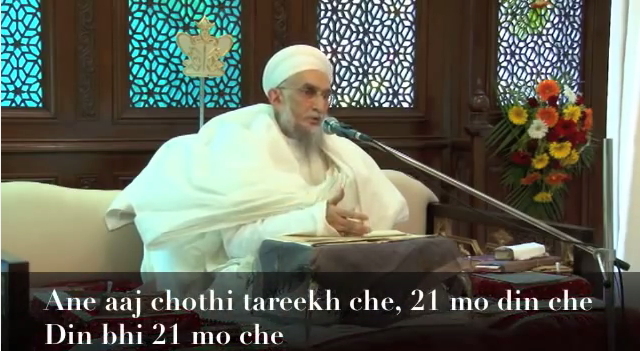
Husain Qutbuddin very dramatically poses the question: ‘how could anyone say that the Ahle Bait must have felt that they were neecha, lowly and contemptible?’ He considers anyone expressing the same to have insulted the memory of Ahle Bait and tarnished their lofty standing.
If he is true, then Dawat texts demonstrate that Ahle Bait SA themselves, in their own words, have tarnished their own standing, and Hudaat Kiraam SA have continued this discourse throughout history. This of course would never be possible and this post will provide evidence why Husain Qutbuddin’s claim is incorrect.
Passages composed in the remembrance and zikr of Imam Husain RA taken from Syedna al-Mu’ayyad al-Shirazi’s RA majaalis mu’ayyadiyyah are an integral element of the Asharah Mubarakah majaalis. Syedna Mohammed Burhanuddin RA regularly recited them in his wa’z and the imagery provided and depictions portrayed have formed the basis of centuries of gham and zikr done by the Doat Mutlaqeen RA. In one such bayaan, Syedna al-Mu’ayyad RA describes the condition of the daughters of Moulatona Fatema SA in Karbala:
If only Fatema would look at the Fatemiyaat (the daughters of Fatema)! For they are surrounded by enemies. Among them, one shouts in grief, O brother! One exclaims, O father! One yells, O grandfather! One cries, O Sorrow! Their garbs are torn! They are anguished by the loss of their beloveds! Their hair has been unfurled; they’ve been forced to abandon the privacy of their quarters.
Syedna Mu’ayyad RA has great stature among the luminaries of Fatimi literature. The use of ‘ya layta’, ‘if only’ here is exceptional. Of course Moulatona Fatema SA is looking at her daughters, but Syedna Mu’ayyad’s RA use of this literary device indicates the emotion that overcomes a Mumin in the zikr of Imam Husain SA and when narrating the tragedy of Karbala. This description of Moulatona Fatema’s SA daughters has been eternalized in Mumineen’s memory, further intensified by the use of these terms and this imagery in Syedna Taher Saifuddin’s RA marthiyah mubarakah, ‘Ya Syed al-Shohoda’ii’. He describes their persecution and the way they are made to walk with the following phrase, ‘yosaqna sawq al-imaai’: ‘made to walk in the manner of slave-girls’.
When Rasulullah SA passed away, Moulatona Fatema SA was mistreated, her hurmat disregarded like that of her daughters’ in Karbala. She was tormented and persecuted to the extent that after dushmano had forcefully taken Amirul Mumineen SA away to coerce his allegiance, she came to the qabr mubarak of Rasulullah SA and, as narrated by Syedna Mohammed Burhanuddin RA himself, said the following with tears flowing from her eyes:

O father! O, my estrangement and loneliness after you! O, my loss; O, my zillat (lowliness and contemptibleness); O, the defilement of my sanctity!
Syedna Burhanuddin’s RA words are similar to an Arabic version in Agharr al-Majaalis: the compilation of bayaans prepared by Syedna Taher Saifuddin RA for wa´z during Asharah Mubarakah. Moulatona Fatema SA attributes to her own self the word zillat, meaning lowliness or baseness. She states that after the loss of Rasulullah SA and the subsequent persecution at the hands of dushmano, she has been dishonoured and humiliated. If Fatema felt this way, would not Fatemiyaat, her daughters who were treated like slaves in Karbala, their veils snatched, their heads uncovered, their men slain, feel similar? Would not her children, upon whom water that was permitted to all people and animals was forbidden, feel the way she did after the zulm carried out upon her and her family?
The Arabic word zillat comes from zalla, to become base or low, i.e. to become neecha
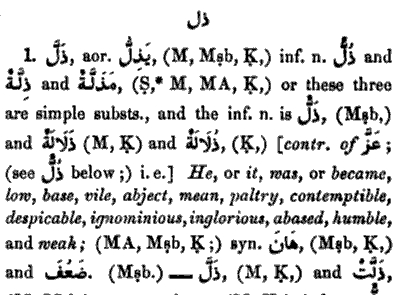
Moulatona Fatema SA described the intensity of her lowliness with the Arabic figure of speech ‘ya’ used for exclamatory intention. She would only say what she felt. If she felt this way, and moreover declared she felt this way, why should her children, facing similar or greater persecution, not feel the same? How can anyone be criticised for attributing a sentiment experienced by Fatema when persecuted, to her daughters and granddaughters who Syedna Mu’ayyad RA has referred to as Fatemiyaat? The parallels between Moulatona Fatema SA and the Ahle Bait SA are clear and the words of Moulatona Fatema SA, Syedna Mu’ayyad RA and Syedna Mohammed Burhanuddin RA illustrate this.
Examples from Fatemi literature further clarify the attribution of zillat to Haqq na sahebo. Syedi Abdeali Mohyiddin QR is renowned for his zikr of Imam Husain SA. In one marthiyah, he states:
O the lowliness of his (Husain Imam’s SA) children, those among them whom have been made prisoners are led by Husain’s son, Ali, the imprisoned.
In another, he articulates:
[The tragedy of Ahle Bait] has set ablaze the innards of taqwaa and has debased its people. This tragedy has disgraced the Quran itself.]
Elsewhere in his poetry he describes the tragedy of Karbala as having disfigured the nose of Islam. The nose is considered an embodiment of respect and honour; references to the nose being disfigured in Arabic literature mean that one’s honour has been taken away from them. These examples clearly illustrate the manner by which Hudaat Kiraam RA have described the zillat, disgrace and baseness attributed to the Ahle Bait SA with respect to the great tragedy and museebat of Karbala. According to Husain Qutbuddin, such statements are sacrilegious, so why have they been made?
Husain Qutbuddin goes on and on about nehj, or tradition. He very pompously claims to know exactly what Syedna Burhanuddin has and has not done. In fact, he insinuates he knows what all the Doat have done, yet he could not see the undeniable interconnection and association between Syedna Mufaddal Saifuddin’s TUS bayaan mubarak and the kalemaat nooraniyah of none other than Moulatona Fatemah SA and the other Hudaat Kiram SA mentioned above, including Syedna Mohammed Burhanuddin RA.
In their desperation to level accusations of inappropriateness against the haqq na saheb, HQ and Khuzaima have now proceeded to make a mockery of a fundamental element of the Dawoodi Bohra faith: the zikr and remembrance of Imam Husain SA. Their abandonment of the haqq na saheb has resulted in their inability to recognize haqq itself. To speak of elements of Husain Imam’s SA gham in this manner: with scorn, scoff and sarcasm, is the gravest of sins. He says the Ahle Bait SA cannot be referred to or described as they were, but this description is common all throughout the history of our community, beginning with Moulatona Fatema SA herself. By abandoning Syedna Burhanuddin RA and disregarding his words, Allah Ta´ala has taken from them the greatest blessing of all: the understanding and awran of the zikr and matam of Imam Husain SA.
Introduction
Syedna Mohammed Burhanuddin RA, our beloved departed father, appointed his son Syedna Mufaddal Saifuddin TUS as his mansoos and our Moula after him; he did this in writing, before numerous witnesses on multiple occasions and in front of thousands of his children Mumineen. Those that deny this, deny Syedna Burhanuddin and defile his memory. That those who follow other than Syedna Mufaddal Saifuddin TUS no longer talk about ‘khaangi nass’ and in their hours of YouTube bayaan fail to respond to a simple question regarding the translation of an Arabic sentence, is evidence that they too know the truth: that Syedna Mufaddal Saifuddin TUS is the 53rd Dai and the mansoos of Syedna Burhanuddin RA.
They no longer wish to speak about nass because they cannot respond. The Q&A series on the FatemiDawat.com site attempt to address the arguments raised on this blog, but the arguments put forth here in the initial posts regarding the very foundation of their claim remain unanswered and disregarded altogether. Why?
Now, in order to further distance their audience from the truth and the matters of nass which they obviously have no answers to, they’ve added yet another smokescreen: one of lies, fabrication, mockery of Dawat and ridicule for the Dai and his ‘amal mubarak. Husain Qutbuddin’s latest Q&A videos, unsurprisingly, yet again highlight his ignorance of not only Dawat texts, but Syedna Taher Saifuddin RA and Syedna Burhanuddin’s RA ‘amal and nehj.
In the first waaz during Ashara 1431 H, Syedna Mohammed Burhanuddin RA stated that in following in the footsteps of his esteemed father, “Mamlook e Ale Mohammed has composed this marthiyah (Fulkul Husain), [which I presented] in the khidmat of Imam Hussain during the historic trip to Karbala (1430 H)”.
The following year, during 1432 H Ashara Mubaraka, he referred to the marthiyah he had composed and stated that “….in perpetuating this unbroken line of bukaa’, Mamlook-e-Aale Mohammed did araz in this marthiyah that…..”
The zikr of Imam Hussain AS and especially this marthiyah shareefah, encapsulates the one of the greatest legacies of Syedna Mohammed Burhanuddin RA – his deep-rooted love for Imam Hussain AS and the nurturing of that love in the hearts of Mumineen.
Khuzaima’s Complete Disregard for this Marthiyah
Yet, this marthiyah, which represents what Syedna Mohammed Burhanuddin stood for and all that Imam Hussain meant to him, has been disregarded and dismissed by Khuzaima and his followers.
Not once, in a single bayaan or waaz, not even during the Asharas he conducted after 1430 H did he recite a single verse from this marthiyah – not one. In fact, he and his sons stopped Mumineen from reciting it. If they wanted nothing to do with it, then at least they could have let those who loved their Moula recite Moula’s marthiyah. But they did not.
Past and Present
Khuzaima clings on to the past, not realising that the past only holds meaning when it is understood through the present. He will recite (just as he has done in his most recent video) Ya Syeda al- Shohadaa’, but never Fulkul Hussain. He recites the marthiyah of his father but never the one of Burhanuddin Moula, who called him ‘Al-Walad al-Ahabb’ (most beloved son) three times. Is this how he shows his reverence to his spiritual father?
Due Reverence
Syedna Mohammed Burhanuddin’s every action, gesture and sentence was revered by every mumin. Khuzaima enjoys drawing parallels between himself and the great Mazoon, Syedi Abdulqadir Hakimuddin QR. However, does he know what Syedi Hakimuddin would do when receiving any correspondence from the Dai of his time? He would be waiting in earnest, anticipating the arrival of a letter or mithaal. When the letter would arrive, he would stand up in reverence, would kiss the seal of the Dai and lay the handwritten words of the Dai upon his forehead. Did he not take heed from the seerat of the eminent mazoons of the past? Taher Qutbuddin reminds us that Khuzaima would do sajda when Syedna Burhanuddin’s RA mithaal would reach him. Why is he respecting Maula’s mithaal mubarak but disrespecting his marthiyah mubarakah?
It seems unfathomable why Khuzaima adamantly refuses to recite this marthiyah. Why is it so difficult for him?
· Is it because he thinks it is below his stature to recite the marthiyah of the 52nd Dai Mutlaq?
That would mean he sees himself above and beyond the position of Dai Mutlaq.
· Is it because he believes that the marthiyah is a misrepresentation of Imam Hussain, the events of Karbala and the meaning of bukaa’ and matam?
· Is he saying that he knows better how to do the zikr of Imam Hussain AS, that somehow he is better versed and better equipped for the rithaa’ of Imam Hussain?
If so, then it is a direct assault on the lofty and exalted status of Syedna Mohammed Burhanuddin RA. He thinks himself superior to the Dai of his time. He is denying that the Dai is the recipient of the faiz of Panjatan, Aimmat and Duat and says and does things which have no basis in fact.
It is worth keeping in mind that Syedna Mohammed Burhanuddin RA composed this marthiyah two years before his stroke, which Khuzaima claims incapacitated Moula. The reality is that even if Moula did not have a stroke and he conferred nass in such a state, it would have made no difference to Khuzaima. He would have still come up with baseless claims that he was mansoos. His rejection of this marthiyah is evidence enough that he rejected everything that Moula said and did.
In the end one can only conclude that given all the facts, Khuzaima’s omission of this marthiyah from all his discourses and gatherings since 1430 H, is further evidence of his deep contempt for Syedna Mohammed Burhanuddin. Ultimately in doing so, he has denied that Syedna Mohammed Burhanuddin was the rightful recipient of the nass of Duat Mutlaqeen.
‘Fulkul Hussain’ Personified
For forty days after Syedna Burhanuddin’s RA passing, this marthiyah mubarakah was recited in Syedna Mufaddal Saifuddin’s TUS presence: at the side of Maula’s qabr mubarak, in sadaqallah and then during the majlis. Every single day. He knows that the single greatest eulogy to his father is the recitation of this marthiyah. It is proof of his deep-seated reverence, unflinching loyalty and uncompromising love for Syedna Mohammed Burhanuddin – something only a mansoos can have.
INTRODUCTION
The Khawarij were a group of people who ‘abandoned’ Amirul Mumineen SA after the battle of Siffeen and claimed that he erred in permitting men to give judgement in religious affairs. They took up the call of ‘la hukm illa li Allah ’ based off of an ayat mubarakah meaning: there is no judgement for anyone save Allah. Amirul Mumineen SA described this phrase as ‘a statement of haqq (truth) through which baatil (falsehood) is sought’.
KQ and his kins’ repeated statements pertaining to the position of Mazoon are in a similar vein. They wish to describe the lofty maqaam and position of the Mazoon in order to perpetrate the greatest falsehood and baatil: that Mr Khuzaima Qutbuddin is the 53rd Dai. The following posts and reasons will illustrate the manner in which KQ and his kids have exploited Dawat texts and references to the Mazoon, both historically and theologically, to their own ends. As ever, they will highlight how the FatemiDawat site and the latest Q&A YouTube videos of HQ disregard key information from Dawat texts preying on people’s ignorance. Even in their press conference held a couple days ago, five minutes would not go by but they would throw references to the Mazoon’s lofty position in the face of unsuspecting and uninitiated members of the press. Even non-Bohras are victim of KQ’s constant badgering.
I wish to make it clear to Mumineen that my intention is to no way lessen the importance of the position of the Mazoon. In fact, by explaining through the use of historical examples and some references to Dawat texts, I wish to separate Khuzaima and his unruly character from the position of Mazoon in the community’s collective memory so that this position can be perceived in the great maqaam that it is, untarnished by KQ’s lies and treachery.
Post 1 – Every Mazoon is not a Dai
Post 2 – Mazoon in Ehd al-Awliyaa’
Post 4 – Syedi Najam Khan, Falibility & The Concept of Mutlaq
Post 5 – Exemplary Service by Mawaazeen Kiraam AQ
Post 6 – Africa: What Really Happened in 1409H
When Syedna Mohammed Burhanuddin announced his judgement, he sealed the fate of those who had an issue with it. On the website they clearly state:
Qutbuddin Mola accepted Burhanuddin Mola’s decision to close the matter, and has NEVER spoken of it until today, when he has to do so in order to defend Burhanuddin Mola’s Dawat. Despite the evidence he had been presented with, Qutbuddin Mola even went to the Heptullah’s home for ziyafat in Nairobi after the ‘faislo’ was given in Burhanpur—this is sure proof of Qutbuddin Mola’s deep ikhlaas.
The words ‘until today’ are a lie. Many people will testify as to how Khuzaima repeatedly referred to the Africa incident. Khuzaima has been harbouring a deep resentment of Syedna Mohammed Burhanuddin’s judgement of 1409H for the past 26 years and has taken every opportunity to express that while he festered in this shadows. It has been eating away at him for decades and this bitterness has spilled over in his claim to the seat of Dawat. As the statements of the website show and in the use of quotations for the word ‘faislo’ which Moula himself used, he has made it amply clear that he has never accepted Moula’s fasal.
A loyal and faithful Mazoon would never have a difference of opinion with the Dai, but he clearly did. He says ‘Shehzada Mufaddal Saifuddin….with no other evidence’ accepted Sh Hussain’s version of events. As clarified above, it was Syedna Mohammed Burhanuddin who passed judgement. What they are really saying is that Syedna Mohammed Burhanuddin:
· Was misinformed as to the correct version of events
· Failed to give due consideration to both sides
· Was gullible and impressionable and therefore biased to one side
· Accepted the testimony of a ‘false witness’
· Was too hasty in passing judgement
· Was flawed in his decision making
Thereby:
· Claiming to be more astute and knowledgeable than Haq na Saheb
· Claiming to be persecuted by the Dai Mutlaq
· Disrespecting and disregarding his supreme authority as designated to him by Imam ul Zaman
· Questioning his ability to discern between a reliable witness and a ‘false’ one
· Questioning his ability to effectively adjudicate over all matters of Dawat
· Questioning his capacity to reason and rationalise
· Questioning his infallibility (Ismat)
· Confronting him irrespective of his final decision
· Ultimately disputing Syedna Mohammed Burhanuddin as Dai Mutlaq
The ‘Ibn ul Khuwaisara’ of Our Age
History is replete with instances of those who have questioned the judgement of Haq na Saheb. Khuzaima is one in a string of many. Ibn ul Khuwaisara was one such individual. As Rasulullah SA oversaw the distribution of the battle-loot, he defiantly approached Rasulullah SA and said “You have not done justice”. Rasulullah SA responded in kind and said “If I am not just, then who is?!”
How are Khuzaima’s reservations and objection to Moula’s judgement different from that of Ibn ul Khuwaisara? Did not Moula explicitly state that he had unequivocally passed judgement and if anyone opposed it, it was tantamount to questioning his own authority?
‘False Witness’
Khuzaima claims that a ‘false witness’ was presented to Moula and accordingly Moula passed judgement. As has been the case, he capitalises on the ignorance of those who are not fluent in Arabic and manipulates the meaning of a hadeeth to suit his needs. He says:
Regarding giving false witness, Rasulullah SA has said: If you obtain from me a wrong judgment/faisla in your favor by giving false witness, then know that I am giving you a seat in hellfire (Bayaan from the Rasail Ikhwan us Safa of Imam Ahmad al-Mastoor).
This is a gross mistranslation of the hadeeth. The hadeeth is as follows:
مَنْ كَذَبَ عَلَيَّ مُتَعَمِّداً فَلْيَتَبَوَّأْ مَقْعَدَهُ مِنَ النَّارِ
The correct translation reads as:
“The individual who misattributes [something] to me, then tell him to take his seat in [hell] fire”
There is absolutely no mention of a ‘false witness’ anywhere in the hadeeth.
What Khuzaima is actually doing is implying that all those who testified to Syedna Mohammed Burhanuddin RA were false witnesses whose testimonies were either incorrect or unverified. Furthermore, he implies that
· only Khuzaima’s testimony and account of what happened should have been heard by Syedna Mohammed Burhanuddin and
· Secondly his version should take precedence and should have outweighed all other accounts.
Questioning the Authority of not just the Dai
Khuzaima also refers to the example of the man who was falsely accused of stealing. Rasulullah ordered the severing of his hands at which point it was revealed by divine intervention to Rasulullah that the man was innocent and through a miracle, Rasulullah rejoined his hands.
Khuzaima has failed to understand the subtext of this case. Instead, he is implying that Rasulullah was prone to errors in judgement. This is a gross and unacceptable understanding of Rasulullah’s exalted position. There is ‘hikmat’ in his every action and decision, just as is the case with every Imam and his Dai.
This can be illustrated by a case recorded by Syedna al-Qadi al-Noman in his Majalis Musa’eraat (a documented record of all his observations of three Imams during sessions and excursions with them). Imam Qaim was presented with a case of an accused individual who was falsely testified against. Consequently Imam ordered the execution. Imam Mansoor (his mansoos) knew that the individual was innocent but was not able to stop the execution in time. He informed Imam Qaim accordingly and Imam Qaim instructed Imam Mansur to convey to the witness that he had, on good authority, proof that he had falsely testified. The witness, instead of admitting that he was wrong, sent a message to Imam Qaim, saying that “the person who informed you that I was wrong, should cease to remain a trusted source”. Imam Qaim was furious at this response and said his second response was even more unforgiveable than the first. As:
· Firstly, the individual in question made a false statement.
· Secondly, when he was notified by no other than Imam Qaim that the facts proved he gave a false testimony, he rejected the idea.
· Thirdly, he went as far as to suggest that the informant of Imam Qaim (in this case, his mansoos Imam Mansur) should not remain a trusted source and instead his account be considered accurate.
· Finally, he questioned the authority of the Imam as one who received the Ilhaam of Allah.
Syedna al Qadi al Noman clarifies further that the reason for the execution of the accused was not that a false testimony was made. In fact, there was another reason (which Imam Qaim was privy to) which justified his execution.
Khuzaima’s actions bear a strong resemblance to this case. He has rejected the testimony of those who were trusted witnesses as recognised by Syedna Mohammed Burhanuddin. He has gone further and implied Moula was falsely led to pass a faulty judgement.
Let us suppose for arguments sake, that someone did present a false testimony to Moula, does it not behove Khuzaima to understand that Imam ul Zaman would have done Ilhaam accordingly and let Moula know? In the case (which Khuzaima refers to) of the one whose hands were severed on order of Rasulullah, it was because of the Faiz of Allah and the assistance of his angels, that Rasulullah came to know of the accused individual’s innocence. Imam ul Zaman would have immediately let Moula know of the truth of the events.
Khuzaima is still convinced till this very day, that Moula was wrong in accepting the testimony of trusted witnesses. In fact, it is this very conviction that testifies to Khuzaima’s resentment, disrespect and outright rejection of Syedna Mohammed Burhanuddin’s status as Dai Mutlaq.
The events of Africa in 1409H are true. Syedna Mohammed Burhanuddin’s judgement, decision and unequivocal bayaan are proof enough.
No matter how hard he strives to blanket the truth, light will always shine through the darkness.
It is as plain as day as to what Syedna Mohammed BurhanuddinRA said and clear that the events of Africa did actually happen. He said, (exact words)
“ek waqt Bhai Qutbuddin ney bhi em
(1)khayal thai gayu, aney em
(2) yaqeen thai gayoo, aney
(3)zehn ma lai leedu key aa saazish….”
A number of salient points are evident. In whatever transpired in Africa, Khuzaima was misled. He was gullible and impressionable in being led astray by those who were less than trustworthy. In fact these people were referred to as ‘munafeqeen’ by Syedna Mohammed BurhanuddinRA. He lacked good judgement and believed – with wholehearted conviction (yaqeen) – that those who were innocent and wrongly accused were guilty. He lacked the ability to discern between right and wrong, and instead gave into his own emotions.
Would a Mazoon of the stature and character claimed by the website, have allowed himself to be duped and hoaxed into believing munafeqeen? Would a Mazoon even correspond and communicate and listen to a munafiq? Where are there signs of the attributed ‘wisdom, siyasat, vision, fairness, integrity and balance’ in this bayaan? The words of Syedna Mohammed BurhanuddinRA also beget the question:
How many other instances have there been where Khuzaima has given into temptation, lacked clarity of judgement, been convinced of his own assumptions and communicated with munafeqeen and consequently been mislead?
The website has furiously spun a tale of solemn virtue for a man whose word was not accepted by Dai al-Zaman. Not only did Syedna Mohammed BurhanuddinRA not accept his version of events, but actually accepted the word of a humble and loyal Mumin. He says,
“I believed Husain bhai and I unequivocally declared that he and his entire family are innocent of these accusations. I accepted his ziyafat, honoured him with a shawl and prayed for his wellbeing. After having done all this and after all that has transpired till now, if someone is still in doubt as to whether Husain bhai may have lied to me and was subsequently pardoned [even though he lied], then it is tantamount to having doubt in my judgement and the appropriateness of my actions. This stands true regardless of the rank and station of the person harbouring that doubt.”
There are innumerable accounts of Khuzaima’s shortcomings, mistakes, instances of disrespect for the Dai and moments of questioning his authority. However, rather than list these – which again the Khuzaima camp will dismiss as fabrications – I have merely highlighted what is crystal clear in the bayaan mubarak of Syedna Mohammed BurhanuddinRA. If they wish to refute the above, then doing so is the refutation of the words of Haqq na Saheb, and they are contesting the very institution of Wali ullah. Let them do so at their own peril.
Their website states:
What happened in Africa in 1409H [1988]? Why did Syedna Burhanuddin RA say in wa’az that Husain Heptullah was not the one who had attempted Qutbuddin Mola’s deportation from Kenya?
In 1409H, Syedna Burhanuddin sent Qutbuddin Mola for Ashara mubaraka waaz to Mombasa. During his stay in Kenya, someone filed a complaint with the Kenya government requesting that Qutbuddin Mola be deported. Kenya government officials sent an official letter to Qutbuddin Mola naming Husain and Saifuddin Heptullah as the people who had filed the complaint against him. In Nairobi, Qutbuddin Mola met with President Moi of Kenya, who also personally named to him the Heptullah brothers as the complaint-filers. Qutbuddin Mola, knowing the Heptullahs’ position in the Dawat administration in Africa, chose NOT to name them in public. But Husain Heptullah went to Burhanuddin Mola in Burhanpur (where the eminent Mazoon Syedi Abdulqadir Hakimuddin is buried) and swore that he and his brother were innocent – before anyone had accused them of anything. Shehzada Mufaddal bhaisaheb immediately accepted their oath—with no other evidence, and without listening to Qutbuddin Mola’s side of the story—with the ‘logic’ that if they had been lying while swearing on Hakimuddin Mola’s qabar “they would have been struck down by lightning.”
Burhanuddin Mola later said to Qutbuddin Mola regarding this attempted deportation, that “such a thing could have only been done by Dawat na dushman”—Burhanuddin Mola thus affirmed that whoever did make the deportation attempt was Dawat no dushman.
Burhanuddin Mola did faislo on that basis, and said he was closing the matter. Qutbuddin Mola accepted Burhanuddin Mola’s decision to close the matter, and has NEVER spoken of it until today, when he has to do so in order to defend Burhanuddin Mola’s Dawat. Despite the evidence he had been presented with, Qutbuddin Mola even went to the Heptullah’s home for ziyafat in Nairobi after the ‘faislo’ was given in Burhanpur—this is sure proof of Qutbuddin Mola’s deep ikhlaas.
Even though he had been the victim in the affair, Qutbuddin Mola was made out by the shehzadas to be the perpetrator. Their best defense was an offense.
Regarding giving false witness, Rasulullah SA has said: If you obtain from me a wrong judgment/faisla in your favor by giving false witness, then know that I am giving you a seat in hellfire (Bayaan from the Rasail Ikhwan us Safa of Imam Ahmad al-Mastoor).
In another example, some people falsely accused a man of stealing, and Rasulullah SA ordered ehna haath kaapwanu, and the punishment was carried out. The accused began to pray salawaat on Rasulullah SA. Jibraeel came to Rasulullah SA and said to him, this man is innocent. Rasulullah called him back and shifa boli, doa kidhi, and mojiza si joined his hands again.
The Africa episode sits as a deep thorn in Khuzaima and his family. It is so deeply imbedded that despite their desperate efforts to erase it from the minds of Mumineen, they have only succeeded in rooting it further.
The following is the accurate account of what transpired, based on the testimonies of those who were present in Africa at the time, Shehzadas, Qasreali Sahebo, khidmatguzars and most significantly, it is based on the unambiguous bayaan mubarak of Syedna Mohammed Burhanuddin RA.
The tale of Africa actually begins in 1407H when Khuzaima visited Kenya. When he visited Nairobi, a submission was made by the Amil and Jamaat that there were approximately sixty munafeqeen who now wished to re-enter into misaaq. Those who are familiar with the history of Africa will note that the 1970s and early 1980s saw a period of cleansing for the community, which lead to a clear division between those who believed and those who didn’t. Khuzaima intended to take their misaq. However, Sh Hussain bhai Hebatullah raised the point that the correct procedure – as outlined in the instructions received from Vazarat – for re-accepting such individuals into Dawat, required that these names be submitted to Huzurala RA first and only once they had been approved, could their misaq be taken. Khuzaima interpreted this as an assault on his authority and tore up the list of names.
Consequently the Amil (Dawood bs) and Sh Hussain bhai accompanied Khuzaima in the car. Sh Hussain bhai attempted to clarify his reasons for objecting of the misaq. As the conversation continued, Khuzaima – as witnessed by two witnesses who are still alive today – proceeded to compare and contrast the policies of Syedna Taher Saifuddin and Syedna Mohammed Burhanuddin. Both the witnesses who participated in this conversation, outline what he said.
He explicitly mentioned that Syedna Taher Saifuddin was far more lenient and tolerant of the dissidents in Dawat, whereas Syedna Mohammed Burhanuddin was intolerant and hardlined in the way he handled munafeqeen. He went on to cite examples such as the case of the ‘Naa’ib’ in Yemen, the ‘Manaahis’ in Jamea, the dissidents in Udaipur and the case of ‘Ghorawala’ in Colombo. In all instances, he claimed that when Syedna Taher Saifuddin had let them be, why did Syedna Mohammed Burhanuddin expose them and excommunicate them? He then said that Burhanuddin Moula was by nature, unkind and drove people away, rather than bringing them closer. The conversation lasted for over an hour and the witnesses recall being in utter shock at what was being revealed.
In that same year, Moula conducted the shaadi of his youngest son, Shahzada Ammar Bhaisaheb in Surat. Khuzaima was not very keen to go but Sh Hussain bhai was. Despite resistance from Khuzaima to leave Nairobi for Surat, Sh Hussain bhai managed to leave for Surat. It was there that he met with Shahzada Yusuf bhaisaheb Najmuddin and divulged the points of the conversation. He redirected him to Syedna Mufaddal Saifuddin who reported the case to Syedna Mohammed Burhanuddin. As per the Ilhaam of Imam ul Zaman, Moula decided to not reveal anything.
During this time, Khuzaima had assumed that Sh Hussain bhai had become an ally and had been enticed into his circle. However, as two years passed with no forthcoming communication from Sh Hussain bhai, Khuzaima realised that he had erred in divulging his true guise. As a result, he began a personal vendetta against Sh Hussain bhai.
Khuzaima did lead Ashara in Mombasa in 1409H. As he travelled around East Africa, his entourage which consisted of his family and diwaans, sort to idealise him as the 53rd Dai. Both Sh Mohammed Yamani and Sh Shabbir Yamani who were in his service at the time, attest to this fact. Obviously, this was met with disdain by mumineen mukhleseen but they refrained from openly confronting him.
During this time, a forged document was prepared which carried the Kenyan government’s letterhead which alleged that Sh Hussain Hebatullah was responsible for filing a deportation request for Khuzaima. It was evidently a forged document as all the past correspondence between official authorities and Sh Hussain bhai, addressed him as “HA Hebatullah” whereas this document referred to him as “Sh Hussain Hebatullah”.
There have been a number of suspicions as to who was responsible for this forgery. However, Khuzaima himself has remained the prime suspect as he had motive to frame and defame Sh Hussain bhai.
The website claims that during this time Khuzaima met with the then president of Kenya, President Moi at an official function, and the president personally informed him that Sh Hussain bhai was responsible for filing the deportation request. A senior Kenyan judge who was present at the event, testified that all that Khuzaima got from the president was a muted wave from afar. There was no meeting or conversation that took place in which the president could have said anything to Khuzaima.
A number of things happened, but I just want to focus on the salient events in this narrative. Eventually this matter was presented to Syedna Mohammed Burhanuddin. Sh Hussain bhai travelled to Burhanpur where Moula was at the time and through the intercession of Busaheba, he and his brother were granted an audience with Moula. Sh Hussain bhai pleaded his innocence and humbly stated that he had absolutely no part to play in trying to deport Khuzaima. In fact, in 1409H it was Sh Hussain bhai who had sought to prevent the deportation of Khuzaima from Africa.
The website claims that Sh Hussain went to Burhanpur ‘before anyone had accused them of anything’. This is simply not true. Sh Hussain bhai was ostracised, marginalised and practically excommunicated by Khuzaima. Khuzaima called an audience at Sh Fidaali Hebatullah’s house and announced that “I sit here on the same chair that my father sat in and excommunicated munafaqeen. Today I am excommunicating these people” – and he indicated to Sh Hussain bhai and those with them. Sh Hussain bhai was compelled by the circumstances which Khuzaima had brought about to go to Moula. As Moula said in his 1409H bayaan: “[Sh Hussain] Maara nazdeek shikayat keedi, Haqiqat bayaan keedu, mei shakwa nahi sunu to pachi kon sunse?!”
Moula listened to him for 45 minutes, and through the Ilhaam of Imam ul Zaman, he declared that Sh Hussain bhai was innocent. The website claims that ‘Shehzada Mufaddal bs’ declared him innocent; this is a blatant disregard of Moula’s bayaan. The 52nd Dai Mutlaq, equipped with the powers given to him by Imam ul Zaman, proclaimed Sh Hussain bhai was innocent and exonerated him from any involvement in the matter; no one else.
Moula had then travelled to London where Khuzaima had brought this forged document to present. However Syedna Mohammed Burhanuddin had made it very clear to him that he had already done ‘fasal’ and he would not entertain any further presentations. Khuzaima was infuriated that Moula had dismissed him and as witnesses to this confrontation relate, Khuzaima said that “even if Sh Hussain were to hold the cloth of Baitullah and swear that he had no part to play in this, I will not believe him.” In saying this, Khuzaima essentially does not believe the Dai’s word and does not accept his verdict.
After all that transpired, Moula left for Nairobi and on the Urus of Syedi Abdulqadir Hakimuddin made it very clear in his bayaan mubarak what had transpired, what Khuzaima thought and did and what Moula’s decision, as Dai Mutlaq, was. This bayaan mubarak was relayed to mumineen worldwide several days after Syedna Mohammed Burhanuddin’s wafaat. A translation of the aforementioned bayaan can be referred to at the end of this post.
Transalation of Syedna Mohammed Burhanuddin’s bayaan mubarak on Urus of Syedi Abdulqadir Hakimuddin QA in Nairobi in 1409H:
“Jealousy destroys a person, eating him up inside. It is especially abhorrent that a Mumin would be jealous of another brother Mumin. Eventually jealousy will lead to enmity and the jealous finally bear the brunt of their actions and realise that their jealousy harmed them most of all.
An example of this jealousy and enmity in practice was recently witnessed in Kenya. Enemies of Dawat in their jealousy and spite falsely slandered a devoted, honest and innocent Mumin bhai and his family. They falsely accused him in instigating the deportation of Khuzaima and have continuously vilified this Mumin bhai and have not only deeply hurt him but have hurt me in the process as well.
This was indeed a new ploy of Satan and his followers when they saw that all their previous attempts at corrupting Mumineen have failed. Nairobi has proved to be an exemplary jamaat in implementing my directives and fulfilling my wishes. Their adherence to the principles of Shariah, their unity and strength has led them to warrant emulation.
To corrupt Mumineen, to lead them away from the path of the Shariah, to hamper them in following my instructions, to question the validity of my Dawat and my actions, they created an atmosphere of doubt and intrigue so that even Bhai Qutbuddin succumbed to their manoeuvrings, and he believed wholeheartedly that a certain khidmat guzar from the aayaan al-jamaat was acting against him.
When Husain Bhai Hebatullah could no longer bear the weight of these false accusations and constant slander that accompanied them, he journeyed to my hadrat in Burhanpur, and swore before me upon everything sacred, upon the saahib of Burhanpur that he was innocent from any wrongdoing, innocent from any overt or covert attempt to bring about the deportation of Bhai Qutbuddin.
I believed Husain bhai and I unequivocally declared that he and his entire family are innocent of these accusations. I accepted his diyafat, honoured him with a shawl and prayed for his wellbeing.
After having done all this and after all that has transpired till now, if someone still doubts whether Husain bhai may have lied to me and was subsequently pardoned [even though he lied], then it is tantamount to having doubt in my accuracy and the appropriateness of my actions. This stands true regardless of the rank and station of the person harbouring doubt.
A false document was prepared which allegedly involved senior officers of Government.
Regarding aqeedah and the core tenets of our faith, another concurrent assault was launched in Nairobi, Mombasa and Malindi. Personal resolutions were signed which went against our beliefs, and against the nahj of Dawat. Some Mumineen fell prey to this ruse as well and subsequently had to renew their vows, their meethaq.
It should be remembered that hudood, dignitaries of Dawat receive their “faiz” through and only through the auspices of the Dai. He regulates this faiz and distributes it amongst them as he sees fit. In our mithaq we pledge our allegiance to our Dai and affirm that the maazoon and muksasir are below him in rank, submitting to his jurisdiction.
May our faith continuously strengthen by repeatedly voicing na’am, saying yes with conviction in the mithaq, and may the transgressions of those embodying the essence of repentance be forgiven.”
 53 Reasons NOT To Believe Khuzaima Qutbuddin